

Tax season exposes every weak point in a firm's workflow. Staff chase missing PDFs, reviewers compare source documents to drafted returns line by line, and partners still worry that a simple transposition error or omitted form will slip through. Most firms don't need another generic automation pitch. They need tools that reduce review time, tighten control, and leave behind workpapers they can defend.
That urgency isn't hypothetical. The broader AI automation market reached $129.9 billion in 2025 and is projected to rise to $1,144.8 billion by 2033, while 78% of businesses now use AI in at least one function, according to Grand View Research's AI automation market report. But tax firms run into a different reality than general operations teams. A workflow that looks good in a sales demo can still break down when it has to ingest brokerage statements, validate tax data, route reviewer sign-offs, and preserve an audit trail.
That's why this list focuses on AI automation companies through a CPA lens. The question isn't which platform has the flashiest AI layer. The question is which one helps your firm ingest documents cleanly, flag real exceptions, document who approved what, and avoid creating a new compliance problem while trying to solve an efficiency problem.
Table of Contents
- 1. WP TieOut
- 2. UiPath
- 3. Automation Anywhere
- 4. Tungsten Automation formerly Kofax
- 5. Hyperscience
- 6. ABBYY Vantage
- 7. Workato
- 8. Zapier
- 9. ServiceNow Now Platform + Now Assist
- 10. Robocorp Sema4.ai RPA
- Top 10 AI Automation Companies: Feature Comparison
- From Evaluation to Implementation Your Next Steps
1. WP TieOut
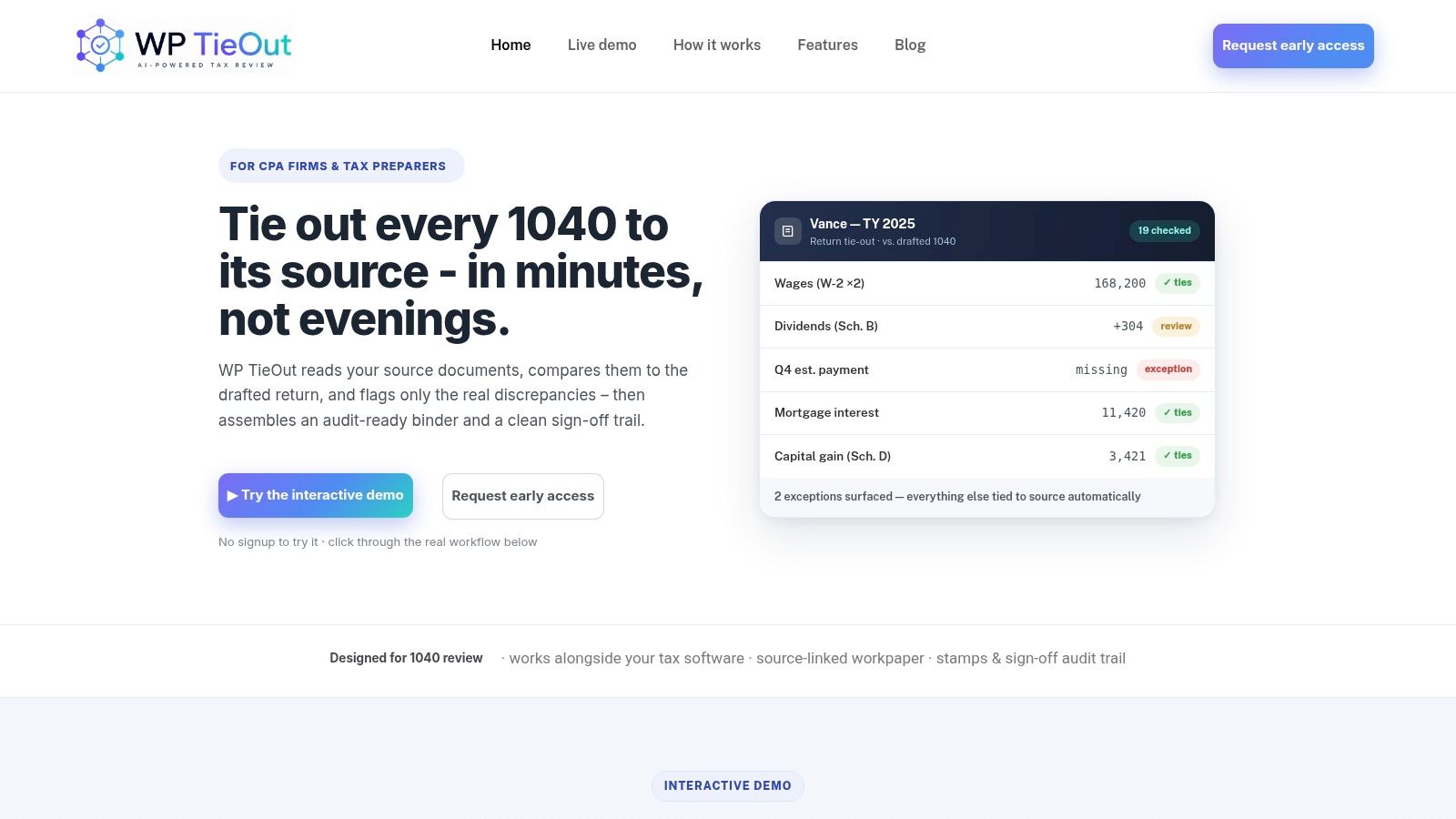
WP TieOut is the most tax-specific platform on this list. It isn't trying to be a universal RPA suite for every department in a large enterprise. It's built for CPA firms and preparers who need to reconcile drafted 1040 returns against source documents without burning reviewer time on obvious matches.
That matters because tax review isn't just document capture. It's validation, tie-out, exception handling, and sign-off discipline. WP TieOut ingests W-2s, 1099s, brokerage statements, and similar tax documents, validates extracted data, and surfaces discrepancies for human review instead of forcing staff to recheck every line item manually.
Why it fits tax review work
The core advantage is review by exception. Clean items can be auto-accepted, while the reviewer focuses on mismatches that need judgment. In a tax practice, that's where AI automation companies usually fall short. They can extract data, but they don't always provide a workflow that aligns with preparer, reviewer, and partner responsibilities.
WP TieOut also produces a bookmarked PDF binder that preserves original pages, adds annotations and stamps, and records who reviewed what and when. For firms that care about internal QC and examination readiness, that output is more valuable than a generic automation success metric.
Practical rule: In tax, automation only pays off when it shortens review without weakening the file you have to defend later.
Another practical strength is workflow visibility. The work board shows live return status across open engagements, and firms can use a no-portal upload link for client intake. Locked multi-year archives and controlled access add a level of record discipline that many broad platforms leave to custom configuration.
Where it wins and where it doesn't
WP TieOut is strongest when your pain point is 1040 review, source reconciliation, and audit-ready documentation. It's also useful when you want a product your reviewers can evaluate quickly through the WP TieOut interactive demo and early-access program rather than a long platform rollout.
Its main limitation is scope. Pricing isn't published, broader availability still requires direct contact, and the focus today is individual return workflows. If your firm wants one platform to automate HR onboarding, accounts payable, tax intake, and audit support across multiple business units, this isn't that product.
Still, for firms comparing broad AI automation companies against purpose-built tax software, this is the clearest example of software designed around the actual review bottleneck instead of generic workflow theory.
2. UiPath

UiPath is what many firms picture when they think about enterprise automation. It combines RPA, orchestration, document understanding, testing, and process mining in one ecosystem. If your tax group sits inside a larger firm with centralized IT and governance requirements, UiPath can fit that environment better than a niche tax tool.
For CPA firms, the practical use case isn't "automate everything." It's automating the handoffs around tax work. That might include collecting files from shared inboxes, routing documents to the right work queue, pushing data between systems, or coordinating review tasks across teams.
Best use inside a tax firm
UiPath makes the most sense when the tax function depends on many systems and needs governance. Roles, permissions, orchestration, and cloud or on-prem deployment give larger firms real control. That's valuable if your compliance team wants standardized approvals and a central automation inventory.
The downside is that firms can overbuy. UiPath is powerful, but many tax teams don't need process mining, testing, and broad enterprise bot orchestration on day one. They need a narrower workflow fixed fast. If you start with the platform before defining the tax process, you'll spend time building around ambiguity.
Broad RPA helps after you know the workflow. It doesn't replace the work of defining the workflow.
If your firm is still deciding whether it needs a broad platform or purpose-built tax tooling, it's worth comparing enterprise automation with software built specifically for return review in this guide to AI tax software options for firms. That's usually where the build-versus-buy trade-off becomes clearer.
Use UiPath when your bottleneck spans multiple applications and internal controls matter as much as speed. Don't use it just because the platform can do more than your tax process requires.
Visit UiPath.
3. Automation Anywhere
Automation Anywhere is another major enterprise name among AI automation companies, with a cloud-first model that appeals to firms that don't want to manage much local infrastructure. Its platform combines attended and unattended automation with document AI capabilities such as IQ Bot.
That setup can work well for tax operations groups that need to automate intake and repetitive back-office movements at scale. If the firm already has SaaS-first preferences and wants a large partner ecosystem, Automation Anywhere is easy to shortlist.
Where it makes sense
The best fit is large-scale workflow automation, especially where the tax team needs support from an IT or automation center of excellence. Firms can use it to route incoming tax documents, trigger downstream tasks, and connect review steps to broader operational systems.
Its biggest trade-off is commercial complexity. Public pricing isn't consistent, and value often depends on how much of the platform you adopt. Smaller CPA firms can end up paying for enterprise capability they won't use, while still needing separate tax-specific review tools.
A more realistic approach is to reserve Automation Anywhere for cross-functional automation and use tax-native software for return review and sign-off. That's especially true if your team is trying to tighten controls around preparer and reviewer liability, similar to the concerns discussed in this overview of tax shield software and tax workflow protection.
- Good fit: Firms with centralized automation leadership and cloud-first standards.
- Less ideal: Small firms that mainly need tax document reconciliation and audit-ready workpapers.
- Watch closely: Contract structure, implementation ownership, and whether document AI is enough without tax-specific validation logic.
Visit Automation Anywhere.
4. Tungsten Automation formerly Kofax

Tungsten Automation, formerly Kofax, has long been strong in capture and document-heavy workflows. For tax and finance teams, that heritage matters. Many AI automation companies talk about documents as one feature among many. Tungsten built much of its reputation around getting documents into usable, governed workflows in the first place.
That makes it relevant for firms handling large volumes of scanned forms, mixed-format source files, and structured approval processes. In tax, poor intake creates review headaches later. A platform that treats document lineage seriously can reduce those downstream issues.
Document control first
Tungsten's appeal is less about flashy AI positioning and more about operational discipline. Capture, transformation, orchestration, analytics, and compliance-friendly handling are the reason firms still evaluate it. If your tax operations team receives messy source packages from many channels, that foundation helps.
Where firms get frustrated is modernization. Legacy Kofax estates can be complex, and licensing often depends on multiple modules. That means tax leaders should resist assuming the platform will be simple just because document capture is the main need.
If your intake process is weak, adding more AI usually gives you faster mistakes, not better workpapers.
I like Tungsten most for firms where document workflow reliability matters more than low-code experimentation. It's a steadier choice than some newer platforms, but not usually the easiest one for a tax department that wants a fast standalone pilot.
Visit Tungsten Automation.
5. Hyperscience
Hyperscience is strongest when the firm has a serious document volume problem. It focuses on intelligent document processing, decisioning, and broader orchestration rather than only OCR. For tax-adjacent operations such as notice handling, mailroom-style intake, and standardized document interpretation, that can be a meaningful distinction.
Its enterprise posture is clear. Hyperscience is built for regulated environments where document accuracy and downstream control matter. That's attractive for larger CPA firms, shared service environments, and public-sector style operations.
Strong for high-volume intake
Tax firms should look at Hyperscience when they need more than extraction. The platform's value is in turning documents into decisions and routing actions. If your team receives high volumes of forms and supporting documents that need classification, validation, and assignment before anyone touches the tax software, Hyperscience can sit effectively upstream.
The trade-off is implementation effort. This isn't usually a plug-and-play answer for a small firm with one review pain point. It tends to reward organizations that have integration resources and a defined intake architecture.
A practical way to think about it is this:
- Use Hyperscience when intake complexity is enterprise-grade and document operations are central.
- Skip it for now if your firm mainly needs to compare tax source documents to drafted returns.
- Expect work around integration, governance, and operational ownership.
For firms with enough volume to justify that investment, Hyperscience can reduce manual handling before review even begins.
Visit Hyperscience.
6. ABBYY Vantage
ABBYY Vantage is a mature option for document-centric automation. If your team has been around OCR tools for a while, ABBYY is probably already familiar. Vantage extends that legacy into a cloud-first IDP platform with prebuilt skills, APIs, and controls that regulated firms tend to care about.
For tax firms, ABBYY is often more useful in intake and classification than in final tax review. That's not a knock on the product. It's just the reality that extracting and classifying data is only part of a tax workflow.
A practical fit for document-heavy teams
The main strength here is maturity. ABBYY has long experience with OCR and document handling, and that usually shows up in the stability of its workflows. If your tax operation needs to process large batches of source material and feed downstream systems reliably, ABBYY can do that well.
The caution is around fit and licensing clarity. Subscription structures, page allowances, and skill packaging can become confusing if no one on the buyer side maps actual expected usage. In tax, buying page-based capacity without understanding seasonal peaks is a good way to make budgeting harder.
This is also where the broader market direction matters. The generative AI in automation market is projected to grow from USD 7.07 billion in 2023 to USD 124.22 billion by 2032, with a 37.50% CAGR, according to FNF Research's generative AI in automation market outlook. That growth doesn't mean every IDP workflow should be rebuilt around generative AI. In tax, controlled extraction and validation usually matter more than novelty.
ABBYY is a good operational product when you know exactly where it sits in the process. It becomes a poor investment when firms expect it to magically solve review logic that belongs elsewhere.
Visit ABBYY Vantage.
7. Workato

Workato isn't primarily an RPA tool. It's an integration-led automation platform. That difference matters for CPA firms because many tax bottlenecks aren't about bots clicking screens. They're about systems failing to exchange information cleanly.
If your firm needs to move data among CRM, document storage, practice management, e-signature, and tax workflow tools, Workato can be a better fit than a desktop-automation-first platform. It gives firms a way to orchestrate workflows across apps with governance and lifecycle controls.
Integration over bots
Workato works best when the process already has structured systems behind it. You can trigger workflows, pass data, manage exceptions, and build repeatable cross-app automations without forcing a bot to imitate human clicks. That's usually more durable over time.
For tax firms, I like Workato in scenarios such as:
- Client intake routing: Move submitted files and metadata into the right queues and systems.
- Status synchronization: Keep practice management and workflow tools aligned so staff aren't working from stale information.
- Approval orchestration: Trigger review or partner sign-off steps across connected applications.
Its weakness is cost discipline. Custom pricing can get premium quickly, and firms need to monitor task or recipe consumption. That's manageable in mature operations, but smaller firms often underestimate how much workflow growth increases platform reliance.
Workato is one of the more practical AI automation companies for firms that already know integrations are the problem. It is less compelling when a team mainly needs document tie-out inside tax review itself.
Visit Workato.
8. Zapier

Zapier is often dismissed by larger firms because it feels lightweight. That can be a mistake. For small and mid-sized CPA firms, Zapier is one of the fastest ways to eliminate annoying administrative steps without involving a major implementation team.
Its appeal is speed. Connect an intake form, cloud storage, email notification, and task system, and you can remove a lot of repetitive coordination work in a day. That's useful if the firm wants quick wins before investing in deeper automation.
Good for fast wins, not deep tax control
Zapier is good at stitching together apps. It is not where I'd place heavy reliance for audit-sensitive tax review logic. You can automate reminders, routing, uploads, and status notifications easily. But once a workflow demands detailed exception handling, strong review controls, or durable workpaper logic, Zapier starts to show its limits.
That doesn't mean it has no place. It means you should use it where simplicity is an advantage. Many firms can improve turnaround by automating the edges of the process and leaving the substantive tax validation to purpose-built software.
If you're comparing workflow layers around return prep and review, this analysis of tax return comparison software helps clarify where generic app automation stops being enough.
One more caution: AI adoption is broad, but execution still trips firms up. In 2024, 76% of business leaders reported significant difficulty with AI deployment, and 56% identified data quality as a critical barrier, according to Vention's AI adoption statistics roundup. Zapier can automate fast, but it won't clean up a bad process or poor source data for you.
Visit Zapier.
9. ServiceNow Now Platform + Now Assist

ServiceNow belongs on this list for one reason. Some larger firms already run critical workflows on it, and tax teams don't always get to choose a separate automation backbone. In those environments, using Now Platform and Now Assist can be more realistic than introducing another enterprise workflow layer.
For tax leaders, the value is governance, auditability, and embedded workflow control. If legal, HR, IT, and risk already live in ServiceNow, bringing tax requests or approvals into the same operating model can reduce friction.
Best for firms already in the ecosystem
ServiceNow is rarely the first tool I'd recommend for a standalone tax automation initiative. It's powerful, but it makes the most sense when the firm already has the platform, the admin talent, and the organizational commitment to use it well.
Its strengths are clear:
- Governance: Centralized controls, approvals, and auditability.
- Embedded AI: Now Assist brings generative AI features into existing workflows.
- Enterprise alignment: Tax can plug into the same system used by other controlled functions.
Its trade-off is complexity. Licensing can be hard to untangle, especially when AI features are bundled into renewals or module decisions. Smaller tax teams can lose momentum if they need a simple workflow solved but must wait for enterprise platform prioritization.
ServiceNow is best seen as an operating system for controlled enterprise processes. If that's your firm's environment, it can work well. If not, it's usually too much platform for the immediate tax problem.
Visit ServiceNow.
10. Robocorp Sema4.ai RPA

Robocorp, now under Sema4.ai branding for its RPA platform, is the most developer-friendly option on this list. It isn't trying to hide the fact that technical users will get the most from it. For tax operations teams with Python talent or an engineering-oriented automation lead, that's a real advantage.
A lot of legacy RPA products promise low-code simplicity, then still require substantial technical support once workflows become fragile. Robocorp takes a more direct path. It's code-native, cloud-controlled, and easier to pilot if your team is comfortable writing and maintaining automation.
For developer-led tax operations teams
This is a strong fit for firms that want flexibility without committing immediately to heavyweight enterprise contracts. Usage-based pricing and a free developer tier make experimentation less painful. That's useful when you're testing whether a task should be automated before you institutionalize it.
I would consider Robocorp for tasks such as portal retrieval, repetitive file movement, system bridging where APIs are weak, or internal utility workflows built by a tax technology team. I would not treat it as a substitute for a purpose-built tax review product.
Start manual, document the decision points, then automate. That's usually safer than trying to infer the process from broken habits.
That advice matters because many firms still reverse the order. One under-discussed issue in automation is the need to clarify the human judgment points before pushing for end-to-end automation. The LinkedIn piece on the manual-first approach to AI automation highlights that gap and argues that firms often automate before they understand their own process boundaries.
Visit Sema4.ai.
Top 10 AI Automation Companies: Feature Comparison
| Product | Core features | Quality & UX (★) | Value & Pricing (💰) | Target audience (👥) | Unique strengths (✨) |
|---|---|---|---|---|---|
| WP TieOut 🏆 | AI OCR + validation, review-by-exception, source‑linked bookmarked PDF binder | ★★★★★ | 💰 Early‑access, pricing on request | 👥 CPA firms, tax preparers, review managers | ✨ Tax‑specific tie‑out, audit‑ready sign‑off trail, built‑in roles |
| UiPath | RPA + document understanding, orchestration, governance | ★★★★ | 💰 Enterprise licensing (custom) | 👥 Large enterprises, regulated teams | ✨ Broad automation + strong governance |
| Automation Anywhere | Cloud RPA, IQ Bot for document AI, attended/unattended bots | ★★★★ | 💰 Enterprise quotes / variable | 👥 Enterprises needing scalable RPA | ✨ SaaS RPA with partner ecosystem |
| Tungsten Automation (Kofax) | Capture → transform → orchestrate (TotalAgility) | ★★★★ | 💰 Module/licensing complexity | 👥 Finance/operations in regulated orgs | ✨ Deep document lineage & compliance |
| Hyperscience | End‑to‑end IDP + inference, agentic workflows | ★★★★ | 💰 Enterprise contracts (custom) | 👥 High‑volume regulated back offices | ✨ Strong inference & automation at scale |
| ABBYY Vantage | GenAI OCR, prebuilt skills, APIs, page entitlements | ★★★★ | 💰 Subscription / page‑based entitlements | 👥 Document‑heavy industries (FS, insurance) | ✨ Mature OCR & classification accuracy |
| Workato | iPaaS + orchestration, large connector catalog, AI steps | ★★★★ | 💰 Custom enterprise pricing | 👥 Teams needing cross‑app integrations | ✨ Integration‑led automation + lifecycle controls |
| Zapier | App connectors, AI steps, team workspaces, task plans | ★★★ | 💰 Transparent task plans; AI model tiers add cost | 👥 SMBs, small teams, fast pilots | ✨ Quick to implement; huge app ecosystem |
| ServiceNow (Now Platform) | Workflow automation + Now Assist (GenAI), governance | ★★★★ | 💰 Complex enterprise licensing | 👥 Enterprises with ServiceNow footprint | ✨ Deep auditability & module integration |
| Robocorp (Sema4.ai) | Python‑first RPA, Control Room, usage‑based tiers | ★★★★ | 💰 Transparent, usage‑based pricing | 👥 Engineering teams, developer‑led automation | ✨ Code‑native RPA; low‑cost pilots and clear tiers |
From Evaluation to Implementation Your Next Steps
The hard part isn't finding AI automation companies. It's choosing the right layer of automation for the problem in front of you. In tax, that usually means separating three very different needs: document intake, cross-system workflow, and technical tax review. Firms get into trouble when they buy one category of tool and expect it to solve all three.
Broad platforms like UiPath, Automation Anywhere, Workato, and ServiceNow are useful when your challenge is orchestration across many systems, governance, and enterprise control. They can be the right answer for large firms with centralized IT, formal approval structures, and enough process maturity to support implementation. But they often require more design work, more internal ownership, and more patience than tax leaders expect.
Document-centric vendors like Tungsten Automation, Hyperscience, and ABBYY Vantage are strongest when the bottleneck is intake, classification, and transformation of messy source material. They can help firms standardize how documents enter the process. What they usually don't solve on their own is the final tie-out between source data and a drafted return, or the sign-off trail a review manager wants to see.
That distinction matters because adoption is accelerating across the market. The AI in industrial automation market is projected to grow from USD 23.76 billion in 2025 to USD 131.62 billion by 2035 at an 18.8% CAGR, according to InsightAce Analytic's AI in industrial automation market report. Growth tells you demand is real. It doesn't tell you whether a product understands tax review risk, preparer accountability, or what an audit-ready file should look like.
For most CPA firms, the best starting point is narrower than they think. Pick one painful workflow. For many firms, that's 1040 review. Map the current handoffs. Identify where staff still rekey, compare manually, or lose version control. Then choose a tool that matches that exact problem.
A tax-specific platform like WP TieOut is compelling because it starts with the actual review issue. It ingests tax documents, validates extracted data, compares the workpaper against the drafted return, and leaves an audit-ready record behind. That's a much cleaner path to ROI than trying to retrofit a generic automation suite into a tax quality-control process.
The firms that get the most value from automation aren't the ones that buy the biggest platform first. They're the ones that remove the most expensive manual step, preserve human judgment where it matters, and build from there.
If your firm wants to cut 1040 review time without weakening documentation, WP TieOut is worth a close look. It was built for CPA firms that need source-document reconciliation, review by exception, and an audit-ready sign-off trail in one workflow. The interactive demo makes it easy to see whether it fits your process before you commit.