

A simple Form 1040 usually costs about $220 to $400, a return with itemized deductions averages $323, and a self-employed return often runs $500 to $1,200. That spread explains CPA pricing. You're not buying a generic form-filling service. You're paying for the amount of judgment, checking, reconciliation, and risk management your return requires.
That surprises a lot of people. They assume tax prep works like buying the same product off a shelf. It doesn't. It works more like hiring a mechanic. A basic oil change is one price. An engine problem that takes diagnosis, testing, and repair is another.
That's why the better question isn't only “how much CPA charge for tax return?” It's “what is my tax situation asking the CPA to do?” Once you understand that, the fee starts to make sense, and you can judge whether a quote is fair.
Table of Contents
- The Starting Point CPA Fees for Tax Returns
- How CPAs Bill for Their Services
- Key Factors That Increase Your Tax Return Cost
- Real-World Pricing Scenarios
- How to Get an Accurate Quote and Avoid Red Flags
- Maximizing Value Beyond the Preparation Fee
The Starting Point CPA Fees for Tax Returns
The cleanest starting point is the basic individual return. For a standard Form 1040 with a state filing but no itemized deductions, the national average is about $220, while returns without itemized deductions more broadly often fall in the $220 to $400 range. A Form 1040 with Schedule A and a state return averages $323, and self-employed individuals typically pay $500 to $1,200 according to SK Financial's CPA tax preparation fee guide.
Those numbers are useful, but only if you treat them as a starting line. They are not a promise that every return should cost the same. A return with one W-2 and a state return is a very different job from a return with freelance income, brokerage sales, or rental property records.
What the baseline fee usually covers
A baseline fee generally covers a fairly straightforward filing. Think of a taxpayer with wage income, common tax documents, and no unusual issues that require extra follow-up.
In plain terms, the CPA is usually doing work like this:
- Reviewing income documents: W-2s, standard 1099s, and the prior-year return.
- Preparing the federal and state return: Entering data, checking for consistency, and applying the right treatment.
- Asking basic follow-up questions: Missing forms, filing status details, or simple deduction questions.
- Final review: Looking for mistakes before the return is filed.
Practical rule: The base price covers preparation. It usually doesn't mean unlimited cleanup, detective work, or tax planning.
Here's a simple way to think about it. A straightforward return is like a routine service appointment. The professional knows the expected steps. The documents are familiar. The time required is fairly predictable.
Complexity changes the price
Complexity is the biggest driver of tax prep cost. Not because CPAs like complexity, but because complex returns create more places for errors, more areas that need judgment, and more time spent tying documents back to the actual return.
If you want a quick self-check, ask yourself how many of these apply:
| Return Complexity | Common Scenarios | Estimated Cost Range |
|---|---|---|
| Simple | One or two W-2s, standard deduction, one state return | $220 to $400 |
| Moderate | Itemized deductions, multiple income sources, more follow-up needed | Around $323 on average for Schedule A with state return, and often higher depending on facts |
| High | Self-employment, Schedule C, business expenses, extensive reconciliation | $500 to $1,200 |
A car-repair analogy helps here. If you bring in a car for a tire rotation, the shop can price that quickly. If you say the engine makes a noise “sometimes” and hand over a list of symptoms, the job changes. Tax returns work the same way. The more diagnosis involved, the more the fee reflects professional time and responsibility.
That's also why two people can both say, “I just need my taxes done,” and get very different quotes. One return is data entry plus review. The other is part preparation, part investigation, part risk control.
How CPAs Bill for Their Services
Price and billing method aren't the same thing. Two CPAs might charge similar total fees but structure them differently. One may give you a fixed project price. Another may bill by the hour. A third may price the work based on the value of specialized advice.
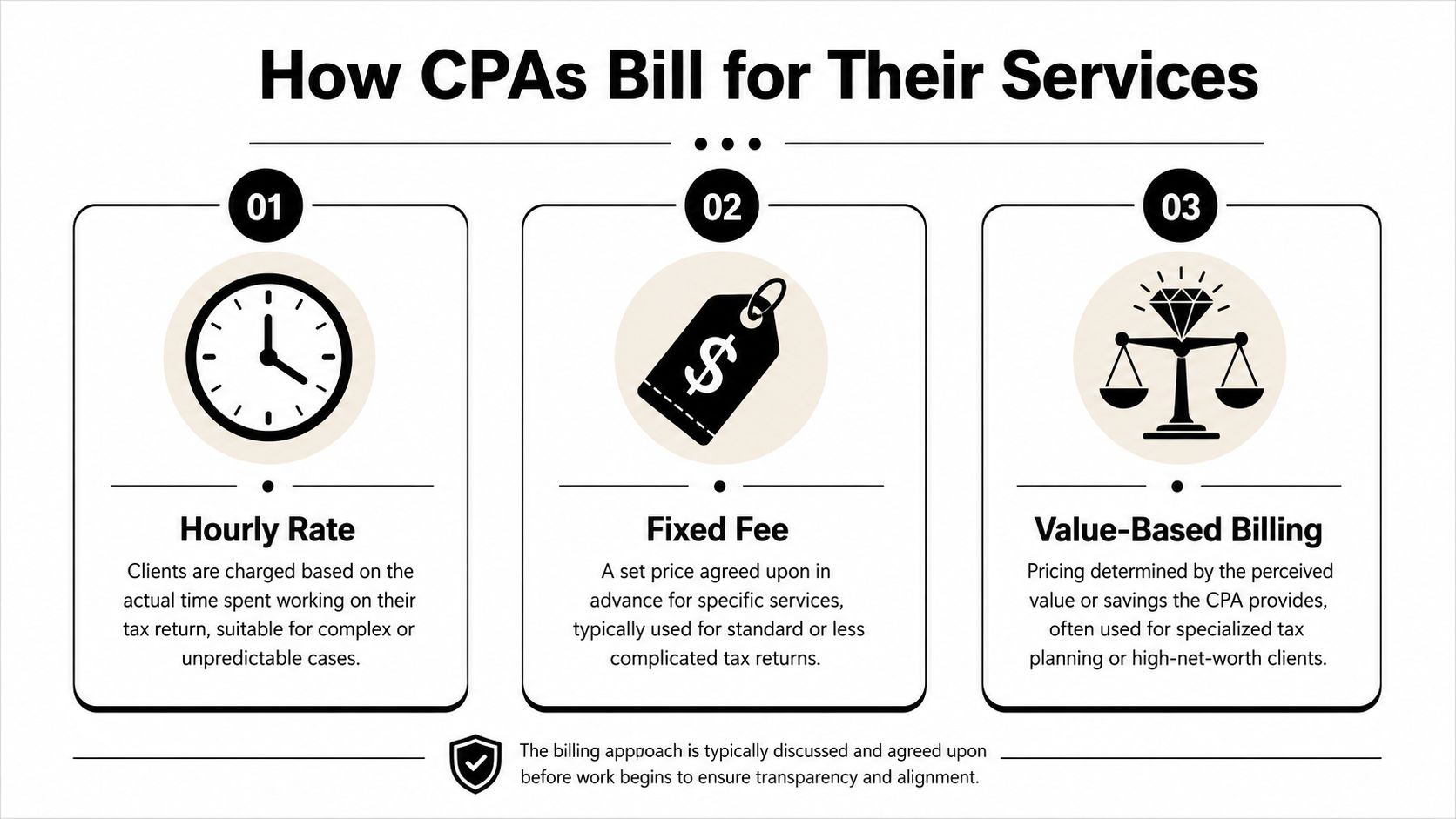
Nearly half of accounting firms, 49%, charge flat fees between $400 and $799 for basic individual returns. Hourly billing is also common, with individual tax work averaging $180 per hour, and highly experienced CPAs in major cities can charge more than $500 per hour, according to Housecall Pro's overview of CPA tax prep pricing.
Flat fee billing
A flat fee means you and the CPA agree on a set price for a defined return or package of work. Clients often prefer this because it makes budgeting easier.
Flat fees usually work best when the CPA can estimate the scope with reasonable confidence. A standard individual return fits that model better than a disorganized file with missing records and several unresolved issues.
From the client side, the main advantage is predictability. The tradeoff is that the price depends on the scope staying close to what you described. If new forms appear halfway through, the fee may need to be revised.
Hourly billing
Hourly billing is more flexible. You pay for the time the CPA spends on your matter.
This can make sense when the work is unpredictable. Maybe you need help sorting out a prior-year issue, reconstructing records, or dealing with incomplete information. In that case, a fixed fee can be hard to quote fairly.
A very organized client with a limited issue may spend less under hourly billing than under a padded flat fee.
The downside is obvious. If the work expands, the bill expands. That doesn't mean hourly billing is unfair. It means you need a clear conversation about scope, expected time, and how the CPA will notify you if the work starts growing.
Value based pricing
Value-based pricing is less common for a plain 1040 return and more common when the engagement includes judgment-heavy planning or specialized strategy. In those cases, the client isn't just paying for form preparation. They're paying for experience, interpretation, and advice tied to their situation.
That model tends to fit clients with more complicated financial lives. The key is transparency. If a CPA uses value-based pricing, they should explain what is included and why that work is different from basic compliance.
A simple comparison makes the billing models easier to evaluate:
- Flat fee: Best for predictable returns and clients who want cost certainty.
- Hourly: Best when the return or issue may change as documents come in.
- Value based: Best when the engagement includes higher-level guidance, not just preparation.
When you review an engagement letter, don't focus only on the number. Look at the billing structure, what's included, and what happens if the facts change.
Key Factors That Increase Your Tax Return Cost
Some returns cost more because the forms are more involved. Others cost more because the story behind the forms is messier. Both matter.

The easiest way to understand price increases is to look at what creates more work for the preparer. Every added layer usually means more review, more questions, and more judgment.
More forms usually means more work
A plain W-2 return is usually straightforward. Once you add schedules and supporting detail, the return takes on a different shape.
Common cost drivers include:
- Schedule A itemized deductions: Mortgage interest, charitable giving, and medical expenses require support and review.
- Schedule C business income: Freelancers and sole proprietors usually need income matching, expense review, and consistency checks.
- Schedule D capital gains and losses: Brokerage activity can require reconciliation and categorization.
- Schedule E rental property income: Rental income, expenses, and depreciation introduce extra judgment.
- Multiple state returns: More than one filing jurisdiction usually means more rules and more preparation time.
- Foreign income or unusual reporting issues: These often require additional analysis.
- Cryptocurrency activity: The hardest part is often organizing the records before the tax return can even be prepared.
Think of each extra form as another room in the house the CPA has to inspect. More rooms don't always mean a problem. They do mean more places where something can be missed.
Organization affects effort
Two clients can have the same tax profile and still receive different quotes or final bills. Why? Document quality.
A client who sends a labeled folder with complete brokerage statements, clearly summarized business expenses, and last year's return saves the preparer time. A client who uploads screenshots, partial PDFs, and duplicate files creates cleanup work before tax prep even starts.
That doesn't mean you need to be perfect. It does mean that neat records lower friction. The CPA spends more time on tax analysis and less time untangling paperwork.
Good records don't make a complex return simple. They do make the work more efficient.
There's also a difference between legal complexity and administrative complexity. A return may not involve unusual tax law, but it can still take extra time if the records are incomplete or inconsistent.
Location changes the market price
Geography matters more than many clients expect. USA Tax Gurus' discussion of CPA fee differences by region notes that geographic cost-of-living adjustments can change CPA fees by 40–60%. It also states that while a simple return may average $220 nationally, firms in high-cost areas such as New York and California often start at $350 to $450 for that same basic filing.
That's not just about office rent. It also reflects local labor markets, staffing costs, and what clients in that area commonly expect from the service relationship.
A quick way to interpret a quote is this:
| Factor | Why it raises fees |
|---|---|
| More schedules | More input, review, and cross-checking |
| Business or rental activity | More judgment and substantiation |
| Multiple states | Separate filing rules and added preparation |
| Messy records | Time spent organizing before preparing |
| High-cost city | Higher market pricing for the same scope |
If you live in a major metro area, don't compare your quote only to a national baseline. Compare it to the kind of market you're hiring in.
Real-World Pricing Scenarios
Abstract pricing only gets you so far. Individuals understand their own situation better when they can see a comparable client.
Scenario one single W-2 employee
Maria works for one employer, receives a W-2, pays student loan interest, and takes the standard deduction. Her documents arrive in one PDF, and nothing is missing.
This is close to the low-complexity end of the market. Her return is likely to fall near the simple-return range discussed earlier. The work is mostly straightforward preparation, a review for accuracy, and filing.
What affects her final bill most isn't tax law complexity. It's whether the engagement includes only preparation or also includes extra consultation, hand-holding, or last-minute corrections after the file is ready.
Scenario two freelance graphic designer
Jordan has several 1099s, uses a home office, tracks software subscriptions, and needs to sort business and personal expenses. One client paid late, another issued a corrected form, and Jordan's bookkeeping isn't fully cleaned up.
This return usually lands in the self-employed category. That means the CPA isn't just entering numbers. They're reviewing expense categories, checking for reasonableness, tying income documents together, and deciding what follow-up is needed.
The fee here often feels higher because the return includes both compliance work and record review. Jordan isn't buying a more expensive form. Jordan is paying for more professional judgment.
The return itself may be one filing. The work behind it can feel like a small project.
Scenario three married couple with a rental property
David and Elise file jointly, have wage income, itemize deductions, and own one rental property. Their rental records are decent, but they have repairs, insurance, and property tax payments that need to be categorized correctly.
This return usually sits in the middle to upper-middle range of complexity. It's more involved than a plain wage return because the rental activity creates extra review points. It also carries more tax impact if something is classified incorrectly.
A CPA may quote this kind of return as a flat fee if the records are orderly. If the rental file is incomplete or prior-year depreciation needs cleanup, hourly billing may be more likely.
These examples show the key pricing lesson. The fee follows the facts. If your tax life looks more like Maria's, expect a simpler engagement. If it looks more like Jordan's or David and Elise's, expect more review and a higher price because there's more work and more responsibility tied to the outcome.
How to Get an Accurate Quote and Avoid Red Flags
The best quotes come from specific information, not vague descriptions. If you tell a CPA, “My taxes are pretty simple,” that doesn't help much. One person's simple return includes a W-2. Another person's simple return includes a side hustle, stock sales, and two states.

What to gather before you ask for a quote
You'll get a better estimate if you provide a short, clear package up front:
- Last year's return: This gives the CPA a quick map of your filing pattern.
- Current-year income summary: W-2s, 1099s, brokerage statements, rental activity, or business income.
- A list of changes: Marriage, move, new business, home purchase, sale of investments, or new state filing.
- Your questions: If you want planning advice, say so early.
Questions worth asking
A good quote conversation should feel specific, not slippery. Ask questions like these:
- What does your fee include?
- Do you charge flat fee, hourly, or both?
- What would make the price go up from the initial quote?
- Will I work with the same person throughout the process?
- How do you handle missing documents or late changes?
Red flags to take seriously
Madras Accountancy's pricing guide notes that a standard Form 1040 with a state filing but no itemized deductions averages about $220, and that quotes significantly below that for anything other than the absolute simplest return can signal inexperience or hidden fees.
That doesn't mean every low quote is bad. It means you should slow down and ask why.
Watch for these warning signs:
- Very low pricing with vague scope: Cheap upfront quotes sometimes exclude common follow-up work.
- Promises about refund size: A preparer should explain your return, not sell a refund.
- No clear engagement terms: If the fee, filing scope, and responsibilities aren't spelled out, misunderstandings follow.
- Rushed intake: If nobody asks detailed questions about your income sources, they may not understand the job they're pricing.
A fair quote is usually the product of a careful conversation. That's a good sign, not a nuisance.
Maximizing Value Beyond the Preparation Fee
The cheapest return isn't always the best deal. A strong CPA relationship gives you more than a filed tax return. It gives you accuracy, a review process, thoughtful questions, and fewer unpleasant surprises.
You can help control cost by being easy to work with. Send complete documents. Label files clearly. Answer questions in one message instead of five scattered emails. That doesn't eliminate complexity, but it reduces avoidable time.
The bigger point is value. A careful CPA helps you understand what's on your return and why it was reported that way. That matters if the IRS asks questions later, if your finances get more complicated next year, or if you need planning advice before making a business or investment move.
When clients focus only on price, they often miss the hidden value of review quality. The better test is simple: did the preparer make the return feel clearer, safer, and better supported?
If your firm prepares a high volume of 1040s, pricing pressure and review quality often collide. WP TieOut helps CPA firms and tax preparers review drafted returns against source documents with a review-by-exception workflow, source-linked binders, and a clean sign-off trail. It's worth a look if you want tighter quality control without slowing down the return review process.