
A client calls late in the afternoon and asks a question that sounds simple. “If I sell the stock this quarter, what happens to my tax bill?” Or, “If I move from W-2 income into consulting, what should I expect next year?” Or, “If I clean up old unfiled returns, how much pain am I really looking at?”
That moment is where a CPA either stays in compliance mode or steps into an advisory role. A quick verbal estimate might satisfy the conversation for five minutes, but it usually creates more risk than clarity. Clients remember rough answers as commitments. Staff often hear “projection” and build something that looks polished but rests on assumptions nobody documented.
A tax pro forma solves that problem when it's done properly. It gives the client a structured answer to a hypothetical question, shows the mechanics behind the answer, and creates a reviewable record of what was assumed, what was excluded, and where the risks sit. Used well, it isn't just a calculation. It's a communication tool and a risk management tool.
Table of Contents
- Answering Your Client's Next 'What If' Question
- What Exactly Is a Tax Pro Forma
- When and Why CPAs Use Pro Forma Computations
- The Core Components and a Sample Layout
- A Mini-Workflow for Creating Your Next Pro Forma
- Common Pitfalls and a Pro Forma Review Checklist
- The Future of Pro Forma with Automation and AI
Answering Your Client's Next 'What If' Question
The client usually isn't asking for math. They're asking for permission to make a decision.
A business owner wants to buy out a partner. An executive wants to exercise equity. A physician starts moonlighting and now has W-2 wages, 1099 income, and deductible business expenses moving through the same return. They don't need a lecture on forms. They need a credible answer to, “What happens if I do this?”
That's why the tax pro forma matters. It turns an anxious question into a structured analysis. Instead of speaking in generalities, you can show the baseline return, isolate the proposed change, and explain the tax effect in a way the client can effectively use.
The difference between a guess and a professional answer
A rough answer sounds like this: “You'll probably owe more.”
A professional answer sounds like this:
- Here's the baseline based on the most recent filed return and current-year information.
- Here's the change being modeled such as a stock sale, new consulting income, or a filing cleanup.
- Here's the projected effect on taxable income, payments, exposure, and planning options.
- Here's what could change the result if the assumptions move.
That shift matters because clients make decisions from the story around the numbers, not just from the numbers themselves.
Practical rule: If the client's question starts with “what if,” your answer should usually live in a tax pro forma, not in an email sentence.
In practice, the strongest pro formas do two jobs at once. They estimate the tax consequence, and they manage expectations. A clean model shows what the answer depends on. That protects the client from false certainty and protects the firm from casual statements that later get treated like advice carved in stone.
Senior associates who get good at this become much more valuable. They stop being the person who explains last year's return and become the person who helps shape next year's outcome.
What Exactly Is a Tax Pro Forma
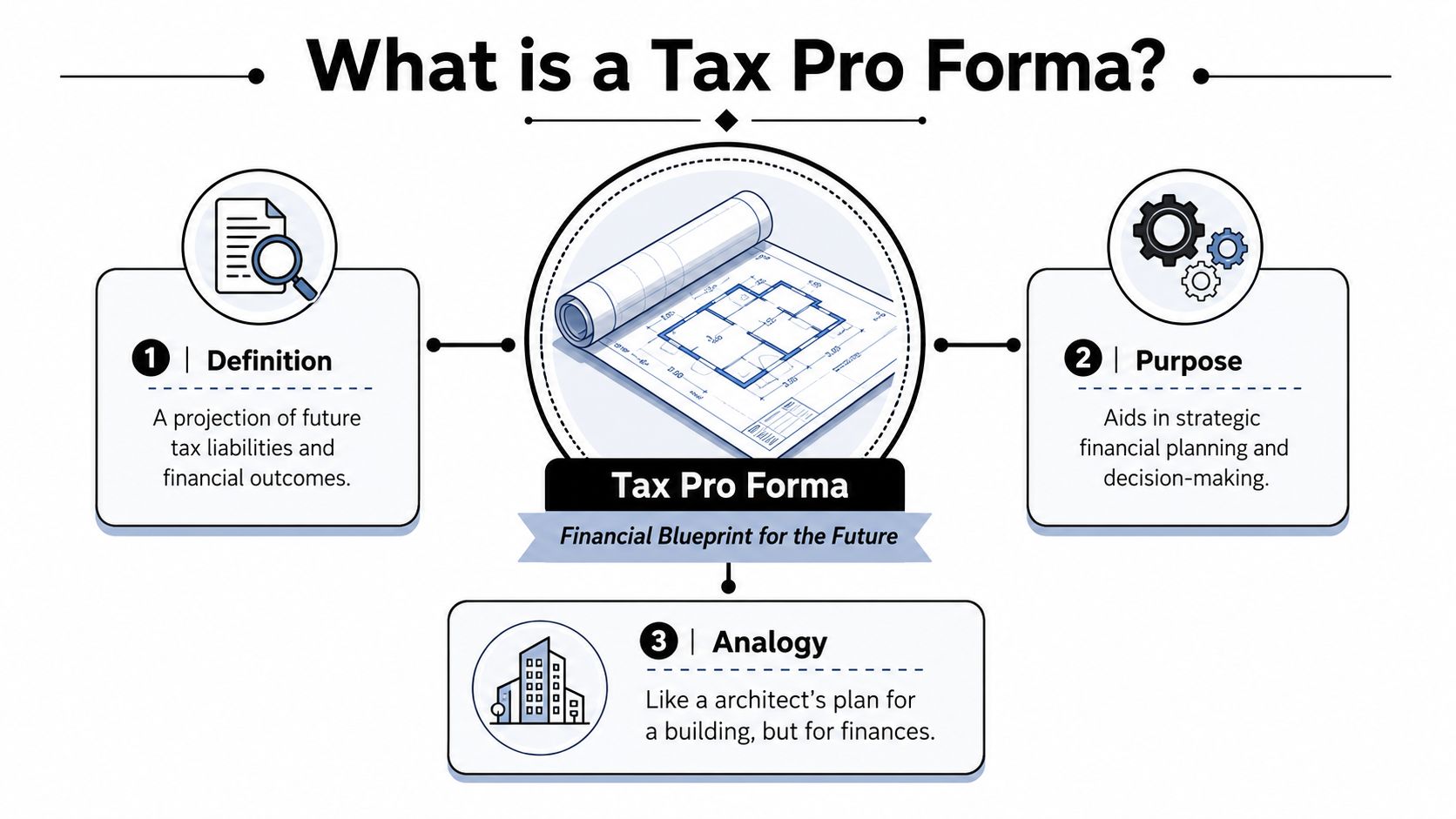
A tax pro forma is best understood as a financial blueprint for a hypothetical future. It isn't a filed return. It isn't a promise. It's a structured projection built to answer, with discipline, what a tax result could look like if specific facts occur.
The phrase itself comes from Latin, meaning “for the sake of form” or “as a matter of form.” In tax and accounting, pro forma statements are hypothetical projections that can't be used for filing because they rely on estimated data to illustrate what-if scenarios, as explained in Shopify's overview of pro forma meaning.
A model, not a filing
That distinction sounds obvious, but firms blur it all the time. Staff pull numbers from a draft organizer, add a few assumptions, and then discuss the output as if it carries the same authority as a completed return. It doesn't.
A tax pro forma is an analytical workpaper. It uses assumptions to model outcomes before the final facts exist. That makes it useful, but it also makes discipline nonnegotiable.
Three points keep the definition clean:
- It starts with real data. Usually that means the latest filed return, current year payroll data, brokerage activity, bookkeeping, or other source documents.
- It changes selected variables. The model reflects a proposed event, not every possible event.
- It stays provisional. If the underlying assumptions move, the output moves.
Why the blueprint analogy works
An architect's plan isn't the building. It shows what the building should look like if the design assumptions hold and the work gets done as expected. A tax pro forma works the same way. It maps the likely tax effect of a future event if the client's facts develop the way the model assumes.
That's why a good pro forma is more than a number on the last page. It should show the client and reviewer what was built into the result.
A weak pro forma answers the question asked. A strong one also answers the next question the client will ask after seeing the result.
For example, if a client asks whether to accelerate income or defer a deduction, the model shouldn't just spit out a projected balance due. It should show the tax effect under the chosen assumptions and identify where volatility sits, such as incomplete basis information, uncertain business expenses, or changes in withholding.
Once you explain a pro forma that way, clients usually understand it immediately. Junior staff do too. It's a structured forecast designed for decision-making, not a substitute for a filed return.
When and Why CPAs Use Pro Forma Computations
CPAs use pro forma computations any time the tax answer depends on facts that haven't fully happened yet or haven't been fully documented. Some uses are formal and externally driven. Others are internal planning tools that help a client choose among competing options.

Decision support for major transactions
At the transaction level, pro forma work helps clients understand scope before they commit. If a company is acquiring or disposing of a significant business, the accounting side of pro forma reporting becomes more formal. Under Article 11 of Regulation S-X, pro forma financial information is required when an acquisition or disposal exceeds 20% significance to a registrant, and the requirement can apply in filings such as Form 8-K, registration statements, and proxy statements, as detailed in EY's discussion of SEC Article 11 requirements.
For tax professionals, that kind of transaction work changes the advisory conversation. You're not only computing tax cost. You're helping management understand how the proposed transaction changes the story investors, lenders, and stakeholders will see.
In closely held businesses, the same logic applies even without SEC filing pressure. Owners still ask questions like:
- Should we buy the target now or wait until year-end
- What happens if we dispose of the underperforming division
- How will the owner compensation and tax profile change after the deal
Planning for individual clients and risk exposure
On the individual side, the tax pro forma is often where the actual planning value lives. Marriage, divorce, a liquidity event, retirement distributions, equity compensation, a new side business, or a move from employee status to independent work all create questions that standard return prep won't answer until after the year has already happened.
The overlooked use case is risk modeling. A pro forma can show not just an expected tax bill, but the possible exposure tied to incomplete compliance. That matters with unfiled returns, inconsistent withholding, and estimated payment gaps. Recent IRS data reveals that 18% of taxpayers with unfiled prior-year returns face penalties exceeding $1,000, a risk noted in Michigan State University Tax Clinic's discussion of unfiled returns.
If a client has an old filing problem, the pro forma shouldn't stop at “what do you owe now.” It should also show the likely pressure points that get worse if nothing is filed.
That's where the CPA's role changes. You're no longer reacting to a completed year. You're helping the client see the operational consequences of delay, timing, and incomplete information before those issues become harder to fix.
The Core Components and a Sample Layout
Most bad pro formas fail for one reason. They mix facts, assumptions, and outputs together so tightly that nobody can tell what drove the answer.
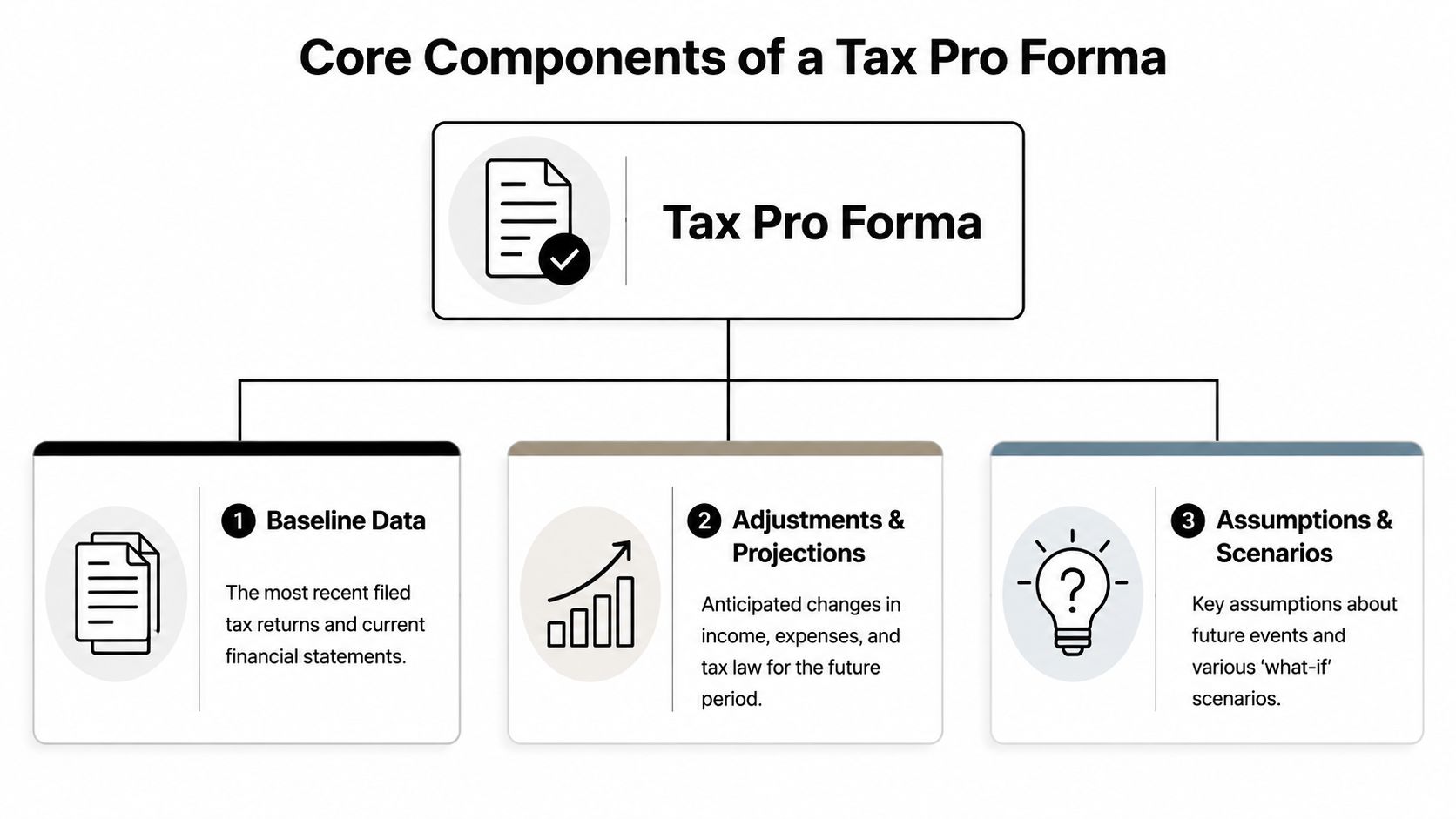
A workable model separates those elements. In practice, every reliable tax pro forma has three core parts: baseline data, assumptions, and projected calculations.
The three parts that matter
Baseline data is your starting point. Usually that means the latest filed return and any current-year source records that are solid enough to use. If the baseline is weak, the model is weak.
Assumptions are the deliberate changes. In this process, discipline matters most. A successful pro forma analysis begins with defensible, driver-based assumptions grounded in historical performance and realistic market conditions, and actionable variables should be tested against two to three years of historical data before applying them to forward projections, according to Becker's explanation of pro forma financial statements.
For tax work, “driver-based” often means things like compensation structure, withholding behavior, business expense patterns, estimated payment habits, entity distributions, and transaction timing. It doesn't mean dropping in a generic growth percentage and hoping the output looks reasonable.
Projected calculations are the tax result after the modeled changes flow through the return. Within these calculations, cascading effects emerge. A change in one income item can alter deduction limitations, phaseouts, credits, payment needs, and exposure areas elsewhere.
A simple layout that works in practice
You don't need a beautiful template to make a strong tax pro forma. You need a layout that a reviewer can follow.
A practical structure looks like this:
| Column | Use |
|---|---|
| Column A | Prior year actual or latest reliable baseline |
| Column B | Specific adjustments for the scenario being modeled |
| Column C | Pro forma projection after adjustments |
Then support the columns with short schedules underneath:
- Income schedule for wages, self-employment, investment activity, pass-through items
- Deduction schedule for business expenses, itemized items, above-the-line deductions
- Payment schedule for withholding and estimated tax assumptions
- Risk notes for missing documents, open factual issues, or unresolved positions
Reviewer note: If you can't trace a projected line back to a baseline amount or a written assumption, the model isn't ready to send.
That format does two things well. It makes partner review faster, and it makes client communication cleaner. The client doesn't need every line of your workpaper, but they do need a result that can be explained without hand-waving.
A Mini-Workflow for Creating Your Next Pro Forma
The fastest way to waste time on a tax pro forma is to start calculating before the client question is pinned down. Good preparation starts with problem definition, not with spreadsheets.
Start with the client question
Begin by reducing the request to one clear decision. “What happens if I sell stock?” is too broad. “What happens if I sell these specific shares this quarter, with current withholding unchanged?” is workable.
That first conversation should isolate the variables that matter. If the client asks three different questions, build three scenarios or make them choose the priority issue. Mixing unrelated issues into one model usually creates confusion.
A practical sequence looks like this:
- Define the event. Sale, job change, new business, old filing cleanup, distribution, exercise, or restructuring.
- Set the time frame. Current year, short period, or projected next year.
- Identify the moving parts. Income type, deduction impact, payments, entity changes, timing issues.
- State what is excluded. Unknown basis, pending K-1 items, incomplete expense detail, unresolved legal positions.
- Agree on the output. Estimated balance due, refund impact, cash need, payment strategy, or risk view.
Build, test, and document
Once the question is tight, gather the baseline. Pull from filed returns and source records, not from memory and not from half-complete organizer notes unless the uncertainty is clearly flagged.
Then apply the assumptions deliberately. For each adjustment, ask whether it has a second-order effect somewhere else in the return. New self-employment income doesn't just add tax. It can alter deductions, payment requirements, and refund expectations. Timing changes can do the same.
The actual workflow is simple, but the judgment inside each stage is where quality lives:
- Use the cleanest baseline available. Draft returns are useful, but filed returns and validated source data are better anchors.
- Apply only the changes needed to answer the question. Scope creep kills clarity.
- Run at least one alternate scenario. Even a conservative and expected case can help frame uncertainty.
- Write down every assumption. If you don't document it, someone will later treat it as fact.
- Prepare a short narrative for the client. The explanation should fit on one page, even if the workpaper takes many more.
A senior reviewer should be able to open the file and answer three questions quickly: What was asked? What changed? Why does the result make sense?
The best pro forma files read like they were prepared for someone else to challenge them. Because eventually, they will be.
That mindset improves both technical quality and client trust. A model that's easy to review is usually also easy to defend.
Common Pitfalls and a Pro Forma Review Checklist
Most pro forma failures aren't technical in the narrow sense. They come from weak inputs, missing interactions, and sloppy communication.
The biggest problem is still baseline quality. If the starting return is incomplete, or if source income wasn't fully captured, the resulting model may look polished while being directionally wrong. That gets especially dangerous when the client has mixed income streams.
Where pro formas break down
Clients with wages alone are usually straightforward. Clients with W-2 income, 1099 income, and self-employment activity are not. IRS data shows that 27% of filers with multiple income types report unexpected refund variances due to unaccounted deductions, a point highlighted in UltimateTax's discussion of common client tax questions.
That matters because many preparers still build these projections too linearly. They model added income but miss side-business expenses, payment shifts, or deduction interactions that make the refund or balance due move in ways the client didn't expect.
Other recurring failures show up in review:
- Assumptions aren't labeled. Reviewers can't tell which inputs are factual and which are estimated.
- Cascading effects are missed. Adjusted gross income changes and downstream impacts aren't fully considered.
- Payment assumptions are stale. Withholding and estimates remain unchanged in the model even though the fact pattern changed.
- Narrative doesn't match the workpaper. The client summary oversimplifies what the schedules show.
Pro Forma Review Checklist
Use a short checklist before anything leaves the firm. A reviewer doesn't need elegance. A reviewer needs control.
| Check Point | Verification Status (Yes/No/NA) |
|---|---|
| Client question is stated clearly and narrowly | |
| Baseline return or source data is identified | |
| All material assumptions are written in the file | |
| Adjustments are separated from historical amounts | |
| Multiple income sources were evaluated for related deductions | |
| Payment assumptions reflect the projected scenario | |
| Cascading tax effects were considered | |
| Missing documents or uncertain facts are flagged | |
| Client-facing summary matches the calculations | |
| Reviewer can trace key outputs back to support |
A pro forma doesn't need to predict the future perfectly. It does need to show that the firm handled uncertainty responsibly.
That's the standard worth teaching to staff. If a file can't pass a checklist like this, it isn't ready for the client, no matter how good the spreadsheet looks.
The Future of Pro Forma with Automation and AI
Manual pro forma work has a familiar weakness. Too much of the team's time goes into gathering source documents, rekeying numbers, tying inputs to a draft return, and checking whether the baseline is even trustworthy.
That's where modern review technology helps. The point isn't to automate judgment. The point is to reduce avoidable error and create a cleaner handoff between preparer, reviewer, and partner.
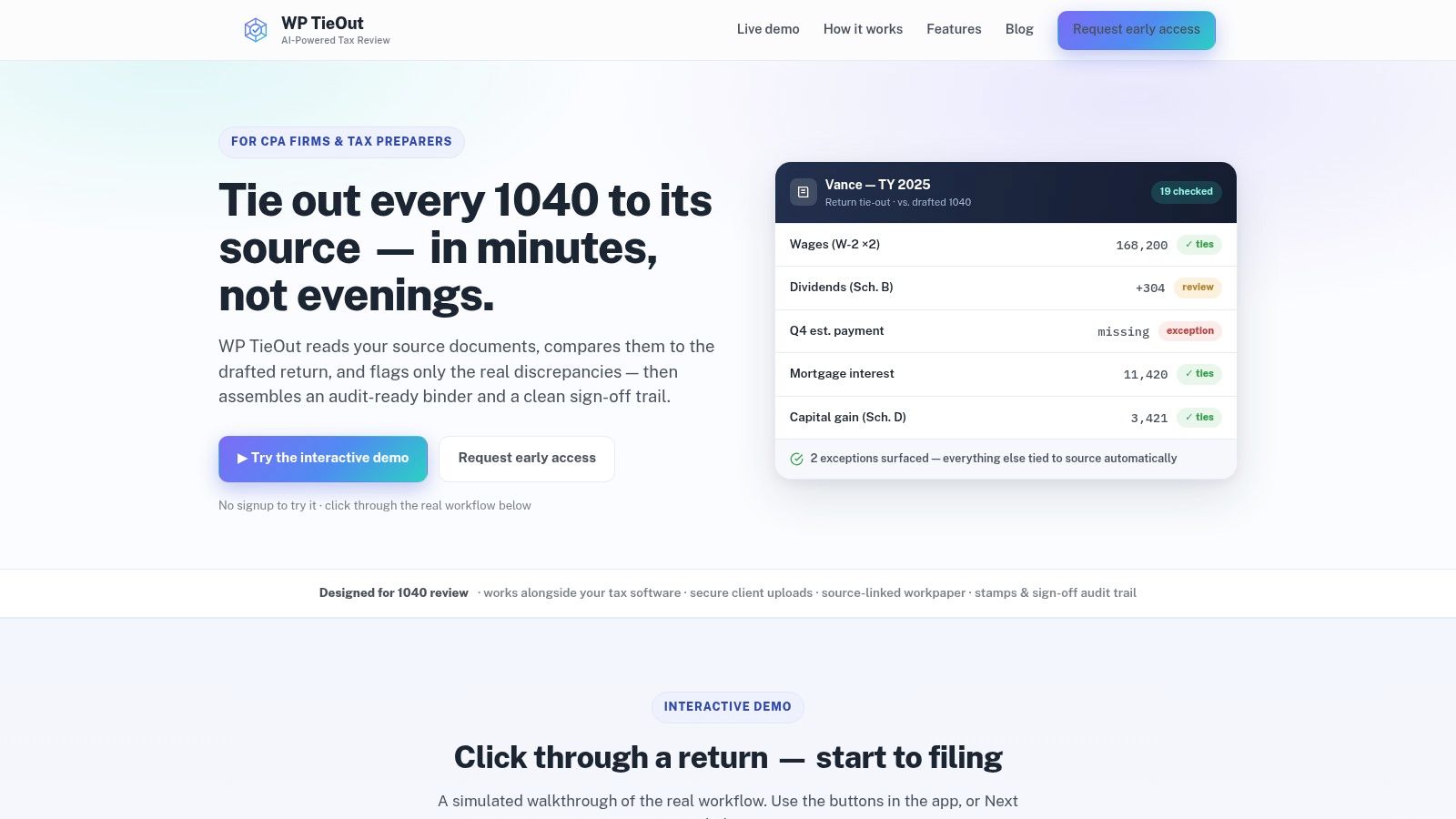
A practical example of that kind of workflow looks like this:
What technology should handle
Good automation should take over the repetitive parts of the process:
- Ingesting source documents such as W-2s, 1099s, brokerage statements, and similar records
- Validating extracted data before it becomes the baseline for analysis
- Comparing workpapers to the drafted return so reviewers focus on real discrepancies
- Creating a source-linked audit trail that shows what was reviewed and when
Those functions de-risk pro forma work because they reduce the chance that a projection rests on bad intake or an unnoticed transcription error. They also make review by exception possible, which is far more useful than line-by-line eyeballing when deadlines tighten.
What still belongs to the CPA
The CPA still owns the core advisory work. Software doesn't decide which scenario should be modeled, whether an assumption is defensible, or how to explain uncertainty to a client who wants a yes-or-no answer from incomplete facts.
That judgment remains human. Technology just gives the professional a stronger platform to exercise it.
For a closer look at how an AI-enabled tax review workflow can support that process, this demo is useful:
The firms that handle tax pro forma work best will likely be the ones that separate machine work from professional work clearly. Let software handle ingestion, validation, comparison, and binder creation. Let the CPA handle scenario design, risk interpretation, and client advice.
If your firm wants a faster, more defensible way to review 1040 source data and support projection work, WP TieOut is worth a look. It helps preparers and reviewers validate source documents, compare them against drafted returns, and maintain a source-linked sign-off trail so the team can spend less time hunting for discrepancies and more time on the judgment that clients pay for.