

It's late in the day, the return is almost ready to release, and the draft 1040 looks clean until one number doesn't quite tie. A W-2 wage feels off. A 1099-INT is in the file, but not on the lead sheet. The brokerage summary agrees to itself, not to the draft return. That's the moment when tax reconciliation stops being an abstract control and becomes the thing standing between a smooth sign-off and a preventable miss.
That pressure shows up constantly in individual return work, yet most published guidance on a tax reconciliation example still centers on corporate provision rules and public-company disclosures. That leaves a practical gap for 1040 teams. The work is different, but the discipline isn't. A good reviewer should be able to trace each material figure from source document, to workpaper, to return, and document why any difference exists.
Table of Contents
- Why 1040 Tax Reconciliation Deserves More Attention
- Building Your 1040 Reconciliation Workpaper
- A Worked 1040 Tax Reconciliation Example
- Handling Common Discrepancies and Mismatches
- Documentation Sign-Off and Creating an Audit Trail
- From Manual Review to Automated Validation
Why 1040 Tax Reconciliation Deserves More Attention
A 1040 return rarely fails because the team doesn't know tax law. It usually fails because information is scattered, source documents arrive in waves, and someone assumes the drafted return already reflects what's in the file. Reconciliation is the control that catches that drift.
For an individual return, reconciliation means more than confirming arithmetic. It means proving that wages, interest, dividends, withholding, estimated payments, and major deductions are supported by source documents and correctly reflected on the draft return. If a number doesn't tie, the file should show why.
That's not a luxury step borrowed from large-company practice. It's basic review discipline.
Corporate rigor has a useful lesson
Public companies already work this way because they have to. Under IAS 12, public entities reporting under IFRS must perform a detailed numerical reconciliation between the theoretical tax charge and the actual tax incurred, which is meant to show how specific items affect the final tax provision, as explained in this IAS 12 tax reconciliation example. The form is different from a 1040, but the underlying message is the same. Every meaningful variance needs a basis.
A reviewer on the individual side should think in that same mindset. Not because Form 1040 copies IFRS disclosure rules, but because the quality standard is similar in practice. If the return says one thing and the file says another, the return is weak until someone resolves that gap.
Practical rule: If a reviewer can't trace a material number in under a few clicks or a few pages, the workpaper isn't finished.
The risk is operational, not theoretical
1040 work has a habit of looking simple while hiding complexity. A return with only a few income forms can still contain withholding mismatches, duplicate document uploads, nominee reporting issues, brokerage summaries that don't match detail pages, or draft-return numbers pulled from an earlier organizer.
That's why tax reconciliation deserves more attention inside firms. It improves three things at once:
- Accuracy: You catch source-to-return breaks before filing.
- Review speed: A clean tie-out file shortens review notes and back-and-forth.
- Defensibility: The firm can show how each conclusion was reached.
The firms that treat reconciliation as a separate review discipline usually run smoother during peak season. The firms that skip it often rely on reviewer memory, visual scanning, and luck. Those methods work until they don't.
Building Your 1040 Reconciliation Workpaper
A good tax reconciliation example starts before anyone opens the draft return. The workpaper has to be built in a way that makes tie-out obvious, not hidden.
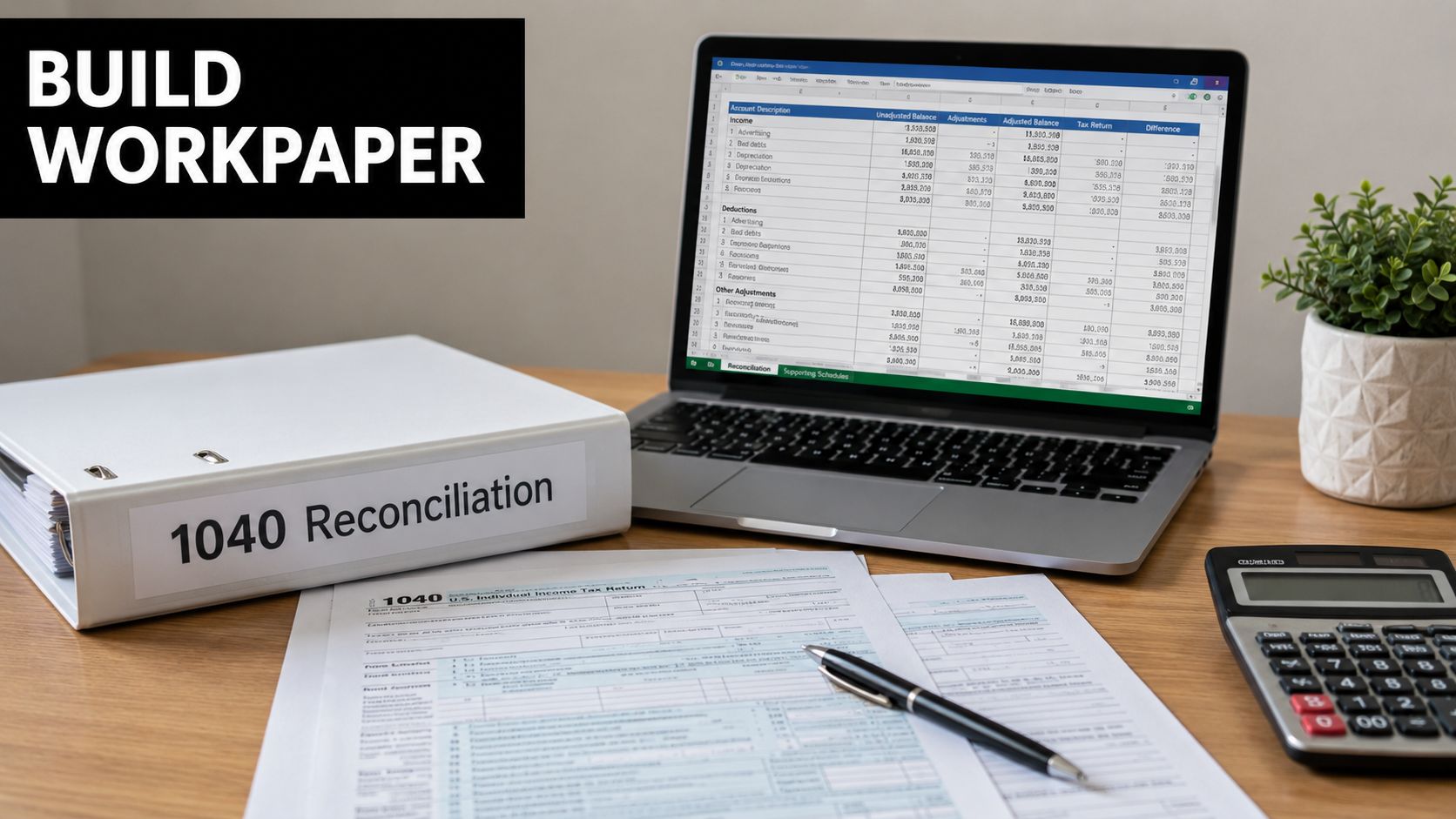
Line-by-line review still dominates many firms, but it's not the strongest control. Analysis shows 78% of CPA firms still perform line-by-line review of 1040 returns, and that process misses 12% of true discrepancies on average, which supports a validation-first approach rather than a reconcile-after habit, as discussed in Grant Thornton's note on income tax disclosure changes.
What belongs in the binder
At minimum, the workpaper set should include the source documents, the preparer's draft return, and a summary sheet that acts as the map for the reviewer. If those pieces live in different folders with inconsistent naming, review time expands fast.
I prefer a binder or digital file structure with these components:
- Source documents: W-2s, 1099s, brokerage statements, K-1s, estimated tax support, prior-year return, and any organizer notes.
- Lead sheets: One for income, one for withholding and payments, and separate support for items that need judgment.
- Draft return: The exact version being reviewed, not an earlier draft sitting in the same folder.
- Issue log: Open questions, pending documents, and reviewer notes that require follow-up.
A lead sheet doesn't need to be fancy. It needs to answer one question clearly: where did this number come from?
Why validate before you reconcile
Many teams reconcile by taking the draft return as given, then checking whether the source documents support it. That sounds efficient, but it builds the process on an untested starting point. A better approach is to validate the source documents first, then compare that validated workpaper to the draft return.
That distinction matters. If the source set contains duplicates, missing pages, unreadable statements, or year mismatches, a return-to-source review can confirm the wrong answer very quickly.
A practical 1040 workpaper usually works best when each line has three references:
| Workpaper field | What it should show | Why it matters |
|---|---|---|
| Source reference | Specific document and page | Lets the reviewer find the support fast |
| Workpaper amount | Cleaned and categorized figure | Shows what the preparer concluded |
| Return location | Form and line reference | Proves the amount flowed correctly |
The fastest review files aren't the ones with the fewest notes. They're the ones where the reviewer never has to guess what ties to what.
The strongest teams also separate factual intake from tax judgment. Enter the W-2 wage exactly as shown. Enter the federal withholding exactly as shown. Then, if a tax adjustment is needed elsewhere, document that as a separate conclusion. Mixing raw source data with downstream tax treatment is what makes review messy.
A Worked 1040 Tax Reconciliation Example
Most articles about a tax reconciliation example stay too high-level to be useful. On actual 1040 work, the only way to teach this well is to walk the file.
The Millers file
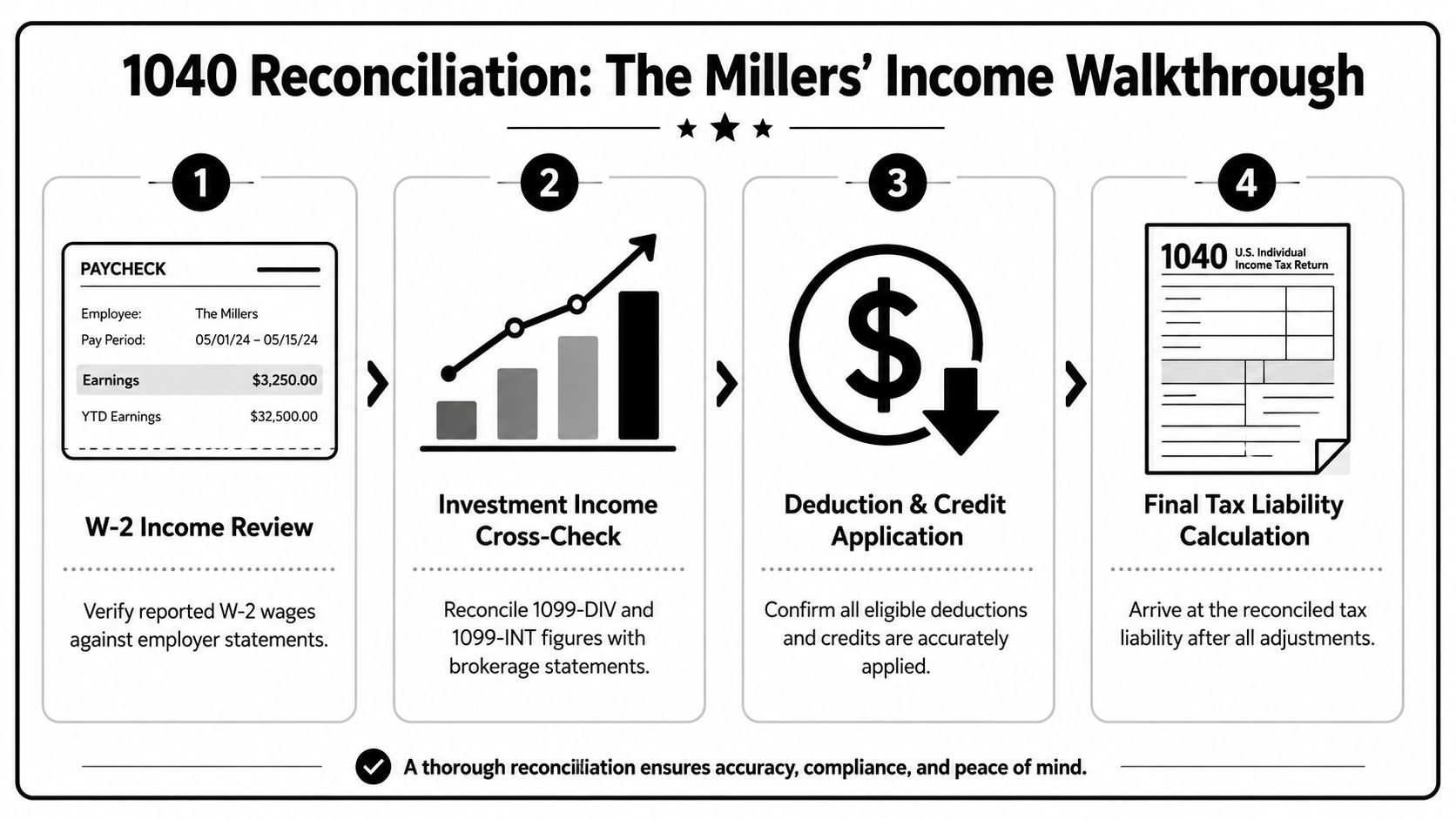
Assume the Millers are a married couple filing jointly. Their source documents include one W-2, one bank Form 1099-INT, and one brokerage Form 1099-DIV. The preparer has already produced a draft Form 1040. The reviewer's job is to confirm the income numbers tie from source, to workpaper, to return.
The work starts with a simple lead sheet. Each income item gets its own row, the source page is referenced, and the return location is listed beside it.
How the tie-out works
Start with wages. The W-2 shows Box 1 wages of $85,100. The lead sheet records that same amount on line A-1 under wage income. The draft Form 1040 should then show $85,100 on Line 1a. If all three agree, the wage line is reconciled.
That sounds basic, but the important part is the trace:
- Source document
W-2, Box 1 = $85,100 - Lead sheet
Income workpaper, line A-1 wages = $85,100 - Draft return
Form 1040, Line 1a = $85,100
That's a complete tie-out because the reviewer can identify the origin, the classification, and the final reporting location.
Now move to bank interest. The 1099-INT shows interest income. The lead sheet should carry the exact interest amount from the form, grouped under taxable interest, and the draft return should reflect that amount on the interest income line. If the bank statement package includes multiple accounts, the workpaper should show whether the amount came from a consolidated tax statement or from separate forms.
Do the same for dividend income. The 1099-DIV amount goes onto the lead sheet, then to the draft return line for ordinary dividends. If qualified dividends are separately stated on the source document, the workpaper should preserve that distinction and show where each figure lands in the return package.
What the reviewer is really testing
The reviewer is not only checking whether the math works. The reviewer is testing whether the data moved correctly through the file without distortion.
For the Millers, that means asking:
- Was the source document complete? Brokerage packages often include summary pages and detail pages. A summary without the tax-reporting page isn't enough.
- Was the amount classified correctly? Interest, ordinary dividends, and qualified dividends can't be merged casually.
- Did the preparer use the current draft return? Reconciliation against a stale draft creates false comfort.
Here's what a clean lead sheet might look like conceptually:
| Income item | Source document | Workpaper amount | Draft return location | Status |
|---|---|---|---|---|
| Wages | W-2 Box 1 | $85,100 | Form 1040 Line 1a | Agrees |
| Taxable interest | 1099-INT | Amount per source | Interest line on draft return | Check tie |
| Ordinary dividends | 1099-DIV Box 1a | Amount per source | Dividend line on draft return | Check tie |
| Qualified dividends | 1099-DIV Box 1b | Amount per source | Qualified dividend support | Check tie |
A good 1040 reconciliation file lets another reviewer retrace the result without re-preparing the return.
A worked 1040 tax reconciliation example becomes useful in practice. The method is repetitive on purpose. You don't want creativity in tie-out work. You want consistency. Every item should pass through the same chain: source, workpaper, return, resolution if different.
If a number doesn't agree, stop the flow there. Don't force it through the lead sheet just to make the file look complete. Mark the variance, identify the cause, and document the conclusion. Clean files aren't the ones with no issues. They're the ones where every issue has an owner and an explanation.
Handling Common Discrepancies and Mismatches
Most review time gets spent at this point. Clean examples are useful for training, but real 1040 files break in predictable ways.
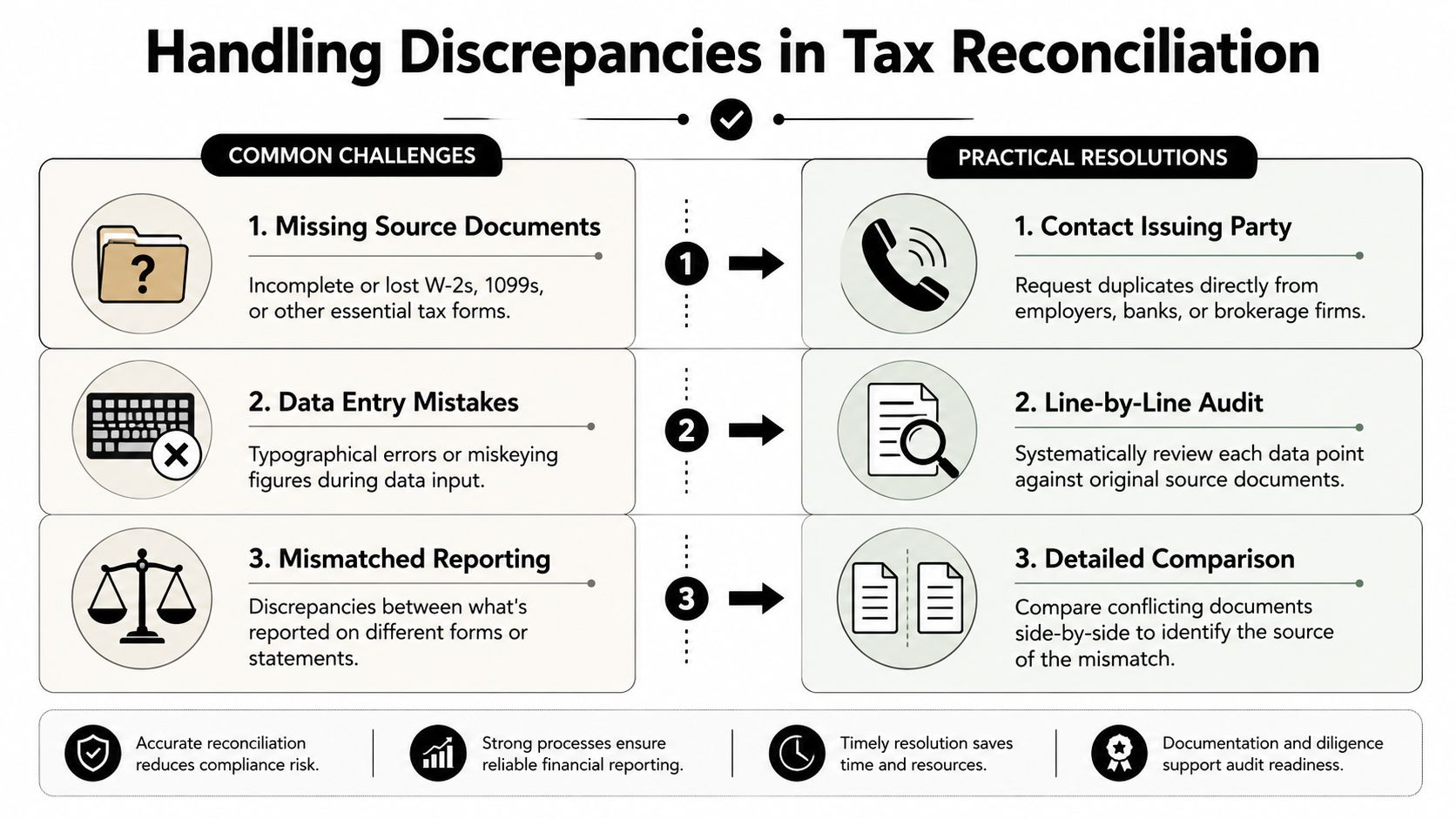
The first pass often isn't enough. Industry benchmarks indicate that up to 15% of initial tax reconciliation efforts contain errors due to incomplete documentation or misclassification, while structured workflows can reduce those error rates to below 3%, according to this tax reconciliation overview from Hyperbots.
When wage boxes don't agree
A common reviewer note appears when W-2 federal wages don't match Social Security wages. New staff sometimes assume one of the boxes must be wrong. Usually, the issue is simpler. Different wage boxes can follow different tax rules.
The right response isn't to force the boxes to match. It's to confirm that the return used the correct box for the correct purpose and that the workpaper notes why the difference exists. If the file lacks explanation, add one. If the source looks inconsistent on its face, ask for payroll support before sign-off.
When a state refund appears
A 1099-G for a state tax refund creates confusion because the form exists, but the taxable treatment may depend on the prior year. The reviewer should pull the prior-year return and determine whether the taxpayer itemized and whether the refund affects the current-year federal return.
This is one of those areas where staff often enter the form because it's present. That's not reconciliation. That's transcription. Reconciliation means tying the document to the return and documenting why it belongs there, or why it doesn't.
When basis is missing on a 1099-B
1099-B work can derail a review fast. If basis isn't complete, the return can't be treated as fully supported just because a brokerage summary was uploaded.
A practical resolution path looks like this:
- Check the detail pages first: The summary page may omit basis detail that appears later in the package.
- Look for supplemental schedules: Many brokers issue gain and loss detail separate from the cover summary.
- Escalate early: If basis still isn't supportable, the file needs a documented follow-up with the client or broker.
- Mark the return as unresolved where appropriate: Don't let an unsupported capital gain line pass because the rest of the return is clean.
When the issue isn't resolved today
Some discrepancies won't be fixed the same day. A payer may need to reissue a form. A client may need to provide a missing page. A brokerage PDF may be incomplete. That's normal.
What matters is how the team handles the open item. Good reviewers keep an issue log with the item, the source of the problem, the current status, and the next action. Weak files bury unresolved items in email or margin comments.
A practical mismatch workflow usually follows this order:
- Confirm the source set is complete.
- Identify whether the variance is factual, classification-related, or timing-related.
- Resolve the issue if support exists.
- If support doesn't exist, document the open item and prevent silent sign-off.
That last point matters most. Silent acceptance is what creates downstream exposure.
Documentation Sign-Off and Creating an Audit Trail
A reconciliation isn't complete when the reviewer figures out the answer. It's complete when the file shows how the answer was reached, who approved it, and what remains open.
That documentation protects the firm in ordinary ways long before any formal examination. It helps when a client calls next year asking why a number changed. It helps when a partner wants to understand why a reviewer cleared a mismatch. It helps when the return is reassigned and someone new has to pick up the file without oral history.
What good documentation looks like
The best audit trails are boring. They are clear, chronological, and easy to follow. Each note answers one of three questions: what was checked, what differed, and how it was resolved.
Useful documentation habits include:
- Use precise annotations: “Agrees to W-2 Box 1” is better than “ok.”
- Keep review notes tied to source pages: A comment without a document reference slows everyone down later.
- Record conclusion and rationale together: Don't write “adjusted” without saying why.
- Preserve open items visibly: Pending issues shouldn't disappear because the return is moving toward release.
For sales tax reconciliation, documenting open issues for the next cycle has been shown to reduce penalty exposure by 70%, and maintaining a robust audit trail can provide over 99% traceability, which is a strong parallel for 1040 review discipline, as described in this sales tax reconciliation guide from Numeral.
Clear documentation does two jobs at once. It supports the current filing, and it saves the next reviewer from reconstructing the file from memory.
Sign-off should follow the return's risk
Not every 1040 needs the same sign-off intensity, but every return needs a defined chain of responsibility. In most firms that means preparer, reviewer, and final approver. The key is that each person's role should be evident in the file.
I want three things visible before release:
| Role | What should be evident |
|---|---|
| Preparer | Source documents were gathered, categorized, and entered |
| Reviewer | Tie-out was performed and exceptions were resolved or elevated |
| Final approver | Open issues were accepted, cleared, or held from filing |
Many firms often lose control. They have sign-offs in the software, but not in the workpaper evidence. A digital checkmark isn't enough if the underlying file doesn't show what was reviewed.
A proper audit trail turns reconciliation into a defensible process, not a personal habit. That distinction matters for quality control and for firm reputation.
From Manual Review to Automated Validation
Manual review still has value. Experienced reviewers catch context problems that software alone won't always understand. They know when a client's brokerage packet looks incomplete. They notice when a state refund seems inconsistent with the prior year. They understand when a number is technically tied but still suspicious.
What manual review still does well
Manual review is strongest where judgment matters:
- evaluating whether a document is complete
- recognizing unusual client fact patterns
- deciding whether a variance is acceptable or needs escalation
- explaining the final conclusion in a way another professional can follow
The problem is that many firms still ask skilled reviewers to spend most of their time on mechanical comparison work. That's expensive, tiring, and hard to scale during filing season.
Where automation changes the economics
Exception-based validation has a real advantage. Public-company tax rules already reflect a materiality mindset. SEC rules require public entities to separately disclose reconciling items that are 5% or more of the computed tax amount, which reinforces the value of systems that surface significant variances instead of making reviewers hunt for everything manually, as explained in this discussion of effective tax rate reconciliation disclosures.
That same logic applies well to 1040 review. The reviewer should spend time on the breaks, not on proving that dozens of obvious items already agree.

A strong automated workflow usually does four things better than a manual one:
- It validates extracted source data before comparison.
- It compares the validated workpaper to the drafted return consistently.
- It highlights true discrepancies instead of making the reviewer eyeball every line.
- It preserves a cleaner digital history of who checked what and when.
That doesn't replace reviewer judgment. It reallocates it. The reviewer stops acting like a scanner and starts acting like a decision-maker.
For firms handling volume, that's the payoff. Better quality control, less avoidable rework, and a review process that doesn't depend on one senior person remembering where every number came from.
If your team is still reconciling drafted 1040s by hand, WP TieOut is worth a look. It's built for CPA firms and preparers who need to validate W-2s, 1099s, brokerage statements, and drafted returns without relying on pure line-by-line eyeballing. The platform focuses on review by exception, creates a source-linked binder, and preserves the sign-off trail that strong 1040 reconciliation work demands.