

A file can look fine on the surface and still fall apart the moment a reviewer asks one simple question, who reviewed this, on what evidence, and why was that conclusion acceptable? That's the gap most firms feel only after a file request lands, the binder from last spring comes off the shelf, and nobody can quickly show which brokerage page was used, who signed off, or how a deduction got from source document to final return.
Audit documentation requirements exist to stop that scramble. In practice, they are not a pile of papers, they're a controlled evidentiary trail that shows what was done, who did it, who reviewed it, when it happened, and what evidence supported the final judgment. Under PCAOB expectations, that trail has to be detailed enough to show the work performed and the review chain, and it has to be retained for seven years in PCAOB-regulated work, because the record itself is what regulators test, not the memory of the team that built it (PCAOB AS 1215).
Table of Contents
- When a File Request Turns Into a Wake-Up Call
- The Standards That Actually Govern the File
- The Five Elements Every Audit File Must Contain
- Retention Timelines and the Timeliness Trap
- Building an Audit-Ready Workflow Step by Step
- What Sufficient Documentation Looks Like in Real Returns
- Documentation Failures That Survive Internal Review
- Your Audit-Ready Checklist and Action Plan
When a File Request Turns Into a Wake-Up Call
A partner gets a 30-day file request, opens a binder from last April, and immediately hits the same dead ends everyone recognizes. The return is signed, the support is there somewhere, but the file doesn't clearly show who reviewed the brokerage statement, which page matched the draft return, or why the wash-sale adjustment was accepted. The documents exist, but the trail does not.
That's the difference between a stack of support and audit documentation requirements that can survive scrutiny. A reviewer is not just checking whether you collected a W-2 or a 1099-B. They're asking whether the file lets them reconstruct the judgment without relying on a conversation, an email thread, or somebody's memory six months later.
Practical rule: if an external reviewer can't tell what happened by reading the file alone, the file is too weak.
That's why the modern file has to function like a record of decisions, not a scrapbook of uploads. The preparer leaves evidence of source review. The reviewer leaves evidence of challenge and resolution. The partner leaves evidence of final approval. If any one of those links is missing, the file starts to look like a claim instead of a defensible record.
For firms that still treat documentation as a closing chore, this is the hard pivot. The product regulators and reviewers are testing is the trail, not the loose papers inside it. That's why a source-linked, review-visible workflow matters so much more than a polished binder cover or a neat folder structure. For a practical framing of that trail, see audit trail best practices.
The Standards That Actually Govern the File
Public company work is the strictest benchmark
PCAOB AS 1215 is clear about what the file has to show. It requires documentation for each engagement, clear evidence of what work was performed, who performed it, who reviewed it, and retention for seven years from the report release date, or from fieldwork completion if no report is issued (PCAOB AS 1215). That retention rule comes from Section 103(a)(2)(A)(i) of Sarbanes-Oxley, which pushed the profession toward records that support the conclusions reached, not just proof that a conclusion exists.
International and many private engagements focus on self-contained files
ISA/ASA 230 requires documentation on a timely basis and in enough detail that an experienced auditor with no prior connection to the engagement can understand the nature, timing, and extent of procedures, the evidence obtained, and the significant matters and conclusions reached (ASA 230 compiled standard). That language matters because it sets a plain test. If the file only makes sense after someone explains it out loud, it is not self-explanatory enough.
Risk assessment documentation has gotten more explicit
SAS 145 raised the bar on documenting how the auditor worked through control design, implementation, and significant judgments about risks of material misstatement (Thomson Reuters on SAS 145). That is the part many older file templates still leave thin. Firms often capture the final test result, but not the reasoning trail behind the risk call that led to the test in the first place.
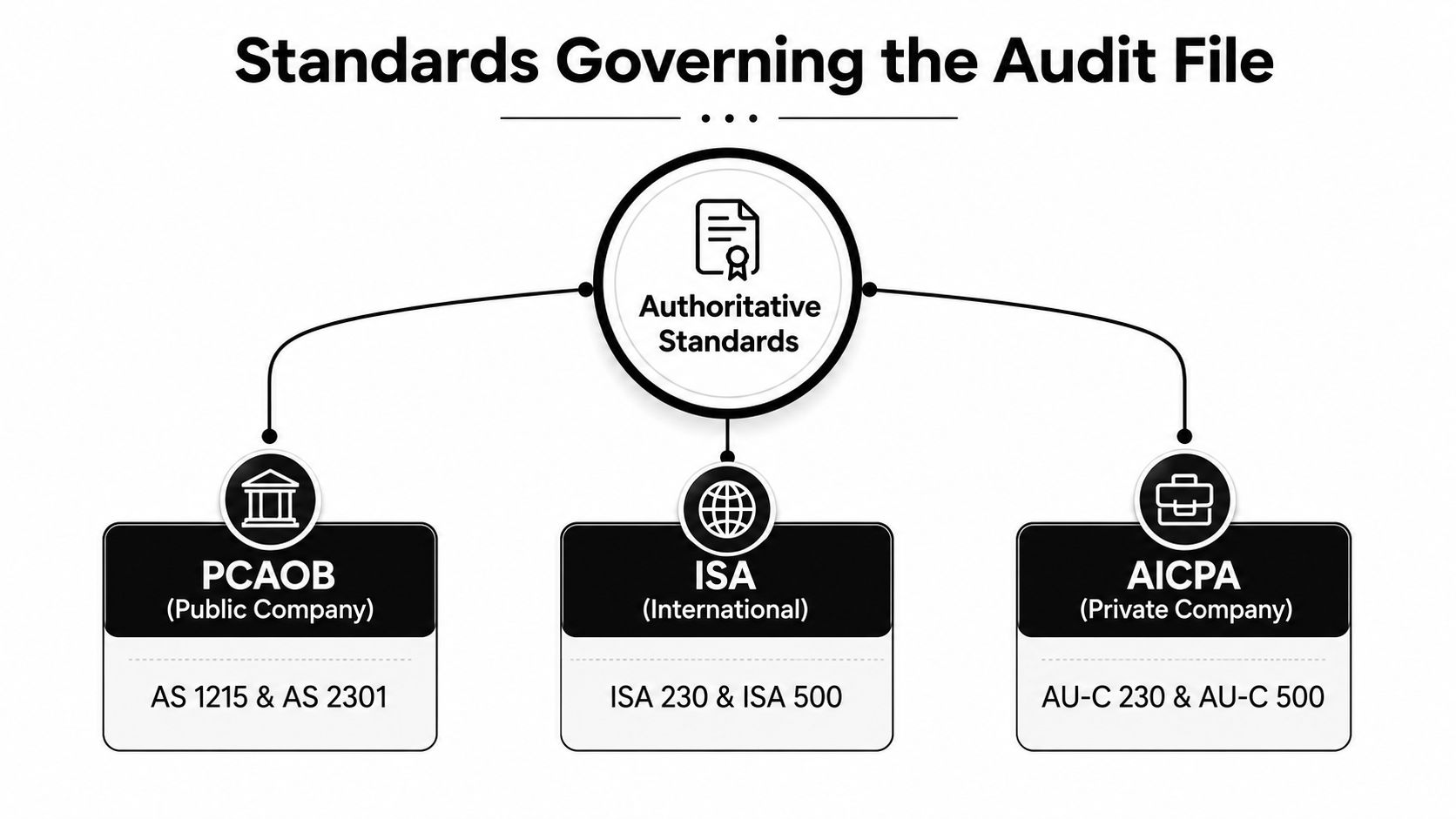
The clean way to read these standards is straightforward. AS 1215 emphasizes traceability and retention. ISA 230 emphasizes a file that can stand on its own. SAS 145 emphasizes the reasoning behind risk and control judgments. A firm serving 1040 clients may not sit under PCAOB audit rules, but the discipline carries over. The stronger the file reads as a decision record, the easier it is to defend when someone asks hard questions.
The Five Elements Every Audit File Must Contain
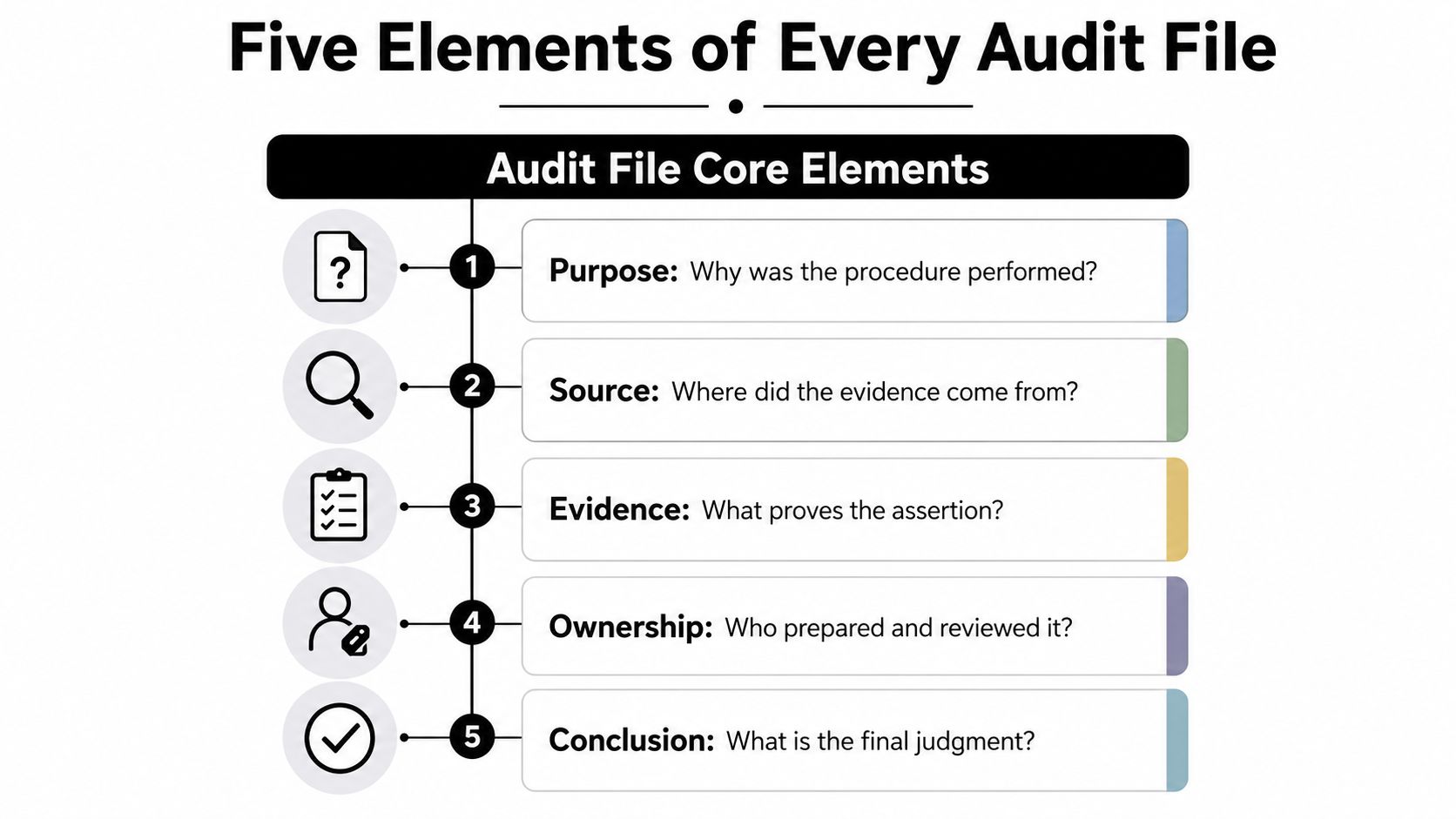
Purpose and source tell the reviewer why the paper exists
A reviewer should be able to answer two questions immediately. Why was this procedure done, and what source document did it rely on? A file that says “brokerage statement reviewed” is weak, because it doesn't explain whether the review was for income, basis, gain treatment, or a reconciliation to the draft return.
Evidence and ownership show how the conclusion was reached
The next layer is the actual proof and the person attached to it. A source page, a highlighted line, a calculation, or a cross-reference to the drafted return tells the reviewer what was used. The preparer name and reviewer name tell the reviewer who carried the responsibility.
A file without ownership is just information. A file with ownership is a record.
That distinction matters in high-volume 1040 work, where multiple people may touch the same return in one week. If a brokerage statement was used, the file needs to show which pages were checked, who checked them, and who validated the result before sign-off. If the work was reviewed by exception, the exceptions need to show what was not accepted blindly and why.
Conclusion closes the loop, but only if the path is visible
A conclusion by itself is not enough. “Accepted” is not a defensible conclusion unless the file shows what was accepted, what was checked, and what issue was resolved. The best files read like a chain of reasoning. The worst files read like a set of disconnected confirmations.
| Element | What the reviewer needs to see | What goes wrong when it's missing |
|---|---|---|
| Purpose | Why the procedure was performed | The support looks random |
| Source | Where the evidence came from | The file can't be tied to the return |
| Evidence | What actually proves the point | The conclusion feels unsupported |
| Ownership | Who prepared and reviewed it | No accountability trail exists |
| Conclusion | What judgment was made | The reviewer has to guess |
That chain is what survives scrutiny. Not volume. Not aesthetics. Just a file that can be read from source to conclusion without a side conversation.
Retention Timelines and the Timeliness Trap
A file can look complete and still fail the retention test. If the supporting PDFs are sitting in a portal but the audit record was assembled late, the reviewer is left with a record that is hard to trust. Storage and retention are different questions, and firms get into trouble when they treat them as the same thing.
The timeline depends on the standard
For PCAOB-regulated engagements, the file retention period is seven years. That comes from PCAOB AS 1215. For other assurance work, ASA 230 expects the file to be assembled on a timely basis and detailed enough that an experienced auditor can follow the work without prior involvement, and retention periods are commonly set by the applicable engagement rules and firm policy, often tied to the report date. The point is practical, not academic. A file has to stay available for the right period, and it has to be built in a way that still makes sense when someone opens it later.
For a U.S. firm that handles both regulated work and individual tax returns, the working rule is straightforward. Keep the file long enough for the governing engagement standard, and finish it early enough that the timeline itself still looks credible.
Timeliness is part of the evidence
Late assembly creates a quiet problem. Even when every support item eventually shows up, a file rebuilt at the end feels different from a file built while the work was happening. Reviewers see that difference fast because the timestamps stop reading like workflow and start reading like cleanup.
Documentation that is backfilled after the fact can be complete and still feel unreliable.
Contemporaneous notes carry more weight because they show the work in motion. In tax work, that means recording the decision while the return, source statement, and exception are still in front of the reviewer, not weeks later when memory has already blurred the details. Timeliness is often what makes a file believable, especially on high-volume 1040 work where the only files that survive scrutiny are the ones that tell a clear, source-linked story. A practical way to keep that trail intact is to build around a documented workflow, like the one described in best practices for document management.
Building an Audit-Ready Workflow Step by Step

Intake and validation need separate records
The first evidence point is intake. Source documents arrive, and the system or reviewer captures what was received, what was readable, and what was incomplete. Validation comes next, where extracted data gets compared to the source and any mismatch gets flagged before the drafted return is touched.
That split matters because intake is not the same thing as approval. A firm can receive a document and still reject it as incomplete or unusable. The record has to reflect both steps if the file is going to explain the final decision later.
Exception review strengthens the trail
The strongest files usually come from exception-based review, not line-by-line eyeballing. That sounds counterintuitive until you look at what gets left behind. Every item in the exception workflow is either resolved or consciously accepted, so the file naturally captures the handful of items that mattered.
If the reviewer touched every line equally, the trail often gets flatter. If the reviewer only documents exceptions, the file becomes easier to defend because each note marks a real decision. For firms trying to tighten their control environment, that is a major operational advantage.
Partner sign-off should be the last visible handoff
The partner step should not be a vague end-of-process stamp. It should show that the draft, the exceptions, and the final support were all visible before approval. A clean sign-off trail gives the reviewer a complete handoff sequence, which is exactly what external scrutiny wants to see.
Best practices for document management become much easier to enforce when the workflow itself produces the record. The point is not more paperwork. The point is a file that already contains the story of how the return got from intake to approval.
What Sufficient Documentation Looks Like in Real Returns
A weak file usually fails on one missing sentence, not on a dramatic error. The support is there, but the file doesn't show the decision path clearly enough for another reviewer to trust it.
W-2 and draft return mismatch
A W-2 arrives with Box 1 wages that don't match the draft return. The insufficient file says the return was checked and accepted. The sufficient file shows the W-2 page reference, the amount compared, the note on why the mismatch existed, and the reviewer's initials next to the final conclusion.
That's a tiny difference on paper, but a large difference in defense. One version says somebody looked at it. The other version shows what was looked at, what changed, and who approved the result.
1099-B and wash-sale adjustment
A 1099-B with a wash-sale adjustment is another common stress point. The weak file contains the brokerage statement and a handwritten “ok.” The stronger file identifies the statement page, the lot or transaction reference, the reasoning used to support the adjustment, and the final link to the drafted return.
Tax workpaper automation helps here because the source pages and the extracted data stay tied together instead of drifting into separate folders. When the evidence stays linked, the conclusion is much easier to defend.
Schedule C and home-office calculation
A home-office deduction depends on a square-footage calculation that can be explained, but only if the file records the method. The insufficient version has a number in the return with no supporting calculation. The sufficient version includes the dimensions used, the math, and the reviewer's confirmation that the calculation matches the claimed deduction.
The pattern is the same across all three examples. Sufficient documentation shows source, method, and conclusion. Insufficient documentation leaves one of those pieces out, and that missing piece is usually the one an examiner asks for first.
Documentation Failures That Survive Internal Review
Most bad files are not obviously bad. They pass an internal glance because somebody saw the return, saw the support, and moved on. External review is different because it asks whether the file can stand without explanations that live only in the reviewer's head.
- Unsigned review notes. The note exists, but nobody can tell who made the challenge or whether it was resolved.
- Findings filed to the wrong engagement. The support is real, but it belongs somewhere else, which breaks the chain of custody.
- Conclusions with no evidence trail. The file says the item was accepted, but it never shows what supported that acceptance.
- Reconciliations that prove math but not judgment. The numbers tie, but the reviewer still can't see why the treatment was right.
- Missing sign-off after a staffing change. A preparer leaves mid-engagement, and the file never clearly records the handoff or the final review.
Each of those failures survives because the internal reviewer already knows the backstory. An external reviewer doesn't. That's the test. If the file needs a memory, an email, or a hallway conversation to make sense, it's not ready.
Your Audit-Ready Checklist and Action Plan

| Requirement | Source Standard | File Artifact | Common Failure |
|---|---|---|---|
| Purpose | ISA 230, PCAOB AS 1215 | Procedure note or workpaper objective | Workpaper exists, purpose does not |
| Source | ISA 230 | Linked source page or statement reference | Source cannot be tied to the conclusion |
| Evidence | PCAOB AS 1215, ISA 230 | Highlighted support, calculations, extracted data | Support is present but not readable |
| Ownership | PCAOB AS 1215 | Preparer and reviewer sign-off trail | Nobody can tell who approved it |
| Conclusion | SAS 145, ISA 230 | Final judgment note with rationale | Acceptance without reasoning |
| Retention | PCAOB AS 1215, ASA 230 guidance | Controlled file archive | File is incomplete or inconsistently stored |
| Timeliness | ISA 230 | Dated, contemporaneous workpapers | File was rebuilt after the fact |
A workable 30-day plan is straightforward. Week 1, finalize the documentation standard and decide what the file must show on every engagement. Week 2, train the team on source linking, review notes, and sign-off discipline. Week 3, pilot the workflow on active returns and fix the gaps that show up. Week 4, lock the process and review the first completed file against the checklist above.
A firm knows the process is improving when three things get easier. Staff find the right item faster. Reviewers say “I don't remember” less often. The next mock file request comes back clean.
WP TieOut gives CPA firms a cleaner way to build the exact evidentiary trail audit reviewers ask for, from intake through partner sign-off. If you want source-linked workpapers, exception-based review, and a defensible audit history for 1040 files, visit WP TieOut and see how the workflow fits into your review process.