

Yes, a CPA can help with most tax problems, but the answer depends on whether your issue is accounting-driven, procedural, or legal. If you're staring at an IRS notice, a pile of missing records, or a return that doesn't match what the government says you filed, a CPA is often the first person I'd call.
You're probably not calm right now. You're trying to figure out whether this is a “fix the numbers” problem, a “deal with the IRS” problem, or a “get a lawyer involved now” problem. That distinction matters more than the license on the business card.
Table of Contents
- The Moment a Tax Problem Lands on Your Desk
- What a CPA Can Actually Do for Tax Problems
- Matching the Problem to the Right Practitioner
- Three Buckets of Tax Problems and Who Solves Them
- Documents and Steps to Prepare Before Hiring Anyone
- Two Tax Problems and How They Played Out
- Fees, Timelines, and Red Flags to Watch For
The Moment a Tax Problem Lands on Your Desk
The panic usually starts with a letter. Sometimes it's the IRS saying something doesn't match. Sometimes it's payroll records that don't tie out. Sometimes it's a 1099 you forgot about until the numbers hit your mailbox and your stomach dropped.
A client in that spot doesn't need theory first. They need a fast read on whether the problem is a bookkeeping error, a process problem, or a legal fight. That's the decision that determines who should touch the file next.
The trap most people fall into
The biggest mistake is assuming any tax professional can solve any tax issue. That's how people waste time, spend money twice, and miss deadlines while they're shopping for the wrong kind of help.
For paid tax advice and representation before the IRS, the recognized practitioner groups are attorneys, CPAs, and enrolled agents, while non-credentialed advisers generally can't represent taxpayers before the IRS in the same way, as noted in this discussion of who can help with nasty tax problems. That doesn't mean every CPA is the right choice. It means the license opens the door, but the problem type decides who should walk through it.
If you're already gathering records, start with an audit trail checklist so you don't hand over a half-baked file and pay someone to rebuild what you could've organized in one evening.
Practical rule: If the issue is “what happened to the numbers,” a CPA is usually in the conversation. If the issue is “what does the law say and what are the legal consequences,” you may need an attorney.
What I'd do in your seat is simple. I'd read the notice carefully, identify the tax years involved, and ask one blunt question, “Is this about records, procedure, or legal exposure?” That question saves more money than many realize.
What a CPA Can Actually Do for Tax Problems
A CPA is strongest when the problem starts with numbers, records, or a filed return that doesn't match reality. In practice, that means the CPA is often the person who untangles the mess before anyone else can negotiate intelligently with the IRS.
Where CPAs are genuinely effective
CPAs can reconstruct income from W-2s, 1099s, brokerage statements, prior-year returns, and IRS notices, then reconcile those records against what was filed. That's exactly the kind of work that resolves disputes rooted in documentation quality, not just legal argument, as described in this overview of CPA problem resolution.
That matters because IRS disputes often turn on whether the paper trail is clean. If income was missed, duplicate reporting slipped in, basis was misread, or deductions weren't supported, a CPA can usually identify the issue and clean up the filing position. CPAs also handle amended returns, correspondence audits, and many office audits, especially when the job is to explain the return with records the IRS can verify.
Where a CPA stops and someone else should take over
A CPA is not the person I'd send into Tax Court for a legal fight, and I would not rely on a CPA alone if there's criminal exposure. The same goes for legal strategy around bankruptcy, fraud allegations, or anything that needs courtroom advocacy rather than accounting repair.
A useful way to think about it is this. A CPA can often fix the return, explain the return, or support the return. A tax attorney is the one I want when the question becomes whether the IRS has a legal case, whether the government is threatening enforcement, or whether the stakes have moved beyond compliance.
The clean decision rule
If the problem is one of these, a CPA is usually the right first hire:
- Messy records that need reconstruction.
- Missing income or duplicated reporting.
- Amended returns after an error.
- Audit response where the issue is documentation.
- Financial statements needed for a tax resolution file.
If the problem is one of these, stop treating the CPA as the final answer:
- Fraud allegations.
- Criminal investigation.
- Tax Court deadlines.
- Legal defense against lien, levy, or prosecution.
A CPA can still help in the background, but the legal side should be handled by an attorney. If you want a clean filing system before the next round of notices, a tax support package can help a preparer keep the file organized and defensible.
Matching the Problem to the Right Practitioner
I don't tell taxpayers to “get a tax pro” because that advice is lazy. The right hire depends on what kind of fire you're putting out, and the wrong hire can make the problem more expensive.
Which practitioner fits which problem
| Practitioner | Best For | Can Represent at IRS | Typical Fee Range | Limitations |
|---|---|---|---|---|
| CPA | Reconstructing returns, missing documents, amended filings, audit support | Yes | Varies by complexity | Not every CPA does resolution work |
| Enrolled Agent | Routine IRS notices, installment agreements, collections work | Yes | Varies by complexity | Less useful when records need deep reconstruction |
| Tax Attorney | Legal disputes, fraud, criminal exposure, Tax Court | Yes | Varies by case | Usually overkill for a simple records issue |
The point isn't that one professional is “better” in general. It's that each one solves a different class of problem. A CPA is usually the best fit when the file is a mess of numbers, source documents, and prior filings that need to be rebuilt before anyone can talk intelligently to the IRS.
My blunt recommendation
If your problem is mostly accounting-driven, start with a CPA. If your problem is mostly procedural and you need help dealing with notices or collections, an enrolled agent may be a better value. If the government is threatening legal consequences, don't shop for the cheapest credential, get a tax attorney.
That same logic is why the audit risk guide matters only after you know what kind of issue you're fixing. A lot of people try to prevent tomorrow's audit while today's return is still broken.
Real-world shortcut: If you can describe the problem in terms of missing forms, mismatched records, or an amended return, you're probably in CPA territory. If you're talking about summonses, appeals, or court, you're moving into attorney territory.
The hard truth is that people often hire too early or too late. Too early, and they pay a specialist for a simple notice. Too late, and they spend months with the wrong professional while the deadline keeps moving.
Three Buckets of Tax Problems and Who Solves Them
A tax problem looks confusing until you name the type of problem. Once you do, the hire decision gets much easier, and you stop paying the wrong person to do the wrong job.
Accounting driven problems
These are the cases CPAs handle best. The IRS may be asking about missing income, basis errors, unsupported deductions, duplicate reporting, or a prior-year mistake. The fix is usually to rebuild the return, match the source records to the filed numbers, and show why the original filing was wrong or incomplete.
That is records work. The taxpayer often wants a strong negotiator, but the case usually calls for someone who can trace the numbers back to the source and rebuild the file in a way the IRS will accept.
Procedural problems
These problems are about process, not the underlying math. Installment agreements, payment plans, lien questions, levies, notices, and collection correspondence all fit here. A CPA or enrolled agent with resolution experience can often handle these cases efficiently, especially when the facts are already clear and the issue is how the IRS will collect.
Many taxpayers lose money by hiring a lawyer after receiving a scary notice, only to discover the issue is administrative. Unless the case has moved beyond collection paperwork, that step is unnecessary.
Legal problems
This bucket includes fraud allegations, criminal referral risk, Tax Court petitions, and disputes where the law itself is the battlefield. A tax attorney belongs here. A CPA may still help gather records or support the case, but the lead role needs to sit with someone who can give legal advice and defend the matter.
The Cato Institute analysis on the tax gap points to IRS customer service, technology, employee training, and code simplification as part of the broader administrative mess. Don't let the label "tax problem" obscure the actual issue. If the case is really about reconstruction, procedure, or law, you need to know that before you hire anyone.
Bottom line: If you cannot tell which bucket you are in, start with a CPA who does resolution work and ask for a straight answer on whether the case belongs with them or needs a lawyer.
People hate this part because it feels like extra work. It is cheaper than hiring the wrong person, and it keeps you from handing a simple accounting mess to a lawyer or a legal fight to someone who cannot fight it.
Documents and Steps to Prepare Before Hiring Anyone
The first consultation goes better when you bring the right paperwork. Without it, you pay a professional to chase basic facts you could've organized yourself.
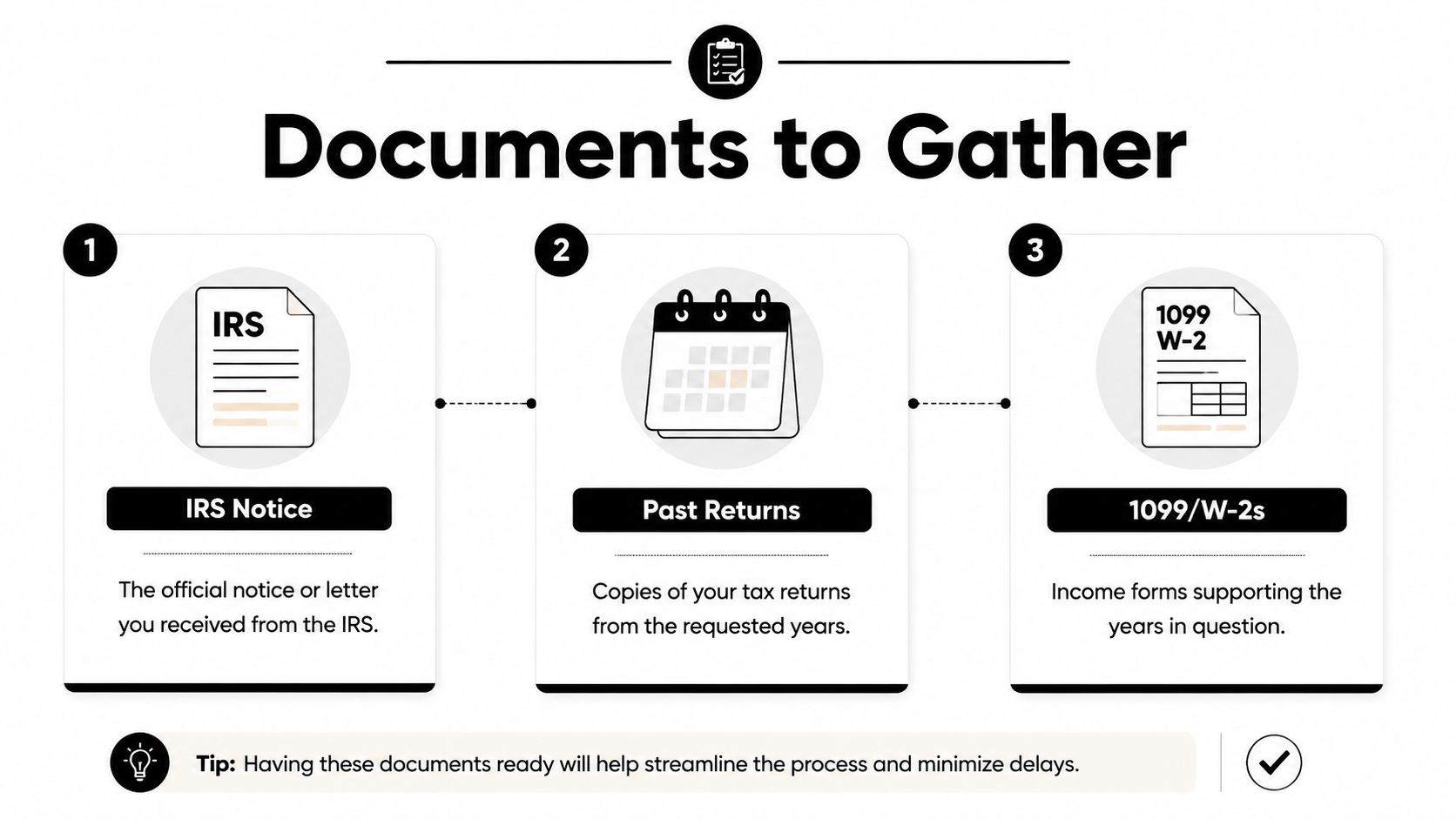
What to gather first
Bring the full IRS notice, not just the first page. Also gather the tax years involved, W-2s, 1099s, K-1s, brokerage statements, bank statements, prior returns, payment records, and any correspondence already exchanged with the IRS. If you've already talked to someone at the IRS, write down the date, the name if you have it, and what was said.
What to do before the first call
- Stop ignoring the deadline. Deadlines don't get better with delay.
- Write a one-page summary. Keep it factual. What happened, when it happened, what you've received, and what you think is wrong.
- Request the IRS transcript. That tells you what the IRS thinks it has on file.
- Confirm representation with Form 2848. If someone's going to speak for you, make sure they can legally do it.
A client who shows up prepared usually gets a sharper answer in the first meeting. A client who shows up with a shoebox of mixed papers gets a longer bill.
What I'd do tonight if this were my problem
I'd make a folder, separate each tax year, and put every notice and statement in date order. Then I'd send the summary to the CPA before the appointment so they can tell me whether I need a resolution specialist, a general CPA, or a lawyer.
A little organization changes the whole conversation. It moves the meeting from “what is going on?” to “here's what needs to happen next.”
Two Tax Problems and How They Played Out
A freelancer once came in with two years of unreported 1099 income and a stack of bank deposits that didn't line up cleanly. A CPA reconstructed the income from source records, filed amended returns, and handled the IRS back-and-forth until the file was cleaned up. That kind of case is squarely in CPA territory because the problem was numbers, records, and return repair.
The second case looked similar at the beginning and turned ugly fast. A small business owner under a sales tax audit thought the issue was just a filing error, but the facts started pointing toward potential fraud exposure. The CPA didn't pretend that was still a simple resolution job, they brought in a tax attorney before the matter escalated further.
Why the outcomes diverged
The freelancer needed reconciliation, documentation, and amended filings. The business owner needed legal triage. Same broad topic, very different professional response.
That's the whole point of asking whether a CPA can help with tax problems. The answer is yes, but only when the work matches the problem. If the issue is accounting-driven, a CPA can save you from guessing, overpaying, and making the records worse. If the issue crosses into legal danger, the CPA should be part of the team, not the only person on the file.
The decision I'd make in each seat
If I were the freelancer, I'd hire a CPA who handles resolution and ask for a reconstruction plan. If I were the business owner, I'd still want a CPA involved, but only after a tax attorney was on board and the legal risk was identified.
Don't let the label “tax problem” hide the real issue. Numbers problems get fixed one way, collection problems another, and legal problems another again.
That's why generic advice fails. It tells you who can help in theory, but not who should help first.
Fees, Timelines, and Red Flags to Watch For
A CPA handling tax resolution work usually bills by complexity, and the work takes time. You're not buying a same-day answer, you're buying someone who can sort the records, diagnose the issue, and build a defensible response.

What to expect from the hire
The work should be measured in weeks or months, not promises made in a 10-minute sales pitch. The fastest resolutions come from clients who hand over complete records on day one and answer follow-up questions quickly.
The biggest red flags are easy to spot. If someone guarantees an outcome, demands full payment before doing any real analysis, or brushes off signs of legal exposure, walk away. Existing guidance notes that not all CPAs specialize in tax resolution, and that tax attorneys may be better suited for serious disputes, liens, garnishments, or criminal exposure, which is why the problem type has to come first, not the credential, as discussed in this tax debt guidance piece.
The three questions I'd ask in the consultation
- Have you handled this exact type of problem before?
- Do you see this as accounting, procedural, or legal?
- If this should go to a lawyer, will you say so now?
If the answers sound vague, keep looking. A good CPA doesn't pretend every tax problem belongs in a CPA's lap.
My advice is simple. Book one paid consultation with a CPA who does resolution work, bring the documents, ask those three questions, and make the hire only if the case fits their skill set.
A CTA for WP TieOut. If you're a CPA or preparer handling messy 1040 files, use WP TieOut to reconcile source documents against drafted returns, surface discrepancies by exception, and keep a source-linked audit trail from intake through sign-off.