

Most firms talk about audit risk as if it starts with aggressive positions, gray areas, or unusual fact patterns. That's incomplete. In 2021, the IRS sent nearly 16 million automated notices for math errors on individual tax returns, making mathematical accuracy the largest initial trigger for audit-related scrutiny on individual filings, according to Northern Trust's discussion of IRS audit risks.
That number changes the conversation. The first threat to a tax practice usually isn't exotic tax law. It's ordinary breakdowns in intake, reconciliation, review, and documentation. A missing 1099, a transposed figure, a brokerage subtotal that doesn't tie, a reviewer who signs off without seeing the source. Those are process failures. They create notices, rework, partner time, and sometimes a much broader examination than the return ever deserved.
If you want to know how to reduce audit risk in a CPA firm, start at the operating model. Partner review matters. Technical training matters. But neither fixes a weak system. Firms reduce risk when they stop treating quality control as an individual habit and start running it as a standardized, traceable workflow.
Table of Contents
- The Real Source of Audit Risk in Your Firm
- Building a Modern Risk Reduction Framework
- Fortifying Your Intake and Validation Process
- Implementing a Review-by-Exception Workflow
- Creating an Indisputable and Searchable Audit Trail
- The Technology That Powers Modern Tax Review
The Real Source of Audit Risk in Your Firm
The biggest controllable risk in most tax practices isn't tax analysis. It's detection risk from preventable mistakes.
A firm can have strong technical people and still generate avoidable notices because the workflow lets bad inputs travel too far downstream. By the time a reviewer sees the return, the file may already be carrying missing source documents, unverified imports, unsupported overrides, and workpapers that don't tie to the draft. Review turns into cleanup. That's expensive, and it's inconsistent.
Detection risk starts before review
When a return is flagged over a simple mismatch, the root cause usually isn't a lack of tax knowledge. It's one of these operational failures:
- Incomplete intake: The firm never received all source documents before preparation began.
- Weak validation: Numbers were transferred without systematic reconciliation to source.
- Reviewer overload: A senior had to eyeball too many pages and missed a critical exception.
- Thin documentation: The file doesn't show what was checked, by whom, or when.
Those failures compound. A preparer rushes because documents arrive late. A reviewer scans instead of verifies because the binder is disorganized. A partner signs off based on trust instead of evidence because there's no clean exception report.
Practical rule: If your review process depends on a tired human proving that everything is correct, your process is carrying more risk than your tax positions.
Firm-level risk is structural
This is why individual preparer checklists only go so far. They help conscientious people. They don't create consistency across teams, offices, or filing deadlines. A firm-level control framework does that.
The goal isn't more review hours. It's a workflow that prevents weak files from reaching final sign-off. That means standard intake requirements, automated validation against source documents, reviewer focus on actual discrepancies, and a record that proves the work happened. Firms that build around those controls reduce noise first. That's usually where the biggest risk reduction sits.
Building a Modern Risk Reduction Framework
Most guidance on audit risk stays at the preparer level. It tells staff to be careful, document support, and follow filing rules. That's necessary, but it doesn't solve the operating problem inside the firm. As Netsurit notes in its discussion of audit risk, manual workpaper-to-return checks show a 21% error rate for paper returns versus 0.5% for e-filed returns, and most guidance still doesn't explain how firms should institutionalize review-by-exception.

Why checklists stop short
A checklist is a reminder. A framework is a system.
The difference matters during busy season. Checklists often rely on memory, discipline, and local habits. One manager requires source tie-out before review. Another tolerates open items in email. One office names files consistently. Another doesn't. Eventually, the same type of return gets reviewed three different ways.
That's not quality control. That's personal style.
If you want a measurable process, define the workflow in a way that survives turnover and deadline pressure. Firms that track quality control metrics for tax review workflows usually find the same thing. Review quality rises when every file moves through the same gates.
The four pillars that actually change outcomes
A workable framework has four pillars.
| Pillar | What it does | What it replaces |
|---|---|---|
| Intake controls | Require complete source collection before prep moves forward | Chasing documents mid-review |
| Automated validation | Reconcile extracted data to source and return structure | Manual copying and visual matching |
| Review by exception | Push reviewer attention to discrepancies only | Line-by-line confirmation of correct entries |
| Dynamic documentation | Build a searchable sign-off record as work happens | Static folders with weak evidence trails |
A few operational points matter here.
Intake controls should function like a gate, not a suggestion. If a return needs W-2s, 1099s, brokerage statements, and prior-year carryforward support, the file shouldn't enter review until those items are present or formally noted as pending.
Automated validation belongs before human review, not after it. Reviewers shouldn't spend expensive time catching transfer errors that software can surface faster and more consistently.
Review by exception changes staff economics. Seniors and managers stop spending their best hours proving that correct numbers are correct. They investigate the handful of items that don't reconcile.
Dynamic documentation protects the firm later. When a notice arrives or a peer reviewer asks how the return was checked, the file should answer the question without a forensic reconstruction project.
Firms don't reduce audit risk by asking people to try harder. They reduce it by making the right process the default process.
Fortifying Your Intake and Validation Process
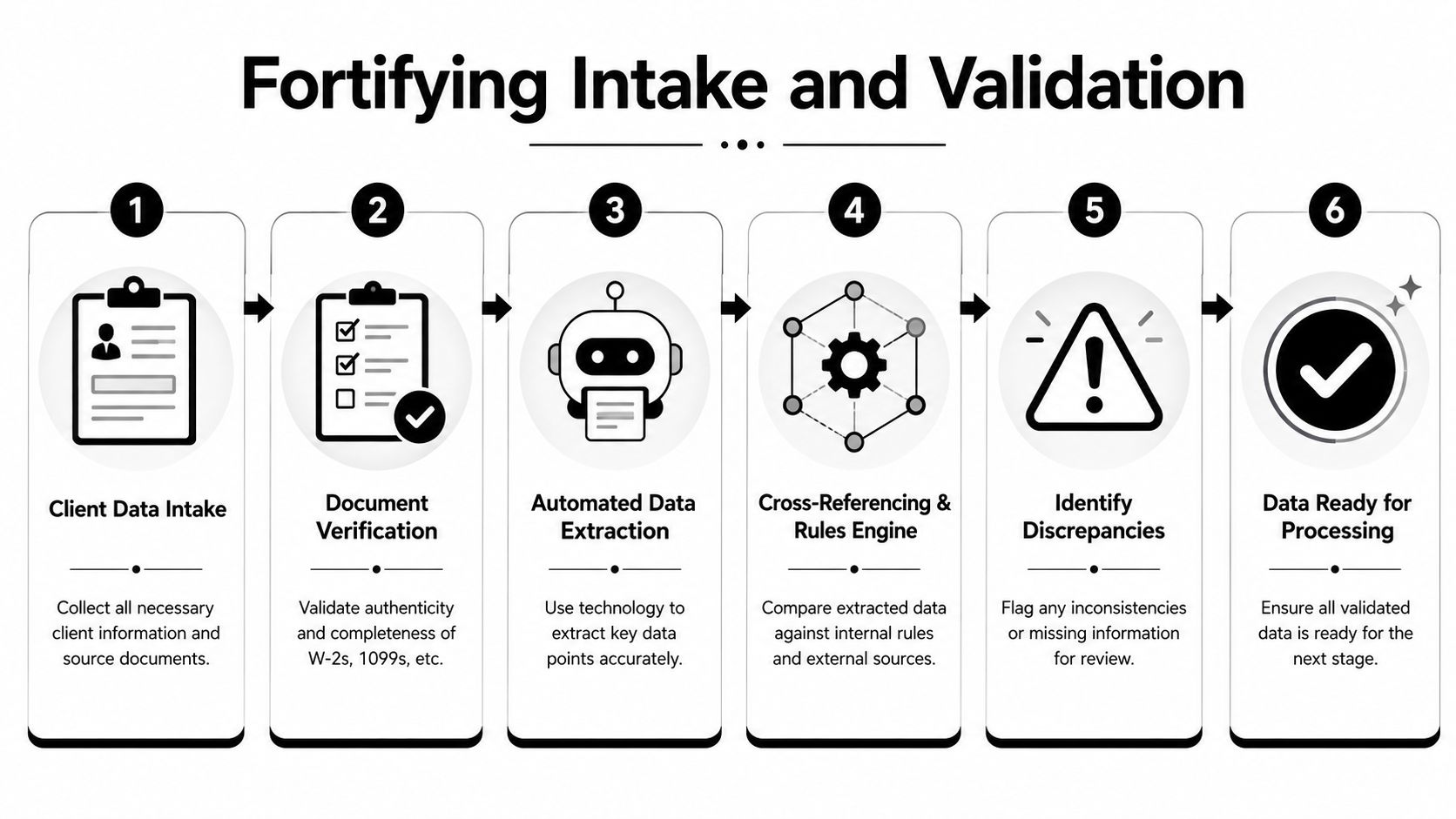
Most avoidable tax review problems begin before technical review starts. The intake packet is incomplete, the source files are unlabeled, the brokerage statements are partial, or the preparer starts drafting before all forms are in. Once that happens, the rest of the workflow gets weaker.
The practical fix is simple. Tighten intake, then validate every extracted figure against source before a reviewer opens the file.
What the old process gets wrong
Many firms still rely on visual reconciliation. A preparer keys or imports data, prints or saves the draft return, and someone else compares it against PDFs on another screen. That method feels thorough because it's labor intensive. It isn't.
According to the My CPE guide on first-time audit success, 85% of IRS automated notices in 2021 were for simple math errors or omitted forms that automated reconciliation systems can detect with near 100% accuracy, while manual review misses 15% to 20% of such discrepancies due to cognitive fatigue. That aligns with what tax reviewers already know from experience. The tenth brokerage page gets less attention than the first. The second review of the day is sharper than the eighth.
A human reviewer is still essential. But human attention is too valuable to spend on basic transfer verification if a system can perform that step first.
What a stronger intake standard looks like
Strong intake is rigid in the right places. It doesn't mean making clients miserable. It means making file status unmistakable.
A good intake standard usually includes:
- Required document classes: W-2s, 1099s, brokerage statements, K-1s, organizer responses, prior-year support, and any special item support must be identified up front.
- Naming discipline: Staff should be able to tell what a file is without opening it.
- Completeness status: Every return should show whether intake is complete, incomplete, or complete with documented exceptions.
- Open-item tracking: Missing forms shouldn't live in inboxes. They need a visible status in the file.
The easiest way to create review waste is to start preparing from a maybe-complete document set.
That's why intake should be owned operationally, not casually. Someone has to decide that the file is ready for prep. If nobody owns that gate, everybody assumes someone else checked it.
Where automation belongs
Validation is where firms can make the fastest operational improvement. Software should ingest source documents, extract the key fields, and compare those figures to the drafted return and workpapers before review begins. For firms evaluating document validation software for tax workflows, the important question isn't whether the tool looks modern. It's whether it surfaces real mismatches and preserves the source support.
Here's a side-by-side view:
| Manual validation | Automated validation |
|---|---|
| Reviewer scans forms line by line | System compares extracted data to draft return |
| Errors are found only if a person notices them | Discrepancies are surfaced consistently |
| Review quality varies by workload and fatigue | Validation runs the same way every time |
| Support is scattered across PDFs and notes | Source linkage stays attached to the item |
The best use of automation is narrow and concrete. It should catch omitted forms, mismatched values, unsupported entries, and tie-out breaks. It should not pretend to replace tax judgment on substantive positions.
That distinction matters. Firms don't need software to decide whether a legal conclusion is defensible. They do need software to prove that a W-2 wage amount on the return matches the W-2 in the file.
Implementing a Review-by-Exception Workflow
Once intake and validation are stable, the review model has to change. Otherwise the firm pays for automation and still runs the file like it's paper.
A review-by-exception workflow means the system checks routine consistency first, then the reviewer focuses on items that need judgment.

How the work should move
This model works best when roles are explicit.
- Preparer loads and drafts the file. The preparer gathers the source documents, confirms intake status, prepares the return, and pushes the file into validation.
- System validates and flags exceptions. The workflow identifies mismatches, missing source support, extraction issues, and return-to-workpaper breaks.
- Reviewer clears exceptions. The reviewer works the flagged items only, resolves them, and documents the resolution.
- Partner signs off at a higher level. The partner confirms that the file is complete, that exceptions were resolved, and that the return's substantive positions make sense.
That structure sounds simple because it is. The complexity comes from discipline. Reviewers have to trust the system enough to stop rechecking every clean item manually. Partners have to require documented exception resolution, not verbal reassurance.
What reviewers should stop doing
The old review habit is familiar. Open source documents on one screen, open the draft return on another, and verify line after line. That consumes senior time and encourages shallow review because the reviewer is busy proving routine facts.
Reviewers should stop doing three things:
- Reperforming data entry checks that a validated system already completed.
- Hunting through folders for support that should have been linked to the item.
- Accepting unresolved notes because “the preparer knows the client.”
What should replace that work is a narrower, better use of expertise.
- Investigate why an amount doesn't tie.
- Confirm that omitted forms were actually omitted and not misclassified.
- Review overrides, assumptions, and unusual treatments.
- Escalate genuine judgment calls to the partner.
A short walkthrough is often more useful than a written policy alone, especially for firms adopting this model for the first time.
How partner sign-off changes
Partner review should get shorter and stronger at the same time.
A partner shouldn't be doing staff-level tie-out work. The partner should be asking different questions:
| Partner question | Why it matters |
|---|---|
| Was the file validated against source? | Confirms the base data was checked systematically |
| What exceptions were raised? | Shows where risk actually existed |
| How were they resolved? | Establishes whether the file is defensible |
| Who signed off and when? | Creates accountability inside the firm |
A clean review-by-exception process doesn't lower standards. It raises them by making every unresolved issue visible.
That's how to reduce audit risk operationally. Don't ask expensive reviewers to inspect every inch of a file. Ask them to resolve the issues that matter and leave evidence that they did.
Creating an Indisputable and Searchable Audit Trail
A saved PDF folder isn't an audit trail. It's storage.
That distinction becomes painful when a client receives a notice or the firm has to answer a peer reviewer's question months later. If the file contains source documents, an unsigned workpaper, some email threads, and a final return, the firm may know the work was done. Proving it is harder.
Saved PDFs are not an audit trail
Documentation fails in predictable ways. Support exists but isn't linked to the entry. The reviewer's note was resolved in chat, not in the file. The partner approved the return verbally. A revised form replaced an earlier one, but nobody can tell which version was reviewed.
That's why documentation quality drives so many findings. According to SearchInform's discussion of audit risk assessment, 68% of audit findings stem from documentation gaps or unverified assumptions, and mainstream guidance rarely explains how workflows should create an exportable, time-stamped record showing who checked what and when.
A defensible file has to answer those questions without relying on memory.
What a defensible file needs
A modern audit trail should contain more than archived documents. It should preserve the chain between source, return, review, and approval.
The essentials are straightforward:
- Source-linked support: A reviewer should be able to trace a figure back to the original form quickly.
- Time-stamped actions: The file should show when validation happened, when exceptions were cleared, and when approval occurred.
- Role-based sign-off: Preparer, reviewer, and partner actions should be distinct.
- Version clarity: The file should show which source and which draft were under review.
- Exportability: If the firm needs to produce the file outside the system, it should remain readable and organized.
For firms refining audit trail best practices for tax engagements, the biggest mindset shift is this. Documentation shouldn't be assembled after the work. It should be created by the workflow itself.
What firms should be able to produce on demand
If a notice arrives, a well-run firm should be able to produce a single package that shows the source documents, the reconciled amounts, the exceptions identified, the notes that resolved them, and the sign-off record.
That package should be searchable. It should be readable by someone who didn't work on the file. It should also be clean enough that a partner can review the history without opening six different systems.
Your documentation should let an outsider reconstruct the review without calling the reviewer.
That standard sounds strict. It should be. When documentation is weak, the firm spends partner time recreating decisions that were already made correctly. When documentation is strong, the file does most of the talking.
The Technology That Powers Modern Tax Review
Technology doesn't reduce audit risk by itself. Bad processes run through better software are still bad processes. But once a firm has the right operating model, technology becomes the layer that makes it consistent.
Technology is the operating layer
The right platform connects the four controls that matter most in tax review.
It starts with intake, where documents are captured in a consistent way. It continues with validation, where extracted values are checked against source and compared to the drafted return. It then supports review by exception, where preparers, reviewers, and partners each see the issues relevant to their role. Finally, it preserves the evidence, so the file carries its own history.
That matters because firms don't fail on isolated tasks. They fail in the handoffs.
A preparer may know a form is pending. A reviewer may assume it was received. A partner may believe the mismatch was cleared. If the workflow doesn't unify those steps, the firm is relying on memory and good intentions.
What to look for in a platform
When a CPA firm evaluates tax review technology, the decision should come down to operating fit.
Look for a platform that can:
- Ingest common 1040 source documents such as W-2s, 1099s, and brokerage statements
- Validate extracted data against the drafted return
- Surface true discrepancies instead of flooding the reviewer with noise
- Support role-based handoffs for preparer, reviewer, and partner
- Generate a source-linked, exportable record with timestamps and sign-offs
Avoid tools that only decorate the old process. A prettier checklist isn't a new control. A shared folder with comments isn't a defensible review system. The platform should change how the work moves, not just where the files sit.
Firms asking how to reduce audit risk often start by looking for one more review step. In practice, the better answer is a redesigned workflow supported by software that makes consistency automatic.
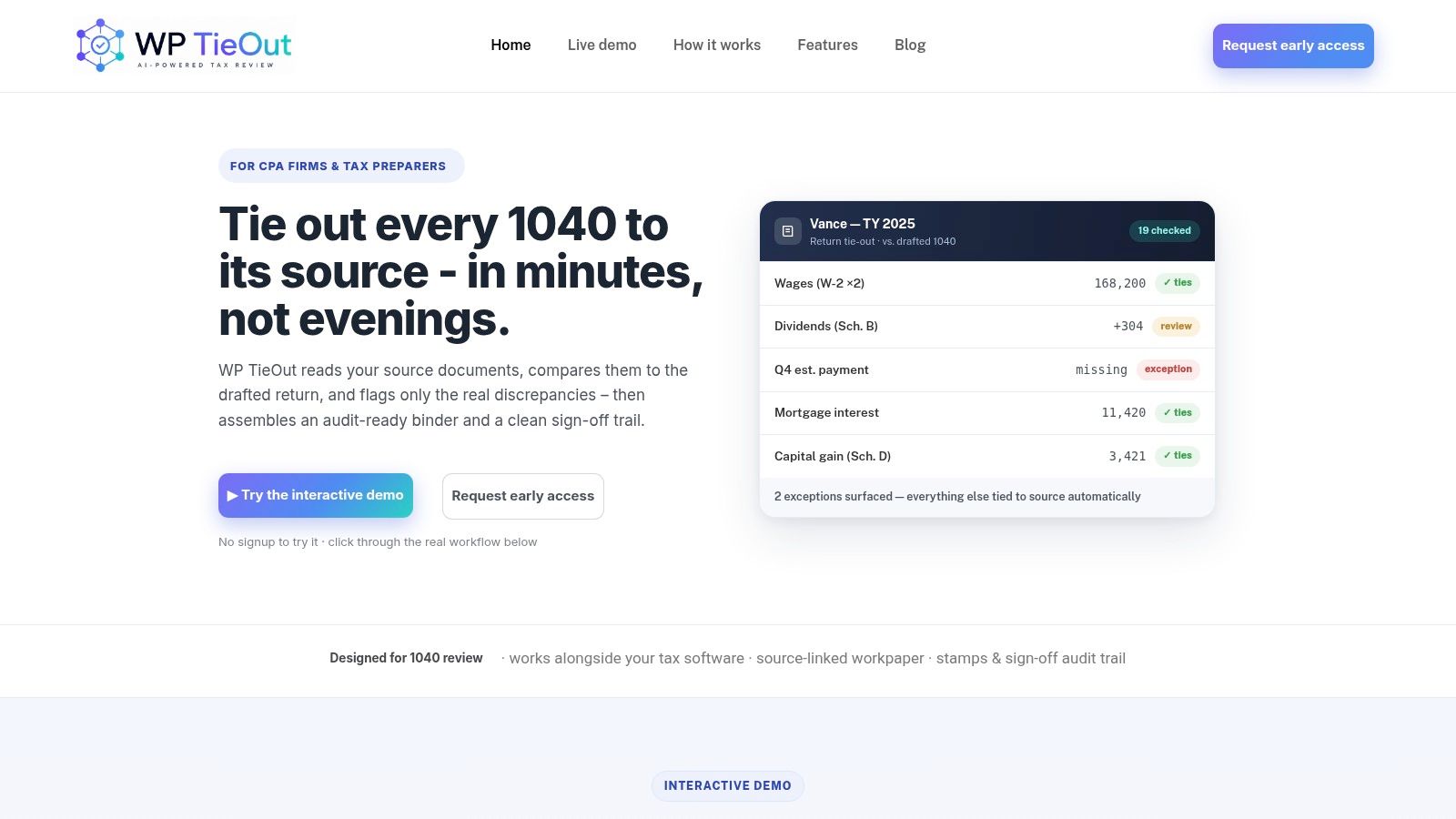
If your firm wants a practical way to tighten intake, validate source documents against drafted returns, run review by exception, and preserve a searchable sign-off history, WP TieOut is built for that workflow. It's designed for CPA firms and tax preparers handling 1040 review at scale, with AI-powered reconciliation, source-linked binders, and role-based review from preparer through partner sign-off.