

A preparer finishes a draft 1040 and marks it ready for review. The reviewer opens the file, can't find the brokerage statement that supports a reported amount, and sends a message asking whether the document was ever received. The preparer searches through folders, the reviewer moves to another return, and a partner eventually waits for an answer that nobody recorded in the engagement file.
The team is working, but the return isn't moving. That distinction sits at the center of how to improve team efficiency in tax review. Faster individual effort won't fix unclear ownership, fragmented source documents, repeated questions, or review queues filled with work that should have been validated earlier. CPA firms improve throughput when they redesign coordination first, then use automation to reinforce the redesigned workflow.
Table of Contents
- Why Tax Teams Lose Efficiency in the Handoffs
- Measure the Work Before Changing It
- Redesign Roles and Review Handoffs
- Build a Balanced Efficiency Scorecard
- Use Automation for Review by Exception
- Lead Adoption and Train for Consistency
- Execute a 90-Day Efficiency Plan
Why Tax Teams Lose Efficiency in the Handoffs
The delay usually starts at a transition. A preparer completes the return but doesn't identify which source pages were validated, which assumptions changed, or which items still need judgment. The reviewer receives a status label rather than a usable decision record. Instead of reviewing exceptions, the reviewer reconstructs the preparer's process.
That reconstruction creates several forms of invisible work:
- Searching: The reviewer looks across portals, folders, email threads, and chat messages for supporting documents.
- Rework: The preparer repeats checks that should have been completed before the handoff.
- Clarification: The reviewer asks questions that could have been answered in the workpaper.
- Interruption: A partner is pulled into an issue before the team has defined the actual decision.
- Risk exposure: Each undocumented transition makes it harder to confirm whether an item was missed or left unresolved.
The result is visible activity without equivalent progress. A growing review queue may look like a capacity problem, but the underlying constraint could be inconsistent binders or incomplete intake. Repeated questions may look like a training problem, yet the firm might lack a required handoff format. Reviewers who recheck everything may appear cautious, while spending their limited attention on low-risk items and leaving less time for complex judgment.
The team workflow management guidance from WP TieOut reflects a practical principle, the workflow has to make responsibility and status visible at each stage. A reviewer should know who prepared the return, what evidence was checked, what changed since the prior version, and what remains open without searching through informal conversations.
Practical rule: A handoff is complete only when the next person can act without recreating the previous person's work.
Meeting design matters for the same reason. A 2012 study on workplace meetings found that functional interaction, especially problem-solving discussion and action planning, was associated with higher meeting satisfaction, stronger team productivity, and better organizational success later on. The same research linked unstructured meetings with poorer satisfaction, productivity, and performance. For tax teams, a short huddle that defines an issue, assigns an owner, and records the next action is more useful than a broad status meeting that creates more follow-up.
These warning signs point to a diagnosis problem before they point to a technology problem. The firm needs to measure where time disappears, which handoffs create rework, and whether reviewers are spending attention on genuine exceptions or avoidable searching.
Measure the Work Before Changing It
A reviewer opens a return marked “ready,” then spends the first part of the review locating missing documents, checking whether source validation occurred, and reconstructing what changed. The return may show little active review time, yet its elapsed cycle time grows because attention is consumed by searching and clarification. Measure that coordination load before changing roles or buying automation.
Start with one workflow, not the whole firm. Select a representative group of 1040 returns covering the usual range of source-document complexity, preparer experience, reviewer involvement, and partner approval. Define the boundaries, such as source package received to final sign-off, so preparation effort is not confused with total elapsed time.
Record waiting time and active work separately. Queue time shows how long a return waits before action. Active preparation and review time show the effort required after work starts. Rework records how often an item returns because the package or decision was incomplete. First-pass acceptance shows whether the next role can proceed without rebuilding the prior step.
A pilot log can remain small. Use the engagement tracker where possible, and add only fields that will support a process decision:
- Return type and complexity category
- Preparer, reviewer, and approving partner
- Date and time of each stage transition
- Active preparation and review time
- Number and category of rework loops
- First-pass acceptance status
- Open exceptions and resolution time
- Missing-source or client-response delays
- Sign-off completion and override notes
Separate lost time by stage. Intake, source validation, preparation, review, handoff, correction, and approval require different remedies. If information hunting dominates, improve source organization and traceability. If corrections dominate, strengthen preparation checks. If approval queues dominate, define which judgments require partner attention and which decisions reviewers can resolve.
A practical pilot baseline
| Measure | How to Capture It | Efficiency Signal |
|---|---|---|
| Queue time | Record timestamps when work enters and leaves each queue | Long waits indicate routing or capacity friction |
| Active review time | Use reviewer time entries or a lightweight pilot log | Rising time may indicate poor handoff quality or excessive review scope |
| First-pass acceptance | Mark whether the next role accepts the package without return | Low acceptance points to incomplete inputs or unclear standards |
| Rework | Record each return-to-sender event and reason | Repeated causes identify process defects worth standardizing |
| Exception resolution | Track open date, owner, decision, and close date | Aging exceptions may reflect unclear authority or missing evidence |
| Source completeness | Record missing documents and late arrivals | Gaps at intake create downstream review interruptions |
| Sign-off completeness | Check preparer, reviewer, and partner records | Missing history weakens control and makes approval status uncertain |
APQC's survey provides a useful reference for measuring coordination costs. It found that the average worker spent 30 of 40 weekly hours on productive work, while internal communication consumed 3.6 hours per week, information searching 2.8 hours, and unnecessary meetings 2.2 hours. The findings, reported in APQC's survey on lost knowledge-worker time, support tracking communication, searching, and meetings as operational categories instead of treating them as unavoidable overhead.
Interpret the results by role. A preparer's output depends on complete inputs and uninterrupted production time. A reviewer's throughput depends on package quality, exception complexity, and decision authority. A partner's work centers on judgment and approval, so raw return volume says little about performance.
Use rolling 90-day averages rather than one unusually busy week. Set the next target only 5–10% above the measured baseline, consistent with the benchmark guidance in the APQC process measurement discussion. The baseline should yield a short diagnosis, such as “source completeness and reviewer searching are the primary constraints,” rather than a dashboard no one uses. Automation can then address a measured bottleneck, while review by exception protects reviewer attention instead of adding another layer to an overloaded handoff.
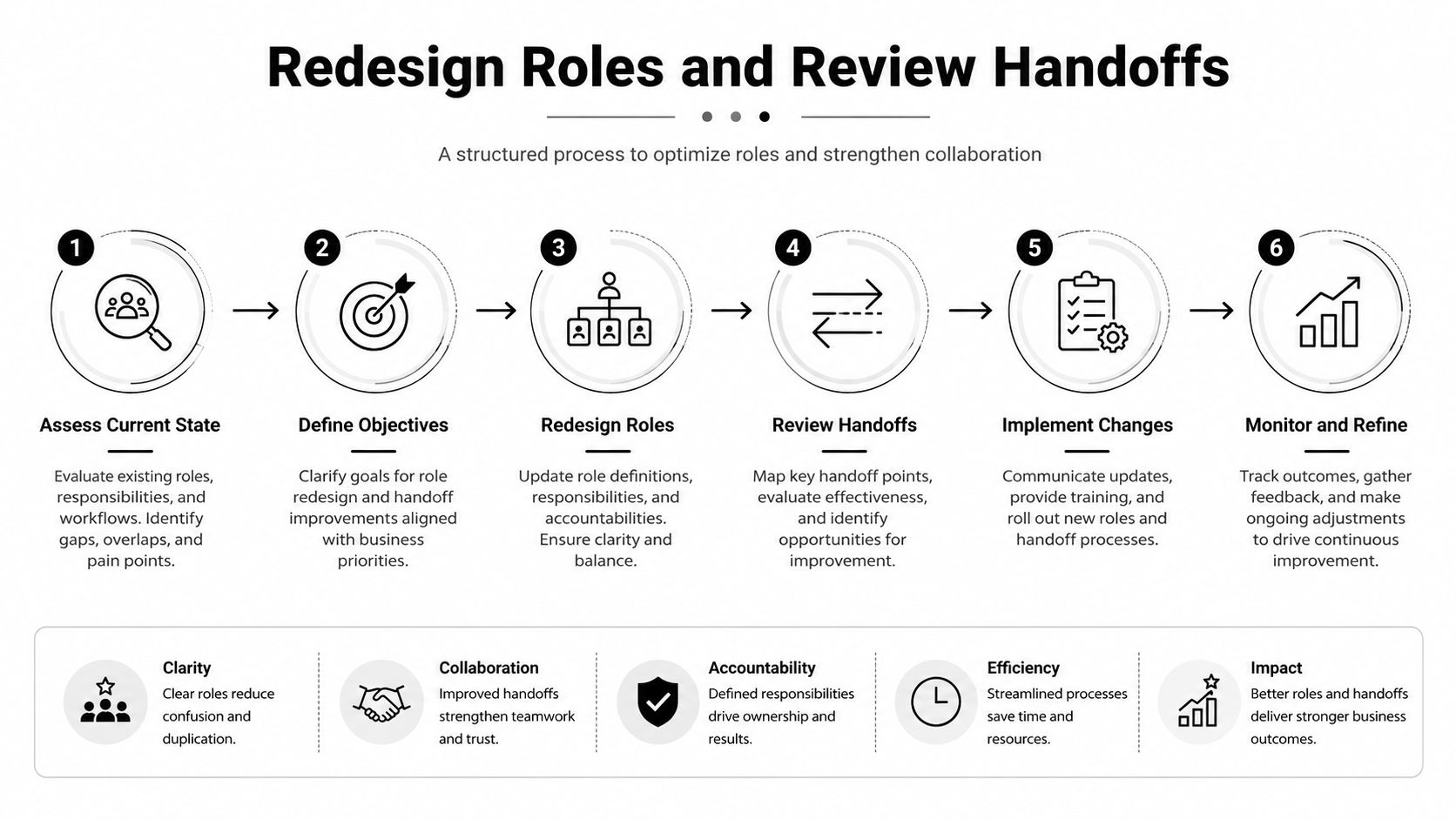
Redesign Roles and Review Handoffs
A reliable handoff answers five questions before work moves:
- What inputs are complete?
- What output has been produced?
- Who makes the next decision?
- When must that decision occur?
- What happens if the package is incomplete?
For a 1040 return, source validation should happen before a reviewer compares source documents with the drafted return. The preparer should identify received documents, missing items, unusual facts, and changes from the prior process. The reviewer should receive unresolved discrepancies, not a second assignment to locate and validate the entire source package.
Define each role at the transition
The preparer owns completeness of the prepared package and explains unresolved items. The reviewer owns technical investigation of routed discrepancies, documents the resolution, and returns incomplete work under a defined condition. The partner owns final approval decisions that require judgment or carry firm-level risk.
A label such as “ready for review” isn't enough. The handoff record should show:
- Inputs: Source documents received, missing, or excluded
- Checks completed: Validation steps and preparation checks performed
- Changes: Amendments, unusual items, or material judgment points
- Exceptions: Discrepancy, evidence, assigned owner, and current state
- Next action: Decision required and expected completion point
- Approval: Reviewer conclusion and partner sign-off where required
Use one canonical record. Don't let the official status live in the engagement tracker while the actual explanation sits in a private chat thread. Informal messages can support collaboration, but the final decision, evidence, and ownership belong in the controlled file.
Protect attention with explicit return conditions
A return-to-sender rule prevents reviewers from absorbing incomplete work. Examples include missing source pages, unexplained manual changes, absent annotations, or an exception without a proposed next action. The rule should be consistent, but it shouldn't become a rigid excuse to reject work that needs professional judgment.
Set service expectations by role and workload pattern. Preparers need protected production blocks and a clear intake cutoff. Reviewers need defined response windows for ordinary exceptions and a separate escalation path for urgent matters. Partners need a concise approval view that separates routine acceptance from unresolved risk.
Microsoft's meeting and collaboration findings describe a coordination environment in which 57% of meetings are ad hoc calls without a calendar invite, and one in ten scheduled meetings are booked at the last minute. The practical implication for tax operations is not to eliminate responsiveness. It's to define when an issue belongs in the queue, when it requires a live conversation, and who records the decision.
Build a Balanced Efficiency Scorecard
Managers need evidence that work is moving faster without shifting risk to another stage. A return completed quickly with incomplete documentation is a control failure, not an efficiency gain. A reviewer who closes many items by accepting weak evidence may improve a local metric while increasing firm exposure.
Build the scorecard around four perspectives:
- Flow: Cycle time, queue age, work in progress, and wait time at each stage
- Quality: First-pass acceptance, rework reasons, discrepancy resolution, and missed-item findings
- Workload: Reviewer capacity, interruption patterns, exception volume, and service levels by role
- Control: Source traceability, complete sign-offs, access exceptions, overrides, and export history
Every measure needs an owner and a response. If queue age exceeds the agreed operating band, the manager checks routing and reviewer capacity. If first-pass acceptance falls, the workflow owner examines intake and preparation defects. If overrides increase, the technical lead determines whether thresholds are too broad, too narrow, or misunderstood.
Separate targets from breach thresholds
A target describes normal performance. A breach threshold starts an investigation. For example, reviewers may have an expected response window for ordinary discrepancies, while unresolved items or missing source evidence require escalation.
Compare similar cohorts. A wage-only return should not be measured against a return with brokerage activity, rental information, or unusual adjustments. Segment work by return type and complexity, then compare performance at the same workflow stage.
The quality control metrics framework from WP TieOut gives teams a way to assess quality and control alongside throughput. Use the scorecard to answer practical questions: Where is work waiting? Which role receives the most avoidable interruptions? Which exception categories recur? Can the firm show who checked an item, what evidence supported the decision, and when approval occurred?
Manager's test: If a metric improves while rework, missed discrepancies, or undocumented overrides worsen, the team has moved risk rather than improved efficiency.
Review the scorecard over a rolling 90-day period to account for seasonal variation, using consistent benchmarking guidance. Keep the measures limited enough to drive action. A small group of connected indicators is more useful than a broad report that no owner reviews.
Use Automation for Review by Exception
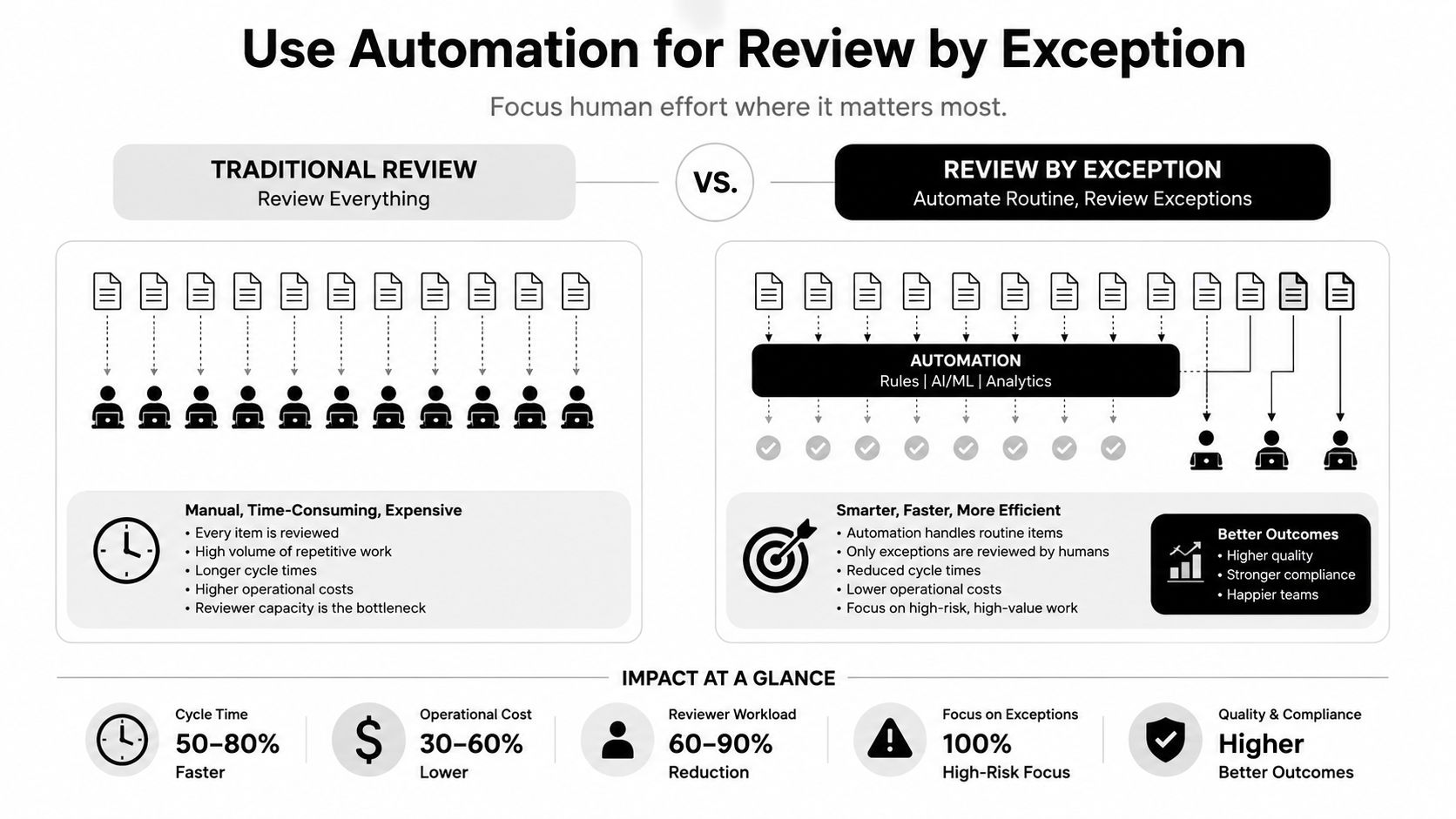
Line-by-line review feels safe because it gives the reviewer constant visibility. It also forces the reviewer to spend equal attention on routine matches and meaningful discrepancies. That model can hide the actual risk, because the reviewer's attention is spread across the entire return instead of concentrated where evidence and judgment diverge.
A review-by-exception workflow changes the control model. Source documents are ingested, extracted values are validated, and the validated workpaper is compared with the drafted return. The system routes genuine discrepancies for human review while preserving source-page traceability and a record of each decision.
Validation must come before comparison. If extracted data is wrong or the source set is incomplete, an automated comparison can create false confidence. The workflow should therefore distinguish among a confirmed match, a genuine discrepancy, an unresolved item, an incomplete source set, and a rejected or overridden result.
Keep professional judgment in the loop
Automation is appropriate for repetitive activities such as extraction, matching, bookmarking, stamping, status changes, and audit-log creation. A qualified reviewer still needs to interpret an exception, assess whether the source evidence supports the drafted amount, and decide whether the issue reflects a preparation error, a legitimate difference, or a fact requiring partner attention.
WP TieOut is one contextual example of an AI-powered tax review platform that compares a drafted return with validated workpaper and source-document information, surfaces discrepancies for review, compiles a source-linked bookmarked PDF binder, and preserves preparer, reviewer, and partner sign-off history. Firms should evaluate any platform against their own source sets, controls, access requirements, and exception behavior. The WP TieOut AI workflow automation overview describes this type of workflow without replacing the firm's professional responsibility.
Test the workflow before expanding it. Include complete and incomplete source packages, ordinary matches, ambiguous documents, duplicate pages, manual overrides, and exceptions that require escalation. Track false positives, false negatives, rejected flags, accepted flags, and cases where a reviewer bypasses the queue. These tests reveal whether the issue belongs in the extraction logic, discrepancy rule, checklist, training, or role design.
Decide how each condition moves
| Workflow Condition | Primary Role | Required Action |
|---|---|---|
| Source set is incomplete | Preparer | Identify the missing item, document the follow-up, and prevent unsupported comparison |
| Validated value matches the draft | System with reviewer oversight | Record the match and retain the source-page reference |
| Validated value differs from the draft | Reviewer | Investigate evidence, document the resolution, and correct or accept with rationale |
| Discrepancy requires judgment beyond reviewer authority | Partner | Decide, document the conclusion, and preserve approval history |
| Extraction or matching result is uncertain | Reviewer | Inspect the source, classify the result, and record an override when necessary |
| Exception remains unresolved | Assigned owner and partner as required | Escalate through the defined path instead of leaving the item in informal chat |
Review by exception isn't a shortcut that removes oversight. It is a structured way to direct oversight toward risk while making routine validation traceable.
Lead Adoption and Train for Consistency
A redesigned workflow fails when staff treat it as optional. Preparers may continue sending informal messages, reviewers may bypass the exception queue, and partners may approve from an incomplete summary if nobody explains the reason for the new controls.
Start with a representative pilot rather than a firm-wide mandate. Select workflow owners for intake, preparation, review, partner approval, and system configuration. Explain the operational problem each rule addresses, such as missing source pages, repeated searches, unclear escalation, or incomplete sign-off. Staff are more likely to follow a control they understand than one presented as another administrative burden.
Train by responsibility
Preparers need practice assembling complete source packages, recording missing items, and explaining unusual facts. Reviewers need practice investigating discrepancy flags, distinguishing evidence problems from legitimate differences, and documenting decisions. Managers need to understand thresholds, overrides, queue health, and cohort comparisons. Partners need a concise approval view that shows unresolved risk without forcing them through routine matches.
Run live testing with a checklist:
- Source completeness: Confirm every expected document is present or marked missing.
- Validation: Check extracted values against the original pages.
- Matching: Compare validated workpaper values with the drafted return.
- Exception routing: Confirm each discrepancy reaches the correct role.
- Binder organization: Verify pages, bookmarks, stamps, and annotations.
- Decision states: Test acceptance, rejection, unresolved, and override outcomes.
- Sign-off: Confirm each required role records its decision.
- Export history: Verify the final record preserves the review trail.
Hold feedback huddles around recurring defects, not personal blame. Ask which rule failed, which input was missing, whether the exception logic was understandable, and whether the handoff required information the prior role didn't have. Record corrections so the team can update the checklist, routing rule, or training material.
Troubleshoot adoption without lowering the control
Excessive false positives may indicate an over-sensitive rule or poor source normalization. Missing source pages may indicate an intake problem rather than an automation problem. Reviewers bypassing the queue may signal that the queue is too slow, unclear, or disconnected from the engagement file.
Watch whether staff complete the handoff fields, whether exceptions receive owners, whether unresolved items escalate, and whether sign-offs remain complete. If speed improves while documentation weakens, pause expansion and correct the workflow. Consistency matters more than a fast rollout.
Execute a 90-Day Efficiency Plan
A practical implementation can move through four controlled phases:
- Diagnosis: Establish the baseline, map every handoff, segment returns by complexity, and identify the largest sources of queue time, searching, rework, and interruption. The decision gate is a clear constraint statement.
- Redesign: Assign role ownership, define required handoff fields, set exception thresholds, and establish source-linked documentation. The decision gate is a complete workflow that can be tested without relying on memory.
- Pilot: Train a limited team, run representative returns, compare results with the baseline, and review misses, overrides, and incomplete packages. The decision gate is evidence that quality and sign-off controls remain intact.
- Expansion: Standardize the working process, publish the scorecard, monitor adoption, and schedule quarterly reviews. Expand only after the team can explain both the gains and the remaining risks.
Use illustrative measures rather than unsupported claims. A before-and-after comparison might show fewer repeated document searches, shorter routine reviewer handling time, stronger first-pass acceptance, and a complete sign-off history. Reviewer time per return may fall while exception-review time rises, and that can represent a healthy shift when attention moves from routine matching to unresolved judgment.
A useful manager checklist is straightforward:
- Can every transition identify an owner and next decision?
- Can reviewers trace exceptions to source pages?
- Are incomplete packages returned consistently?
- Are similar returns compared in similar cohorts?
- Do speed measures sit beside quality and control measures?
- Can the partner see unresolved risk and complete approval history?
- Does the team review defects and adjust rules without hiding misses?
Teams are ready to scale when work moves predictably, reviewers focus on meaningful exceptions, partners retain clear authority, and the audit trail remains complete. Efficiency means less coordination waste, not less professional care.
WP TieOut provides an AI-powered tax review workflow that validates source documents, compares workpapers with drafted 1040 returns, routes discrepancies for review by exception, and preserves source-linked binders with preparer, reviewer, and partner sign-off history. Visit WP TieOut to explore the workflow and evaluate whether it fits your firm's handoff, review, and control requirements.