
Peak season rarely fails because a reviewer can't read a tax return. It fails because the reviewer must compare a drafted 1040 against W-2s, 1099s, K-1s, brokerage statements, and client correspondence one line at a time, while chasing missing documents and documenting decisions for a partner. By the time the return reaches final review, the queue is full, the source files are scattered, and “tie-out complete” may mean little more than a second person glanced at the numbers.
That's why a useful reconciliation software comparison for tax firms must start somewhere other than bank feeds and general ledgers. The question is whether a platform can validate source documents, identify meaningful discrepancies, route exceptions, preserve evidence, and support accountable sign-off on a drafted 1040.
Table of Contents
- Why CPA Firms Need a Different Comparison Lens
- The Shifting Evaluation Standard in Reconciliation Software
- Six Criteria That Separate Real Review Tools from Generic Reconciliation Platforms
- Weighted Scoring That Actually Predicts Reviewer Throughput
- Sample RFP Questions to Send Every Vendor
- Operational KPIs and ROI Math for 1040 Review
- Governance, Audit Trails, and the Limits of Faster Matching
- Matching the Right Tool to Your Firm and Next Steps
Why CPA Firms Need a Different Comparison Lens
Most reconciliation platforms were designed around a relatively structured problem. They compare bank activity, subledger entries, or general-ledger balances, then apply matching rules based on amounts, dates, references, and tolerances. That model works well when records are consistent and the principal task is deciding whether two financial entries represent the same transaction.
A 1040 review has a different shape. A preparer may receive a W-2 with one employer name, a brokerage statement with another account label, and a client-provided explanation that changes how an item should be treated. The reviewer must assess not only whether values agree, but whether the correct source document supports the correct return field, whether a duplicate or amended statement exists, and whether a judgment call has been recorded for the next reviewer.
Practical rule: If the software can reconcile transactions but can't show the source page, reviewer decision, and partner approval, it isn't a complete 1040 review solution.
A senior reviewer should therefore evaluate tools in this order:
- Exception-based review: Can the platform remove cleared items from the reviewer's queue and expose only unresolved differences?
- Source-linked workpapers: Can every conclusion point back to the original PDF, scan, or document page?
- Reviewer accountability: Can the firm see who checked an item, what they changed, when they did it, and who approved the result?
- Tax workflow fit: Does the tool understand forms, schedules, withholding, basis, and return fields, or does it treat everything as generic transactions?
- Handoff control: Can preparers, reviewers, and partners work from one evidence trail instead of exchanging spreadsheets and email?
Generic platforms often optimize for transaction volume and matching speed. Tax reviewers need context, provenance, and judgment support. A green dashboard is useful only when the firm can explain why each item cleared and reproduce that explanation later.
This guide treats the decision as a framework rather than a vendor scoreboard. A product that dominates bank-to-book reconciliation may be the wrong purchase for a firm whose bottleneck is drafted-return review. Conversely, a purpose-built 1040 tool won't replace a broad finance platform when the firm's primary workload involves trust accounts, client ledgers, or balance-sheet close.
The Shifting Evaluation Standard in Reconciliation Software
A reconciliation product can match transactions accurately and still fail a 1040 review. The market was estimated at USD 2.53 billion in 2024 and projected to reach USD 7.54 billion by 2033, with a 13.1% compound annual growth rate from 2025 to 2033, according to market coverage of reconciliation software and AI in accounting. Buyers now compare platforms by automation, workflow control, integration, and evidence preservation, not by spreadsheet replacement alone.
Accounting firms have raised that standard through wider automation and AI adoption. A 2025 survey of 700 US accounting professionals reported that 95% of accounting firms had adopted at least one automation technology in the prior year, while 46% used AI daily. The same research stream reported AI adoption in accounting firms rising from 9% in 2024 to 41% in 2025 (accounting and finance AI adoption research). It also estimated finance-function AI adoption at 37% in 2023 and 59% in 2025.
The buying question has changed. A system must classify messy inputs, reduce the reviewer's queue, explain suggested matches, and preserve the evidence behind each decision. For drafted-return review, that means document lineage, exception context, override history, and a sign-off trail that a partner or inspector can follow.
| Evaluation Dimension | Legacy Priority | Current Priority |
|---|---|---|
| Matching | Exact or tolerance-based transaction matching | Context-aware matching across source documents and return fields |
| Automation | Volume processed | Exceptions removed from the reviewer's queue |
| Integrations | Bank, ERP, and ledger connectivity | 1040 workpaper, document, and tax-preparation connectivity |
| Review | Reconciliation status dashboard | Source-linked review-by-exception workflow |
| Controls | Completed or incomplete status | Reviewer attribution, comments, timestamps, and approval history |
| Reporting | Balance and exception totals | Evidence packs that another reviewer can replay |
| AI | Suggested matches | Explainable classification, duplicate detection, and controlled human override |
Comparison models support this shift toward measurable substance. One 2026 ranking model assigned 40% of its score to features, with ease of use and value receiving 30% each (reconciliation software scoring framework). For a tax firm, features should mean exception routing, source linkage, traceability, integration, and reusable controls, not a longer checklist.
Generic finance platforms remain appropriate for high-volume bank, ledger, trust-account, or close workflows. A purpose-built 1040 review tool is the stronger choice when the firm's constraint is drafted-return review and partner approval. The practical test is direct: can the reviewer defend every clearance, locate its source, and show who approved it?
Six Criteria That Separate Real Review Tools from Generic Reconciliation Platforms
A generic reconciliation platform can look impressive in a demo because matching is easy to show. The harder test is whether the platform supports the decisions a 1040 reviewer makes.
Review-by-exception depth
Look for configurable tolerances across income, withholding, basis, and other return-relevant fields. The reviewer should be able to focus on unresolved discrepancies instead of reopening every document.
A red flag is a fixed matching rule that treats a small amount difference the same way as a missing form or an unexplained basis change. Generic platforms often offer tolerance settings, but they may be designed for ledger amounts rather than tax-form context.
Source-linked workpapers
Every cleared item should connect to the originating source page. A reviewer shouldn't have to open a document folder, search for a statement, and manually confirm which page supported the decision.
Ask to see the final workpaper, not just the dashboard. If the output contains totals without page references, annotations, or original-source preservation, the firm will still spend time reconstructing evidence during a peer review or examination.
Sign-off and accountability
The system should record preparer, reviewer, and partner activity with timestamps and comments. It should distinguish an automated suggestion from a human approval and retain the reviewer's override when the suggested result is rejected.
Generic platforms often show that an account was completed. That's not enough for a tax firm. A partner needs to know who resolved an exception and why.
AI-assisted document classification
A tax review tool should help classify common document noise, including duplicate statements, amended forms, and inconsistent names. It should support human confirmation rather than converting uncertain matches into accepted facts.
Demand examples using real or representative W-2 and 1099 variations. A vendor that demonstrates only clean, standardized records hasn't tested the difficult part of your workflow.
Integration with 1040 workpapers
Bank and ERP connectors don't solve a drafted-return review problem. The platform must work with source documents, validated workpapers, return fields, and the firm's preparation process.
Firms evaluating a tax-focused workflow can review the 1040 reconciliation automation capabilities from WP TieOut alongside broader platforms. The comparison should focus on where the reviewer works, where evidence lives, and how the final approval is recorded.
Audit-ready evidence export
Require an export that another reviewer can follow without access to the vendor's interface. It should preserve source documents, page references, annotations, exception history, user attribution, and sign-off events.
| Criterion | Generic Finance Reconciliation Platform | 1040-Specific Review Tool, such as WP TieOut | Use-Case Fit for Tax Firms |
|---|---|---|---|
| Matching unit | Ledger, bank, or subledger transaction | Source document against drafted return field | 1040 tool fits return review |
| Exceptions | Amount, date, or reference mismatch | Income, withholding, basis, document, and return-field discrepancy | 1040 tool exposes tax-relevant risk |
| Evidence | Reconciliation record and attachments | Source-linked workpaper with document lineage | 1040 tool supports review defense |
| Roles | Preparer and approver for account tasks | Preparer, reviewer, and partner handoffs | 1040 tool fits CPA review layers |
| AI use | Transaction matching and anomaly suggestions | Document classification and return comparison | 1040 tool fits messy tax inputs |
| Output | Account status or close report | Review binder and sign-off history | 1040 tool supports peer review |
| Best fit | Bank-to-book and finance close | Drafted 1040 quality control | Choose based on queue composition |
Weighted Scoring That Actually Predicts Reviewer Throughput
An unweighted checklist rewards products that collect features, not products that remove work from the reviewer's queue. Use the independent 40/30/30 model as a starting point: assign 40% to features, 30% to ease of use, and 30% to value, as described in the reconciliation software ranking methodology. For a tax firm, translate those categories into operational terms instead of copying the labels.
I recommend this scorecard:
- 40% exception-based review depth: document classification, field-level comparison, configurable tolerances, duplicate detection, exception routing, and reviewer overrides.
- 30% evidence and workpaper usability: source links, page-level references, annotations, prior-period support, export quality, and ease of reviewer navigation.
- 30% controls and integration value: role-based access, preparation and review handoffs, partner approval, tax-system connectivity, implementation effort, and total operating cost.
Score each area using the same evidence standard. A vendor receives a high score only after demonstrating the function with representative documents, not after describing it in a sales call.
For a smaller firm with a single dominant review bottleneck, exception depth should decide the result. Vendor A might handle tax-document comparison and produce source-linked exceptions cleanly, while Vendor B might offer broader finance integrations but force reviewers back into spreadsheets. A side-by-side feature list could call Vendor B more thorough. The weighted score should favor Vendor A if the firm's actual constraint is 1040 review time.
A larger multi-partner firm should score governance more aggressively within the controls and integration category. A platform that saves reviewer clicks but can't show partner approval, override history, and exportable evidence creates a control gap. That gap can outweigh a polished interface or a broader connector library.
Make demo scoring difficult to manipulate
Use a shared worksheet and require every vendor to answer the same prompts:
- Show a duplicate and an amended statement.
- Show a mismatch in withholding.
- Show a basis-related exception.
- Show a reviewer override.
- Export the completed evidence trail.
- Demonstrate preparer-to-reviewer-to-partner handoff.
Record whether each result was automatic, suggested, or manual. Track how many screens the reviewer opened and whether the source page stayed attached to the decision. Firms can use quality-control metrics for tax review workflows to define the measurements before the demo rather than letting vendors choose flattering success criteria.
Sample RFP Questions to Send Every Vendor
Send the same questions to every vendor, and score the responses against the weighted model. Don't accept “yes” as an answer. Require a demonstration, a sample export, or a written description of the control behavior.

Exception handling
- Can administrators configure exception rules by form, schedule, field, document type, and risk category?
- Can the system distinguish a missing document from a value mismatch?
- Can reviewers change or override a suggested match while preserving the original suggestion and reason?
Hard-coded rules expose a demo shortcut. Ask the vendor to change a tolerance live and show how that change affects the queue.
Processing latency
- What is the processing time per return under normal conditions?
- How does the system handle delayed feeds, large brokerage files, scanned documents, and reprocessing?
- What happens when extraction confidence is low?
Don't ask only for an average. Ask how the vendor measures the start and end points, and whether the stated time includes validation, comparison, and workpaper generation.
Source-document preservation
- Does the final workpaper preserve the original document pages?
- Are page references, annotations, and document versions retained?
- Can the firm export the complete evidence package without vendor assistance?
A PDF that contains only extracted values is not a source-linked workpaper. Require a sample binder using representative W-2 and 1099 files.
Audit-trail granularity
- Does the log record every automated match, manual clearance, override, comment, and approval?
- Are timestamps and user identities retained?
- Can the firm distinguish preparer, reviewer, and partner actions?
Ask the vendor to show an exception from intake through final approval. That exposes whether the audit trail is a real workflow record or merely a completion status.
Role-based access
- Can administrators separate preparer, reviewer, partner, and administrative permissions?
- Can firms restrict access by client, engagement, or workflow stage?
- Are review and approval responsibilities assignable without sharing credentials?
Role design matters because a fast workflow becomes a weak control if the same user can prepare, clear, and approve without meaningful separation.
Security and compliance
- Does the vendor maintain SOC 2 coverage relevant to the proposed service?
- How does the platform align with IRS Publication 4557 safeguards?
- Where is data stored, and how is it protected in transit and at rest?
- What happens to client data when the contract ends?
Security responses deserve the same scoring discipline as feature responses. A vendor that can't provide clear documentation on access controls, retention, incident handling, and data export shouldn't receive a high value score merely because its matching demo looks efficient.
Operational KPIs and ROI Math for 1040 Review
A vendor's automation rate does not establish value. A CPA firm needs its own baseline, a defined review population, and a measurement method that captures both speed and review quality.
Track auto-match rate, exception rate, time per exception, cycle time, manual match rate, and aged open items. Define matching accuracy as matched records divided by eligible records, exception rate as the share of partially matched or unmatched items, and cycle time as the period from data upload through final sign-off. The operational reconciliation KPI guidance also supports using real transaction data in a pilot and comparing baseline periods before accepting vendor claims.
For drafted 1040 review, add two tax-specific measures:
- Reviewer minutes per return: Count time from assignment through completed review, including source-document lookup, exception analysis, and rework.
- Partner sign-off hours: Measure time partners spend resolving unclear exceptions, reviewing overrides, and reconstructing evidence before approval.
The capacity model should separate cleared items from genuine exceptions. Start with total review hours, then estimate how much work leaves the reviewer queue after automation. An automatic clearance counts as a saving only when it remains accurate and source-supported. False positives create rework, while an exception without document context can take longer to resolve than a manually cleared item.
| Metric | Baseline, No Tool | Scenario A, 60% Auto-Match | Scenario B, 85% Auto-Match |
|---|---|---|---|
| Eligible review items | 1,200 returns' eligible items, measured by the firm | Same pilot population | Same pilot population |
| Automatically cleared items | Established through baseline review | 60% of eligible items, measured in the pilot | 85% of eligible items, measured in the pilot |
| Remaining exceptions | Baseline exception population | 40% of eligible items, before false-positive review | 15% of eligible items, before false-positive review |
| Reviewer time | Current minutes per return | Actual pilot minutes per return | Actual pilot minutes per return |
| Partner review | Current sign-off hours | Pilot sign-off hours | Pilot sign-off hours |
| ROI calculation | Baseline hours × loaded cost | Reduced hours × loaded cost, less tool cost | Reduced hours × loaded cost, less tool cost |
Treat the table as a test design, not a forecast. Populate it with the firm's return population, reviewer time, loaded labor cost, implementation cost, subscription cost, and rework burden. Compare the results across two to three baseline periods so the firm can measure late reconciliations, aged items, and post-close adjustments rather than relying on a sales claim.
Run the pilot by document type and return complexity. A tool may handle clean W-2s effectively while producing more exceptions on brokerage statements or amended forms. Judge the result by the reduction in reviewer minutes without a corresponding increase in missed issues, false positives, or unexplained overrides. That is the ROI measure that matters for 1040 review.
Governance, Audit Trails, and the Limits of Faster Matching
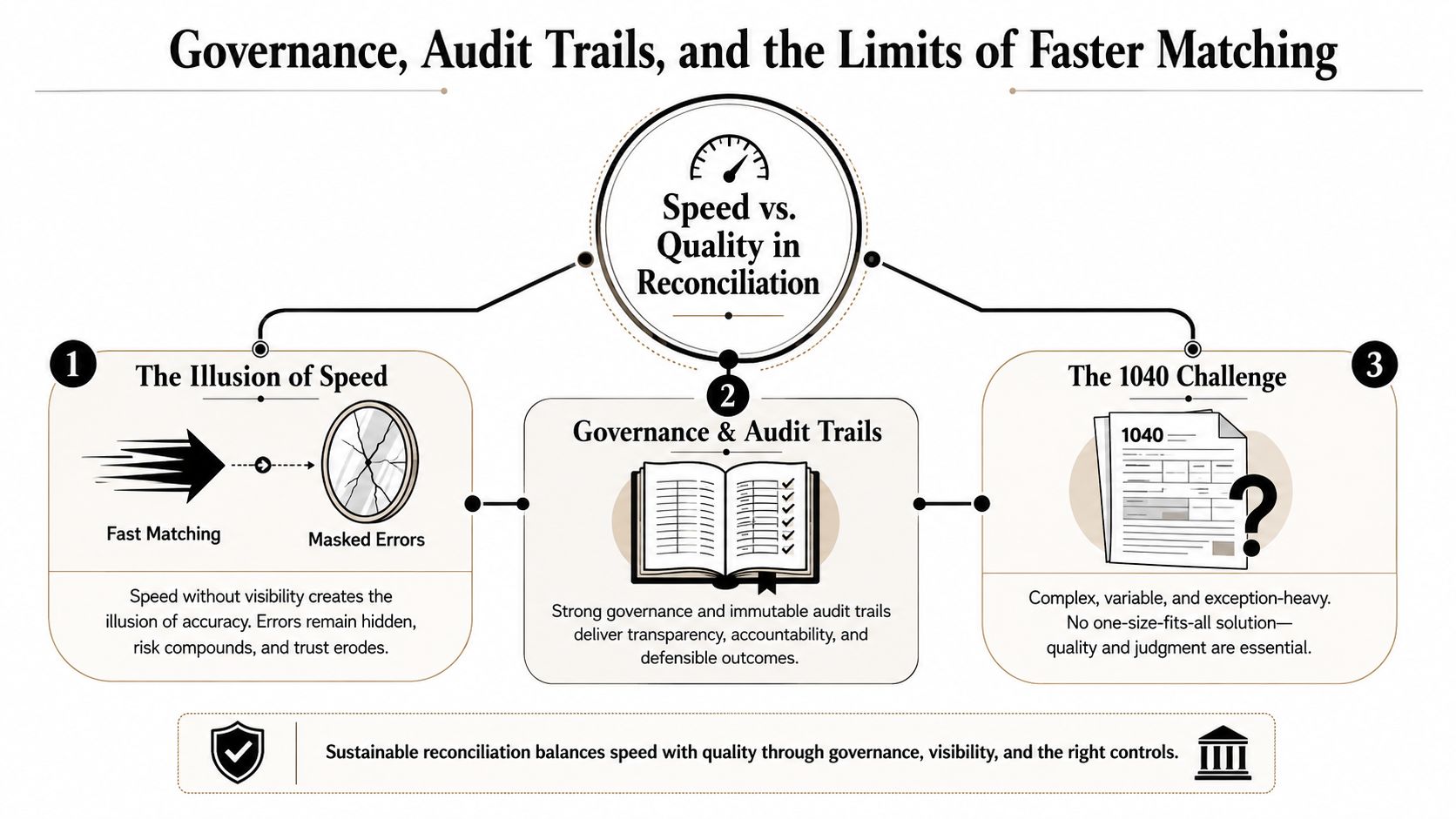
Fast matching can improve throughput while weakening review quality. If the source data is incomplete or the drafted return contains an error, an automated system can create a tidy reconciliation record without proving that the underlying result is correct.
That's the central governance risk in 1040 work. A dashboard can show green checks while hiding whether the reviewer saw the original W-2, confirmed the withholding field, evaluated an amended statement, or approved a basis difference. Tax firms need evidence of the decision, not just evidence that the software completed a process.
The minimum evidence trail
Require the platform to preserve:
- Original source lineage: The W-2, 1099, brokerage statement, or other document page that supports the reviewed value.
- Exception history: The original discrepancy, system suggestion, reviewer action, and final status.
- User attribution: The identity of the person who prepared, reviewed, overrode, commented, or approved the item.
- Timestamped approvals: The date and time of reviewer and partner sign-off.
- Exportable evidence: A binder or report that another reviewer can understand without reconstructing the workflow in the application.
A notice, peer review, or malpractice claim can turn a routine question into an evidence-retrieval exercise. The firm should be able to produce the relevant source document, comparison result, comments, and approvals in minutes, not search across inboxes and shared drives for days.
The audit-trail capabilities for tax review software should be judged by this replay test: give a reviewer the exported file without the vendor's interface and ask whether they can determine what happened, who decided it, and what source supported the decision.
Faster matching is a throughput enabler. It isn't a substitute for professional judgment or control evidence.
The approval decision should also reflect risk. A tool that clears routine items automatically can still require mandatory human review for certain forms, schedules, document conflicts, or low-confidence extractions. Governance is strongest when the firm controls those boundaries and can prove that the system enforced them.
Matching the Right Tool to Your Firm and Next Steps
A small preparer with under 500 returns and no formal partner-review layer generally needs a lightweight 1040 review workflow, not an enterprise close platform. The priority is fast source validation, focused exception handling, and a workpaper that prevents the preparer from repeating the same comparison manually.
A firm with multiple partners, documented SOPs, and formal review obligations needs stronger governance. It should prioritize role separation, configurable workflows, source-linked evidence, approval history, and exports that support peer review. A broad finance platform may fit if the firm also manages substantial bank-to-book, trust-account, or balance-sheet reconciliation work. It's a poor fit when the queue is primarily drafted 1040 review and the tool treats tax documents as generic attachments.

Run a controlled pilot
Use a short pilot with real workflow conditions:
- Select three representative returns, including at least one with multiple income documents and one with a non-routine exception.
- Record current reviewer minutes, exception volume, document-search time, and partner sign-off effort.
- Require the vendor to produce a source-linked workpaper sample.
- Test a duplicate, amended, or inconsistent document.
- Review every automated clearance for false positives and missing context.
- Time-box the pilot to one week.
- Compare the result against the scorecard, not the sales presentation.
The right tool should reduce line-by-line eyeballing while making the remaining judgment calls easier to defend. Compare WP TieOut with your other candidates using the exception, evidence, governance, and throughput criteria established above.
WP TieOut offers an AI-powered workflow that compares validated source data with drafted 1040 returns, surfaces discrepancies for review, and compiles source-linked workpapers with sign-off history. Visit WP TieOut to evaluate the workflow against your shortlist and schedule a focused demonstration for your firm.