

A draft 1040 arrives with student loan interest already populated on Schedule 1, line 21. The preparer has attached a Form 1098-E, the number looks reasonable, and the return is nearly ready to release. That's exactly when a quick line-by-line review can miss the core issue: the amount on the lender statement may include accrued or capitalized interest that the taxpayer didn't pay during the tax year.
For a tax reviewer, the question isn't merely whether a borrower has student debt. It's whether the reported amount is qualified interest paid, claimed by the right taxpayer, on a qualifying loan, in the correct year, and within the applicable income and filing-status limits. The reliable review starts with source documents, not the software field.
Table of Contents
- What Student Loan Interest Means on a 1040
- How Interest Accrues and Capitalizes
- Tax Treatment of Student Loan Interest
- Worked Examples for Real Returns
- Pitfalls Reviewers Should Not Miss
- Reconciliation Checklist for 1040 Review
- Pulling It All Together in Review
What Student Loan Interest Means on a 1040
The reviewer's first task is to identify what the Schedule 1 entry represents before accepting it. Student loan interest is generally an above-the-line adjustment to income for qualified interest paid during the tax year on a loan used solely for qualified higher-education expenses. The loan must relate to the taxpayer, the taxpayer's spouse, or an eligible dependent, and the person claiming the deduction must meet the applicable legal requirements.
Form 1098-E is usually the first source document to inspect. It can show the interest amount reported by the lender, but it doesn't replace the eligibility analysis. A reviewer still needs to confirm the taxpayer's identity, the lender, the payment year, and whether the loan proceeds were used for qualifying education expenses. The source-document workflow described in income documentation guidance for tax reviewers is useful here because the return entry should be traceable to the underlying intake record.
Start with the legal obligation
Ask who was legally obligated to pay the loan. A taxpayer may have made a payment on another person's debt, but payment activity alone doesn't establish deduction eligibility. The taxpayer's filing status, dependency status, and relationship to the borrower matter just as much as the amount shown on the form.
The loan-use test also deserves attention. A loan refinanced into a new obligation may remain qualifying if the new debt continues to represent qualified education borrowing, but a reviewer shouldn't assume every refinance preserves the deduction. Review the lender statement and the refinance documents when the account history is unclear.
Practical rule: Treat Form 1098-E as evidence of reported interest, not as automatic proof that the entire amount is deductible.
Separate paid interest from balance activity
Interest can accrue without being paid. It can also be capitalized, meaning unpaid interest is added to principal. Neither event, by itself, establishes that the taxpayer paid deductible interest during the year.
That distinction explains many apparent mismatches between a lender portal and the draft return. A year-end statement may show interest activity, while Form 1098-E reports the amount the lender treated as paid for information-reporting purposes. Reconcile the two, document the difference, and avoid importing an accrued balance into Schedule 1 just because it appears in the account history.
How Interest Accrues and Capitalizes
Loan interest generally accrues against the outstanding principal over time. Servicers calculate the charge under the loan terms, often using a daily balance method and an annual rate converted to a daily rate. The borrower may not make a payment while the interest accumulates, particularly during deferment, forbearance, or an income-driven repayment period where the required payment doesn't cover the month's accrued interest.
Capitalization changes the balance mechanics. When unpaid interest is capitalized, the servicer adds it to principal. Future interest then applies to the higher balance, so a borrower can see a growing account even without taking out a new loan.
A controlled example
Consider a hypothetical $30,000 unsubsidized loan at 6.8% during a 12-month deferment. Using a simple annual illustration, the accrued interest is approximately $2,040. If the borrower doesn't pay that amount and the servicer capitalizes it, the principal becomes approximately $32,040.
The example is useful for review training, but it isn't a deduction conclusion. The borrower may have no cash interest payment for the year even though the account history shows substantial accrued interest. The reviewer must establish what the borrower paid and what the lender reported as paid.
| Period | Starting Balance | Accrued Interest | Capitalized? | Ending Balance |
|---|---|---|---|---|
| Deferment period | $30,000 | Approximately $2,040 | No, during accrual | Approximately $30,000 |
| After capitalization | $30,000 | Approximately $2,040 | Yes | Approximately $32,040 |
The table illustrates why the deduction review can't rely on the ending balance. A higher balance may reflect capitalization rather than a deductible payment. Conversely, a borrower may have made a payment that included interest and principal, with only the qualified interest portion relevant to the return.
IDR shortfalls require a separate question
Income-driven repayment plans calculate monthly payments as 5% to 20% of discretionary income, with discretionary income based on adjusted gross income above a poverty-line multiplier, as described in the Congressional Research Service explanation of IDR mechanics. If the required payment is below monthly accrued interest, the unpaid amount can create negative amortization.
That's a portfolio risk, but it's also a tax-review risk. A borrower may report that they “paid the loan” through automatic payments, while the account still accumulated unpaid interest. Pull the payment history and distinguish payments made from interest merely posted to the account. For broader policy context, keep current on tax law updates affecting return review, but don't substitute a general update for the loan-specific records.
Tax Treatment of Student Loan Interest
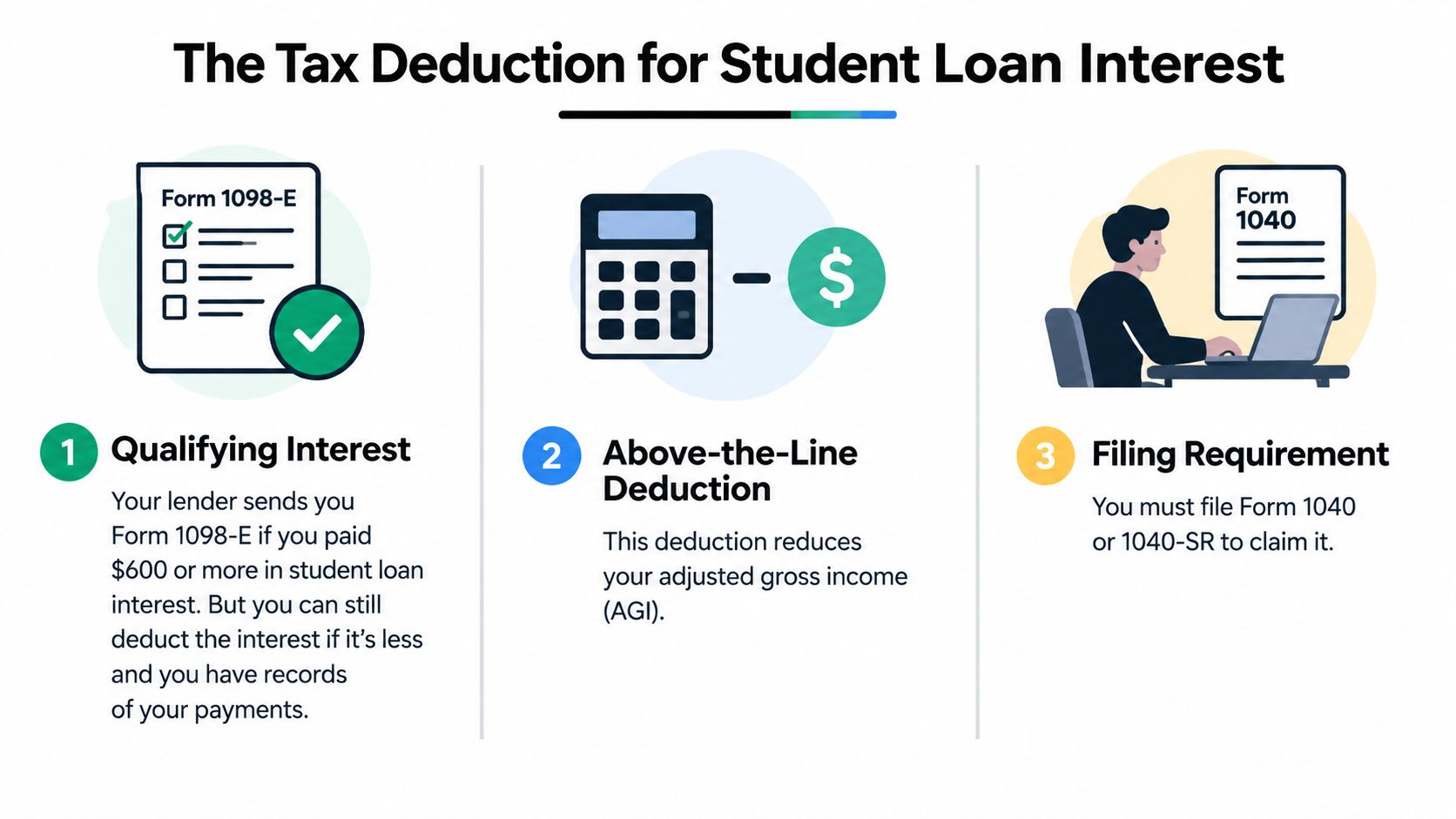
The deduction is an adjustment to income, not an itemized deduction. For an eligible taxpayer, qualified student loan interest is entered on Schedule 1 and flows through to the Form 1040 adjustment calculation. The maximum deduction is $2,500, subject to the taxpayer's modified adjusted gross income and other eligibility restrictions.
Form 1098-E helps establish the reported amount. A lender generally furnishes the form when interest paid reaches $600, but the absence of a form doesn't automatically eliminate the deduction. If the paid amount is lower, the reviewer should request a lender statement, payment history, or other reliable records rather than defaulting to zero.
Apply the income and status filters
For 2024, the deduction phases out at modified AGI between $80,000 and $95,000 for single filers and between $165,000 and $195,000 for married taxpayers filing jointly, as reflected in the applicable IRS treatment. A taxpayer above the top of the relevant range receives no deduction. The software calculation should be checked against the return's filing status and modified AGI, especially when other adjustments or income items changed late in preparation.
The deduction also isn't available to a taxpayer claimed as someone else's dependent. Married taxpayers filing separately don't qualify, and the deduction isn't available for interest on a loan from a related party. Those restrictions often explain why a Form 1098-E exists but the correct Schedule 1 entry is zero.
Confirm the loan purpose
The loan must have been used solely for qualified higher-education expenses. A reviewer shouldn't accept a client summary that says “school loan” without checking the account history when the debt has been refinanced, consolidated, or mixed with other borrowing.
The cleanest workpaper records four conclusions:
- Qualified borrower: The taxpayer is legally responsible for the debt and isn't claiming an impermissible payment.
- Qualified use: The proceeds funded eligible education expenses.
- Qualified payment: The amount represents interest paid during the tax year, not merely accrued or capitalized interest.
- Qualified return position: The taxpayer passes the dependency, filing-status, MAGI, and statutory cap tests.
Worked Examples for Real Returns
The following profiles use the supplied figures as review illustrations. They show why the Form 1098-E amount, not the loan balance or capitalized-interest disclosure alone, drives the deduction analysis.
Profile A
A single taxpayer has $45,000 of Stafford debt at 6.5%, $78,000 of AGI, and an income-driven repayment plan with a $0 monthly payment under partial financial hardship. The lender reports $4,100 of qualified payments on Form 1098-E, while the portal discloses $1,340 of capitalized interest.
The $1,340 capitalization is not added again to the deduction. The reviewer starts with the qualified amount reported as paid, applies the statutory cap and MAGI calculation for the relevant year, and documents the treatment of the capitalized amount separately. On the facts provided, the Schedule 1 line 21 entry is $2,500, assuming no other eligibility issue applies.
Reviewer note: “Used qualified interest paid reported on Form 1098-E, limited to the statutory cap; excluded separately disclosed capitalized interest.”
Profile B
A married couple filing jointly has $32,000 of MAGI exactly at the 2023 phaseout floor. The supplied profile states that the deduction is fully eliminated under the applicable return facts. Even if Form 1098-E reports paid interest, the income calculation controls the final entry.
Schedule 1 line 21 entry: $0.
Reviewer note: “Disallowed under the applicable MAGI phaseout calculation despite lender-reported interest.”
Profile C
A borrower has both a federal consolidation loan and a private refinance. The reviewer receives two Forms 1098-E with amounts that don't reconcile to the client's summary. The correct approach is to identify the qualifying obligation represented by each form, review the refinance date and loan-use history, and exclude any amount tied to a nonqualifying obligation.
The federal consolidation lender's Form 1098-E may support a deduction if the consolidated debt remains qualifying. The private refinance requires its own eligibility review, and the portal's capitalized-interest disclosure shouldn't be treated as paid interest without payment evidence. The exact Schedule 1 entry depends on the qualifying paid amounts after the statutory cap and income tests. It shouldn't be forced to the client's rounded estimate.
Reviewer note: “Reconciled both Forms 1098-E to loan histories and limited the entry to qualifying interest paid.”
A concise tax reconciliation example can help staff document why the return amount differs from the borrower's account summary.
| Profile | Balance & Rate | AGI / Filing Status | 1098-E Amount | Capitalized Interest | Schedule 1 Line 21 | Reviewer Note |
|---|---|---|---|---|---|---|
| A | $45,000 at 6.5% | $78,000, single | $4,100 | $1,340 | $2,500 | Cap applied, capitalization excluded |
| B | Not provided | $32,000, joint | Not provided | Not provided | $0 | Deduction eliminated under supplied facts |
| C | Federal consolidation plus private refinance | Not provided | Two forms | Portal disclosure | Determined after reconciliation | Qualifying debt and paid interest verified |
Pitfalls Reviewers Should Not Miss
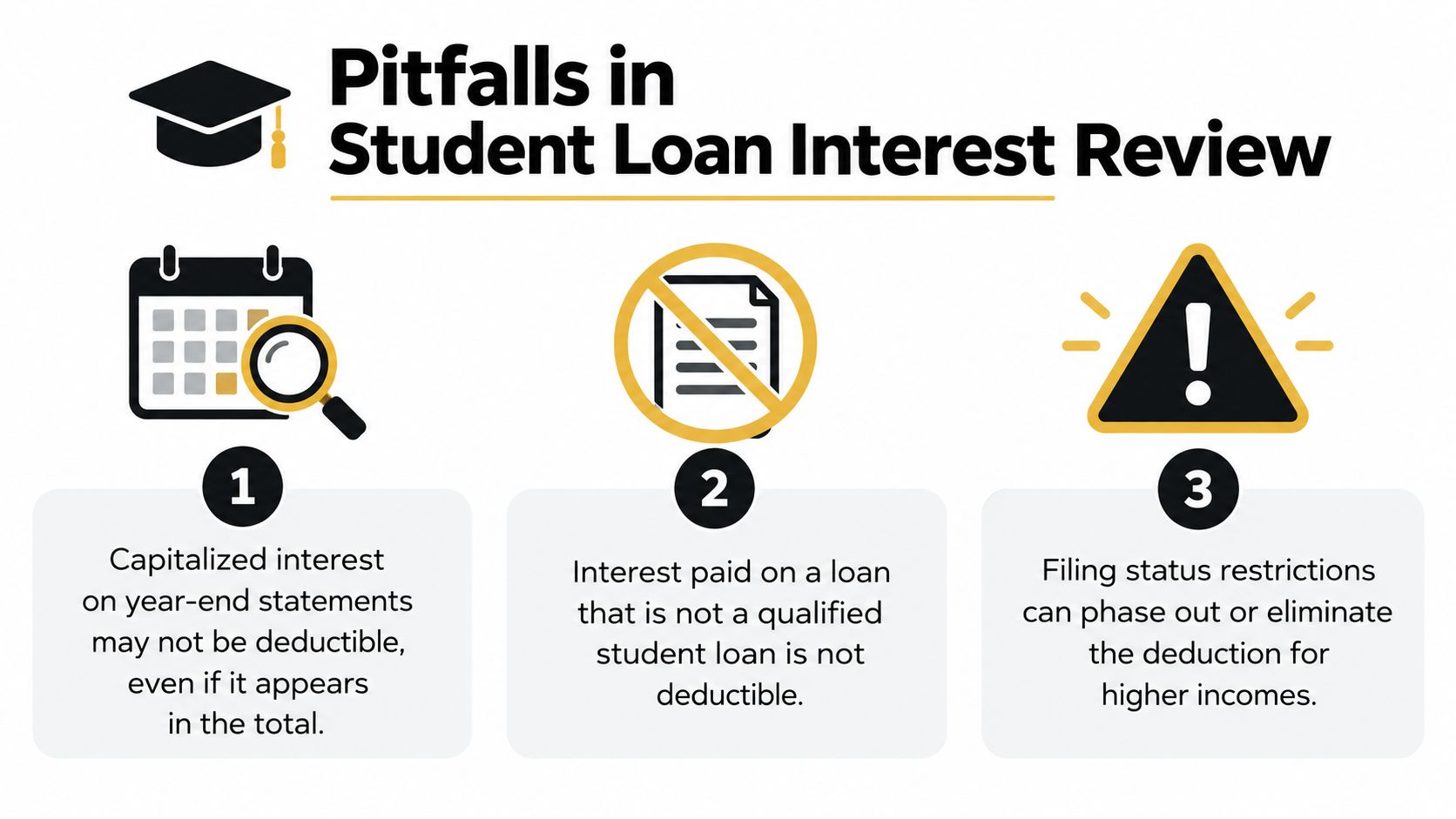
The most common errors appear when the draft return is compared with a client summary instead of the actual loan records. A reviewer can often triage them quickly by matching the symptom on the 1040 to the document that should resolve it.
The statement shows interest, but the form doesn't
A year-end lender statement may show accrued or capitalized interest that doesn't appear on Form 1098-E. That's not necessarily an omission by the lender. It may mean the amount wasn't treated as interest paid during the year. Pull the payment history and capitalization event detail before changing the return.
A paid-off loan has no visible form
A borrower who paid off a loan during the year may have a final Form 1098-E delivered through a different lender portal or intake file. Search the full document set, including archived lender records, rather than assuming no form means no interest. The final payoff statement can also separate interest from principal and fees.
Dependency creates a duplicate claim
If a parent claims the taxpayer as a dependent, the taxpayer may not be entitled to claim the deduction. Review the dependency section of both the intake questionnaire and the return facts. A duplicate claim can arise when the borrower takes the deduction personally while another return treats the borrower's education costs or dependency differently.
Autopopulation ignores the phaseout
Tax software may carry a Form 1098-E amount into the return before the final modified AGI is available. Compare the software result with the completed income calculation and filing status. An amount that was valid at intake may be reduced or eliminated after late-arriving income documents are entered.
Refinancing splits the evidence
A refinance can produce two Forms 1098-E, one from the original servicer and one from the new lender. Their totals may overlap, omit a transfer period, or include different descriptions of capitalized interest. Reconcile account numbers, transfer dates, payment dates, and the qualifying purpose of the replacement loan.
A third party made the payment
A parent, spouse, or another person may have sent the payment, but the reviewer still needs to establish who was legally obligated to pay and who can claim the adjustment. Don't infer eligibility from the bank account used for the payment. Obtain the loan agreement and borrower information when the payment source conflicts with the taxpayer shown on Form 1098-E.
The student loan interest review video can supplement staff training, but the workpaper should still cite the actual lender records supporting the filed position.
Reconciliation Checklist for 1040 Review
Use the same sequence on every return. Consistency prevents reviewers from spending time on harmless balance fluctuations while missing a filing-status restriction or duplicate document.
- Confirm the Form 1098-E. Make sure the form is attached to the intake file and belongs to the taxpayer or spouse shown on the return.
- Tie the amount to Schedule 1. Compare the form's reported interest with the amount entered on Schedule 1, then explain any difference created by the cap or eligibility limits.
- Verify taxpayer and spouse identifiers. Confirm the names and Social Security numbers align with the return facts.
- Check lender details. Review the lender name and employer identification number on Form 1098-E against the servicer record.
- Confirm the payment year. Exclude amounts from another tax year, even if the lender portal displays them in a cumulative account history.
- Establish legal obligation. Confirm the taxpayer is legally responsible for the loan and isn't claiming an impermissible third-party payment.
- Review dependency status. Check whether another taxpayer can claim the borrower as a dependent, and document the conclusion.
- Validate filing status. Confirm the return status is eligible and that the applicable MAGI phaseout calculation uses the correct status.
- Re-run the tax calculation. Verify the capped adjustment flows correctly from Schedule 1 into the Form 1040 calculation, then record the reviewer's initials and tie-out note.
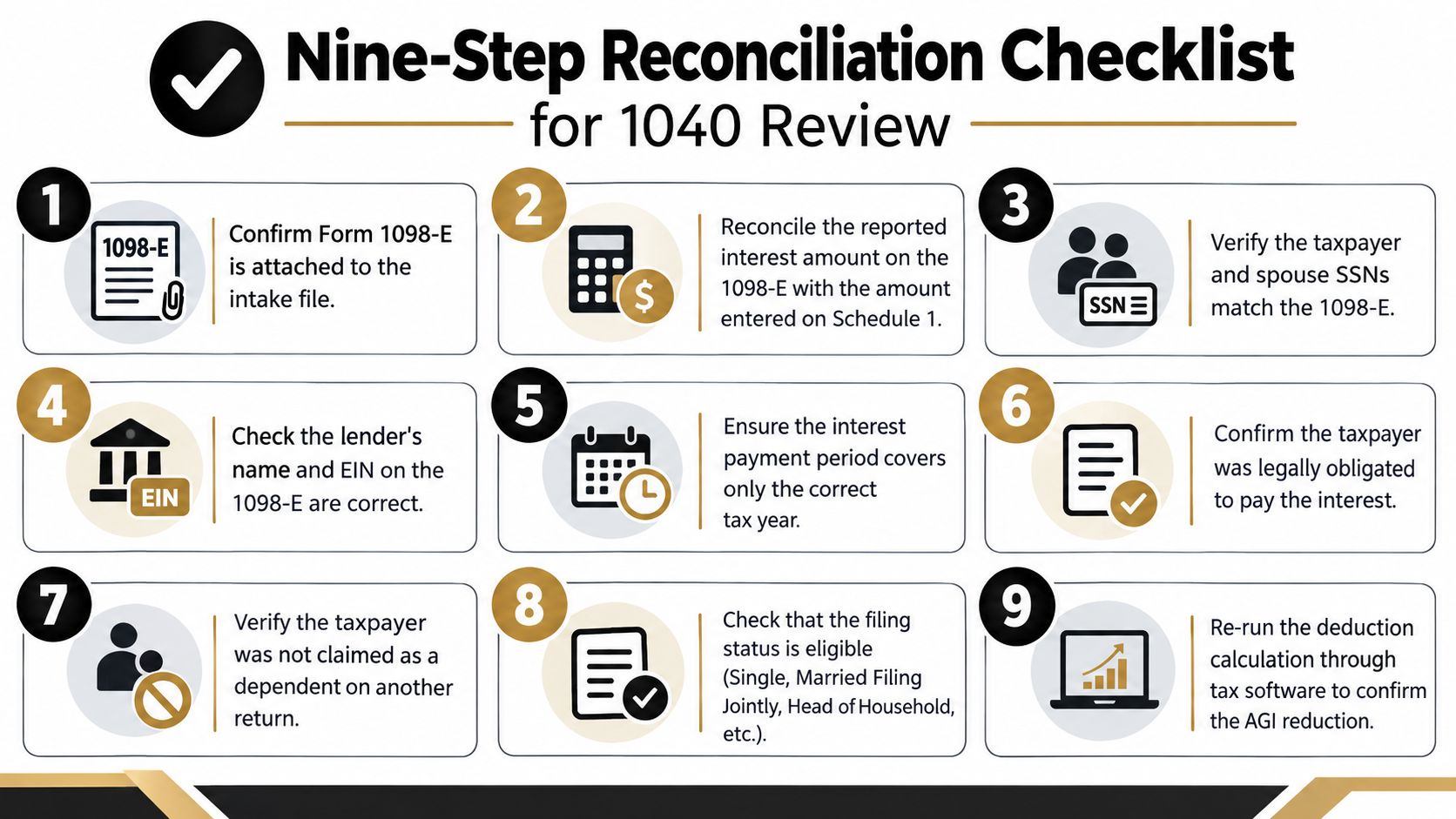
The checklist works best when each step points to a source document. Use the Form 1098-E for the reported amount, the lender transaction history for payment dates, the capitalization detail for balance changes, the intake questionnaire for dependency and filing facts, and the completed return calculation for the final adjustment.
Keep the reviewer note short but specific. “1098-E tied to Schedule 1” is weaker than “Form 1098-E reconciled to lender history, capitalized interest excluded, MAGI calculation reviewed, cap applied.”
Pulling It All Together in Review
Student loan interest rarely dominates a 1040, but it creates a concentrated set of documentation and eligibility risks. The reviewer's core habit is simple: compare Form 1098-E with Schedule 1, verify the MAGI and filing-status treatment, confirm dependency allocation, and reconcile capitalized interest to the lender's transaction history.
The broader policy environment also affects borrower conversations. In the United States, federal rates reset annually for new loans and are tied to the 10-year Treasury note plus a congressional margin. For the 2025-26 academic year, undergraduate Direct Subsidized and Unsubsidized loans carry a 6.39% fixed rate, graduate Unsubsidized loans carry 7.94%, and Direct PLUS loans carry 8.94%, according to historical federal student loan rate data. In the United Kingdom, the Plan 2 rate reached 7.3% in 2025, while Plan 5 and Plan 1 were 4.3%, according to House of Commons Library rate information.
Those figures matter because clients often confuse the nominal rate with the amount deductible on a return. They're separate questions. The tax file concerns qualifying interest paid, while the loan account may also show accrual, capitalization, subsidies, or plan-driven balance changes. The Congressional Budget Office estimated average federal IDR subsidy rates of 15.9% for undergraduate borrowers and 17.5% for graduate borrowers over 2020-2029, illustrating why repayment-plan mechanics matter to government and lender economics, not only to the individual borrower. CBO's federal student loan analysis provides the policy context.
A firm can embed this review into its standard 1040 workpaper, or use a review platform that validates source documents and compares them with the drafted return. WP TieOut includes a tax calculation view with a student loan interest adjustment field and can preserve source-linked review evidence, including reviewer sign-off history, as part of the broader return workflow. Used appropriately, that kind of exception-based process supports the same conclusion the manual checklist requires: every amount on Schedule 1 should have a defensible source and treatment.
Use the checklist on every return with a Form 1098-E, then test the workflow on your next review batch with WP TieOut. Its source-document validation and drafted-return comparison can help your team surface student loan interest exceptions before delivery and preserve a clear tie-out record for review.