

You've probably had this conversation more than once this season. A client sees that the return was accepted, expects the usual refund timeline, then calls when nothing arrives. Your staff checks the IRS tools, finds little that's useful, and now the firm has two problems instead of one. The return is delayed, and the client thinks someone made a mistake.
That's the operational reality of tax return processing delays today. The IRS may own the queue, but firms own intake quality, review discipline, documentation, and client communication. That's where resilience lives. If you treat every delayed return as an isolated fire drill, your team burns time, partners get dragged into avoidable escalations, and clients lose confidence. If you build a repeatable control framework, delays become triageable.
The firms handling this well aren't just better at explaining IRS delays. They're better at sorting delay types, setting timeline expectations, tightening pre-file review, and documenting every judgment call before the return leaves the office.
Table of Contents
- The Anatomy of Modern Tax Return Processing Delays
- Quantifying Timelines for Common Delay Scenarios
- Proactive Delay Mitigation for Your Firm
- How AI Reconciliation Reduces Delay Risk
- Building Defensible Audit-Ready Binders Automatically
- Client Communication Templates and Escalation Checklists
The Anatomy of Modern Tax Return Processing Delays
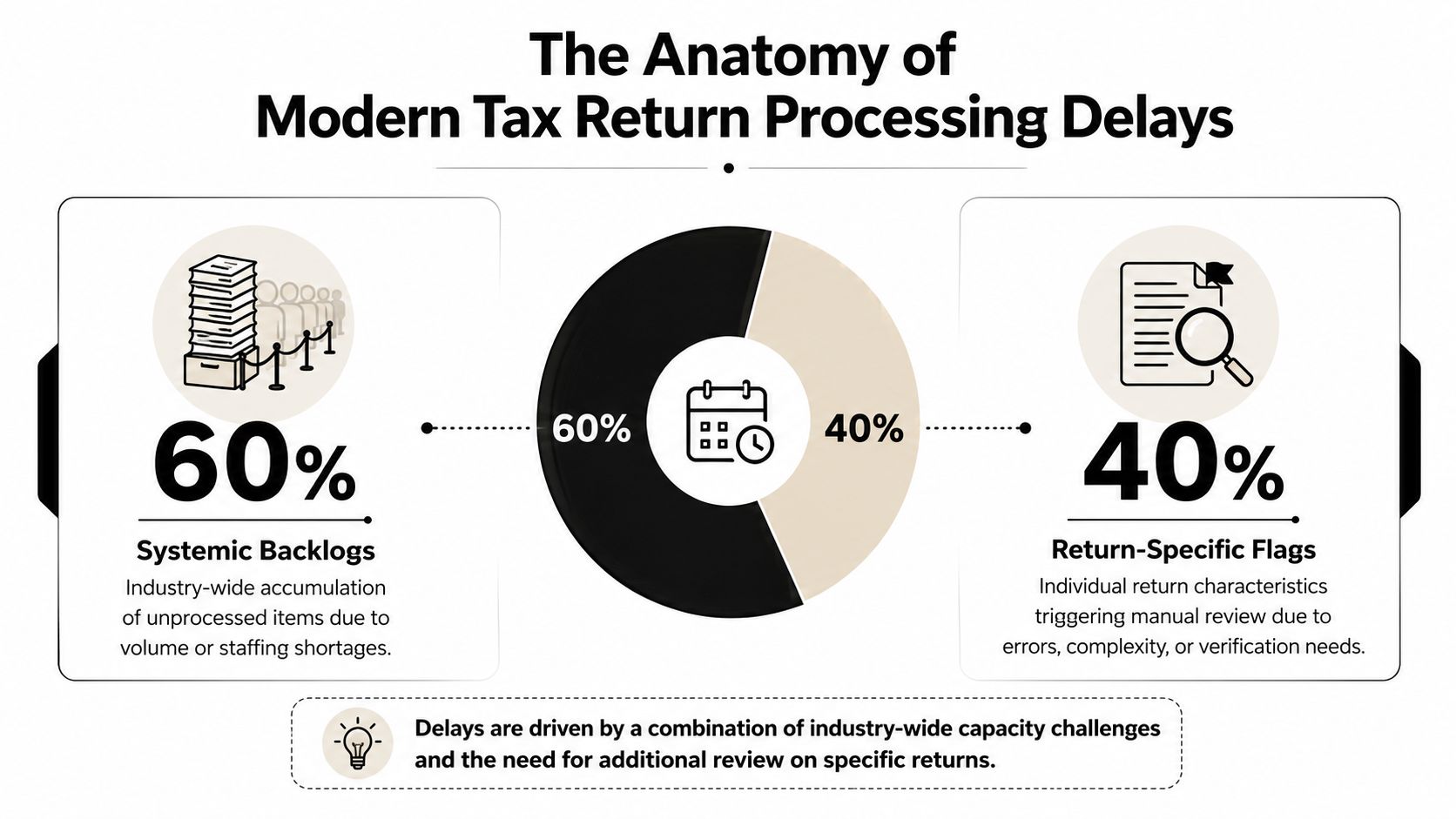
Most firms talk about tax return processing delays as if they come from one source: IRS congestion. That's incomplete. In practice, delays usually fall into two buckets. The first is a systemic backlog, where a return is stuck in volume. The second is a return-specific flag, where something about that filing moves it out of normal automation and into a slower path.
During one recent peak, the IRS faced 35.3 million returns requiring manual processing, nearly a five-fold increase from pre-pandemic levels, according to the Taxpayer Advocate Service report on filing season delays. That same report notes the queue included returns suspended due to errors and returns held for mandatory reviews. These conditions are operationally distinct, even if the client only experiences them as “my refund is late.”
Backlog delay and review delay are not the same problem
A backlog delay is a queue problem. The return may be complete and accurate, but it's waiting behind paper inventory, error inventories, or staffing constraints. That kind of delay is frustrating, but it usually doesn't call for corrective filing action from the firm.
A review delay is different. Certain returns are diverted because a specific item triggers scrutiny. One overlooked issue is the hidden manual review attached to some credit claims. Public messaging around the standard refund timeline often leaves out the fact that some returns enter a mandatory holding pattern under the PATH Act. As explained in TurboTax's discussion of refund delays and PATH Act timing, EITC and ACTC claims can be delayed until mid-February regardless of how early the taxpayer files.
That's not an audit. It's not proof of an error. It's a procedural hold. Firms create avoidable panic when staff treat every delay beyond the usual benchmark as evidence that something went wrong.
Practical rule: Before anyone amends, calls the client with concern, or opens a rework file, identify whether the return is sitting in line or has been routed out of line.
For firms trying to reduce preventable handoffs, tax technology also matters. A stronger tax compliance software workflow helps teams classify delay risk before transmission instead of after the client starts calling.
What firms should diagnose before taking action
When a delayed return lands in your internal queue, staff should answer four questions first:
- Was the return paper-filed or e-filed? Filing method changes both processing speed and escalation logic.
- Does the return include credits or forms that commonly create holds? Staff should know which items naturally change timeline expectations.
- Is the issue likely a procedural hold or a data mismatch? Those require different client language.
- Has anyone already taken an action that resets the process? Unnecessary amended filings and duplicate submissions can make a manageable delay worse.
A resilient firm doesn't just explain IRS delay mechanics. It teaches staff to diagnose the type of delay before they react.
Quantifying Timelines for Common Delay Scenarios
Once a return is delayed, the useful question isn't “why is the IRS slow?” It's “what timeline fits this return?” Staff need something more precise than a generic warning that processing may take longer.
Recent data gives a workable baseline. In one recent season, delayed e-filers waited an average of 7 weeks, while delayed paper filers waited 14 weeks, according to Clarity Tax Relief's summary of IRS refund delay statistics. That same source notes that returns including Form 8379 face a required 14-week processing window, or 11 weeks if e-filed. For client service, that distinction is operational gold. It lets your team replace open-ended reassurance with a reasoned timeline.
Where the timeline usually changes
The biggest mistake firms make is anchoring every client on the standard fast-path expectation. That works only for straightforward returns that stay inside normal automation. Once a return leaves that lane, the filing method and form mix matter more than the original filing date.
Paper filing still carries the heaviest timeline penalty. Even when the return is substantively fine, paper introduces handling, manual touchpoints, and a longer path to resolution. That doesn't mean every paper-filed return becomes a problem. It means your team shouldn't describe paper delays as unusual.
Form-specific holds need their own scripts. Form 8379 is the clearest example because the delay isn't accidental. It's built into the process. If staff don't identify that at intake or review, they'll set the wrong expectation and create unnecessary follow-up work.
A practical timeline table for staff use
| Return scenario | Working expectation for staff conversations |
|---|---|
| Delayed e-filed return | Use the recent delayed e-file average as your expectation anchor, not the standard fast-path benchmark |
| Delayed paper-filed return | Treat this as a longer-cycle case from the start and prepare clients for a materially slower process |
| Return with Form 8379, e-filed | Explain that this form changes the normal timeline because it requires a separate processing track |
| Return with Form 8379, paper-filed | Assume the longest routine timeline among common individual return scenarios |
A good internal metric dashboard should also separate accepted, processed, refund issued, and firm follow-up required. If your reporting collapses those into one status, managers can't see where work is accumulating. Teams that want tighter service-level discipline should build these distinctions into their quality control metrics.
The client hears one sentence: “It's delayed.” Your operations team should see a category, a likely timeline, an owner, and a next review date.
Proactive Delay Mitigation for Your Firm
You can't control IRS staffing, legislative holds, or downstream queue behavior. You can control what leaves your firm. That's where most avoidable tax return processing delays are won or lost.
The most useful control change for many firms is simple. Stop treating all return review as one uniform process. Some returns deserve a pre-file control lane because they carry a higher chance of getting kicked into manual review even when the preparer did solid work.
Build a pre-file control lane for flagged returns
The IRS's newer Return Review Program can trigger false positive flags on legitimate EITC and ACTC claims, causing delays of up to 10 weeks, as described in Claimyr's discussion of RRP false positives and manual review delays. The same source notes that firms can reduce risk by building workpapers that explicitly pre-validate eligibility for those credits.
That should change how your review file is built. If the return includes EITC or ACTC, don't rely on general reviewer familiarity. Require targeted support in the workpapers so the reviewer can confirm eligibility without hunting across the file.
A practical control lane usually includes:
- Eligibility support up front: Place household, dependent, and income support where the reviewer expects it, not buried in notes or scattered PDFs.
- Clear tie-out for credit inputs: If a credit depends on a threshold or status determination, make the source path obvious.
- Reviewer prompts for known trigger points: Add checklist language that forces the reviewer to consider mismatch risk, not just arithmetic accuracy.
- Partner sign-off for exceptions: If the file includes unusual facts, preserve the judgment in writing before filing.
That's where disciplined document management best practices for tax review matter. Delays often start as documentation failures, not tax law failures.
What works and what wastes time
Firms improve delay resilience when they separate controls that reduce filing risk from controls that only create the appearance of rigor.
What works:
- Front-loading high-risk support. A reviewer should see the most delay-sensitive items early.
- Using return-specific checklists. A short checklist for credit-driven returns beats a giant generic review sheet.
- Assigning ownership before transmission. One person should own final confirmation that the return is complete and coherent.
What doesn't work:
- Endless line-by-line eyeballing. It burns reviewer time on low-risk items and leaves less attention for genuine exceptions.
- Overreliance on memory. Senior reviewers know a lot, but memory is not a control system.
- Reactive rework after acceptance. Once the return is in the system, your options narrow fast.
If a return is likely to draw scrutiny, the file should make the return easy to defend before anyone transmits it.
The strongest firms don't add friction everywhere. They add precision where the delay risk is concentrated.
How AI Reconciliation Reduces Delay Risk
Manual review breaks down in predictable ways. The preparer is moving fast. The reviewer is tired. The source documents are complete, but not organized in a way that supports quick verification. Then a small mismatch survives the review cycle and goes out the door.
That's where an AI reconciliation workflow changes the economics of review.

Review by exception beats line review
A line-by-line review model assumes the reviewer should look at everything with equal intensity. In real tax operations, that's rarely efficient. Most fields are routine. A much smaller set deserves concentrated attention because that's where omissions, transpositions, and source-to-return mismatches usually live.
AI reconciliation supports a review-by-exception model. Source documents are ingested, key data is validated, and the drafted return is compared against that validated workpaper. The reviewer doesn't waste time proving that obvious items are obvious. The reviewer spends time where the source and the return don't agree, or where support appears incomplete.
That shift matters for delay risk because many manual review triggers begin with ordinary quality failures: mismatched figures, overlooked forms, missing support, inconsistent taxpayer data, or review fatigue. Technology won't eliminate every IRS hold. It can reduce the number of preventable filing defects your team creates on its own.
Where automation helps the reviewer think better
Good automation doesn't replace tax judgment. It clears noise so tax judgment can show up where it counts.
In practice, firms tend to benefit in a few specific ways:
- Source consolidation: W-2s, 1099s, brokerage statements, and similar records are easier to compare when they're normalized into one review workflow.
- Exception surfacing: Reviewers can focus on true discrepancies instead of scanning unchanged fields.
- Handoff clarity: Preparers, reviewers, and partners can see what was checked and what still needs attention.
A quick demo often makes the difference clearer than a description alone.
The operational benefit is straightforward. Firms reduce reviewer fatigue, shorten rework loops, and tighten consistency across staff levels. That's especially valuable when the firm is trying to manage tax return processing delays without turning every client inquiry into a partner-level issue.
Building Defensible Audit-Ready Binders Automatically
A delayed return creates two kinds of pressure. The first is timing pressure. The second is proof pressure. Clients want to know not only when something will move, but also whether the firm can stand behind what was filed.
A strong digital binder solves both.

A good binder solves two problems at once
When the review process automatically builds a bookmarked, source-linked file, the firm gets more than storage. It gets a record of preparation logic. Every tied-out figure can point back to its support. Every reviewer action can show who handled it and when. Every annotation can preserve context that would otherwise disappear after filing.
That changes how delay cases are handled internally. Staff don't have to reconstruct the file from email threads, downloads, and memory. They can open one record and see the source set, the review trail, and the sign-off history.
“We know why we filed it this way” should never depend on whether the preparer still remembers the file.
What an operations team should preserve
An audit-ready binder doesn't need to be flashy. It needs to be consistent, searchable, and defensible. The most useful components are usually:
- Source-linked return support: Each material figure should trace back to an original document or documented firm conclusion.
- Review stamps and annotations: Preserve who checked the item and what they concluded.
- Version clarity: Staff should be able to distinguish draft, revised, and filed states without guesswork.
- Role-based sign-off history: The file should show preparer review, reviewer completion, and partner approval where required.
That kind of structure helps even when the issue never becomes an examination. It supports notice response, internal quality review, training, and partner oversight. More importantly, it lowers the stress of delayed-return follow-up because the file itself answers questions that would otherwise trigger a scramble.
Client Communication Templates and Escalation Checklists
Even a well-run firm will still face tax return processing delays. The difference clients notice is whether the firm communicates like a control center or like a help desk guessing in real time.
Clients don't need technical lectures. They need a calm explanation, a realistic timeline, and confidence that someone owns the matter.

Three templates firms can use immediately
Initial delay notice
Subject: Update on your tax return processing
Your return was accepted for processing, but the IRS has not yet completed the next step. At this stage, the delay does not by itself indicate an error or audit. Some returns move more slowly because of filing method, required review steps, or IRS processing volume.
Our team is tracking the status and will update you on the next review date. If the IRS issues any notice or request, please forward it to us promptly so we can review it with you.
Status update when nothing has changed
Subject: Status check on your return
We reviewed your file again and there is no material status change yet. That can be normal in delayed processing cases. We are continuing to monitor the return and will let you know if the IRS posts a change or if action is required from you.
You do not need to file anything additional unless we specifically advise you to do so.
Client receives an IRS notice
Subject: Please send us the IRS notice
Please upload or forward every page of the notice you received, including any inserts. Do not respond before we review it with you. Some notices are informational, while others require a response within a stated timeframe.
Once we review the notice, we'll tell you whether the best next step is monitoring, a response package, or direct contact with the IRS.
An internal escalation checklist that keeps staff aligned
Use a simple internal checklist so staff know when to monitor and when to escalate.
- Confirm the return profile: Identify filing method, major credits, special forms, and any prior notices.
- Review the file before speaking with the client: Staff should never speculate when the workpapers already contain the answer.
- Log every contact: Keep one running communication history inside the client file.
- Escalate based on complexity, not volume of calls: A high-value or factually complex case may need partner review sooner.
- Treat amended-return requests carefully: Clients often ask to “fix” a delay that isn't caused by a filing defect.
The communication standard should be proactive. If your team waits for the client's third follow-up before taking ownership, the technical quality of the return won't save the relationship.
A steady update with no new development is still better than silence. Silence makes clients assume the file is unmanaged.
Firms that want fewer preventable delays, tighter review controls, and cleaner audit trails should look closely at WP TieOut. It gives tax teams an AI-powered way to validate source documents, reconcile drafted 1040s by exception, and produce a source-linked binder with a clear sign-off history. That combination helps firms improve review consistency while reducing the operational drag that delayed returns create.