

A return arrives in the review queue late in the afternoon. The preparer has entered the W-2, imported brokerage data, and attached the client's questionnaire. The reviewer is moving quickly because several more returns are waiting. A transposed Social Security number or an omitted 1099 doesn't look dramatic on the screen, so the return gets signed and filed. Months later, an IRS notice forces the firm to reconstruct what happened, who checked the item, and whether the source document was ever available.
That scenario isn't a failure of professional judgment alone. It's usually a failure of workflow design. A reliable tax return review process should identify high-risk exceptions, assign responsibility clearly, preserve the evidence behind each decision, and make the final review easier to defend than to explain from memory.
The pressure to improve is practical, not theoretical. The IRS reported that it closed 497,621 tax return audits in fiscal year 2025 and recommended $26.8 billion in additional tax, while examination coverage was much higher for taxpayers with substantial positive income than for individual returns generally, as documented by the Taxpayer Advocate Service's lifecycle overview. Firms can't build a quality program around the assumption that every return will receive a complete downstream inspection. They need to catch discrepancies before filing and prove what they checked afterward.
Table of Contents
- Why Your Review Process Is Your Real Product
- Building Intake Validation and Role Handoffs
- Exception-Based Review Versus Line-by-Line Checking
- Reconciliation Techniques That Catch Real Errors
- Documentation and Audit Trail Best Practices
- Integrating Automation and AI Securely
- KPIs and Quality Controls for Continuous Improvement
Why Your Review Process Is Your Real Product
Most CPA firms describe the tax return as the deliverable. Clients see the PDF, the filing confirmation, and the balance due. Internally, however, the return is only the visible result of a more important service: the firm's method for turning incomplete, inconsistent source information into a defensible filing.
A missed form can create more work than the original return. The client receives a notice, calls the firm, and expects someone to know whether the issue came from an omitted document, an extraction error, a client misunderstanding, or a reviewer's decision. If the file contains only a final return and scattered email threads, the firm has to investigate its own process while managing the client's anxiety.
Practical rule: If a reviewer can't show what was compared, what exception was resolved, and who approved the resolution, the firm has a documentation problem even when the filed return is correct.
The IRS's own quality guidance recommends a structured review that compares the intake information and supporting documents with the completed return, checks identity information and tax items, and resolves discrepancies before signing. It also describes a designated reviewer as the preferred method and says the taxpayer should participate in the review. That guidance is summarized in the IRS VITA work-checking document.
Rework is a process cost
Line-by-line review often feels safe because it keeps the reviewer involved in every field. In practice, it can consume senior attention on low-risk items while leaving too little time for the exceptions that deserve judgment. The same reviewer may spend several minutes confirming information that already agrees with validated source data, then rush through a complicated brokerage statement or an unusual credit calculation.
That pattern affects more than efficiency. It contributes to client retention risk, malpractice exposure, staff fatigue, and partner bottlenecks. A client doesn't experience the firm's internal effort as quality if the firm later asks for documents it already received or gives conflicting answers about a notice.
The broader processing environment reinforces the need for efficient prevention. The IRS's historic e-file expansion moved from a 1986 pilot involving 25,000 returns filed through 5 preparers in 3 cities to nationwide availability in 1990, when 4.2 million returns were filed electronically. By 2011, e-filed returns had crossed 100 million in a single filing season, according to the IRS e-file history document. Digital volume makes structured validation essential. A firm that scales filings without scaling its review evidence creates a larger queue of future explanations.
For firms evaluating their service model, the same principle applies when explaining how much a CPA charges for a tax return. The price reflects not only form completion, but also the quality of intake, review, communication, and retained support behind the filing. The review process is what clients are ultimately buying when they pay for professional assurance.
Building Intake Validation and Role Handoffs
A reviewer shouldn't be the first person to discover that a return is missing a brokerage statement. Intake validation belongs at the front of the workflow, before preparation and certainly before final review. The objective is to establish whether the file is complete enough to review, not merely whether a draft return exists.
Start with a source inventory. For an individual return, that may include W-2s, 1099-INT and 1099-DIV forms, 1099-B statements, 1099-R forms, estimated payment records, prior-year returns, identity details, and the client questionnaire. The inventory should distinguish between received, expected, not applicable, and outstanding documents. “No brokerage activity” is a client-confirmed status. An empty folder is not.

Define the handoff contract
The preparer, reviewer, and partner need separate responsibilities. A handoff should transfer a controlled work product, not an informal request to “take a look.”
Preparer checks
- Source completeness: Record which expected documents arrived and identify unresolved requests.
- Extraction accuracy: Compare imported values with the original pages, especially names, taxpayer identification details, payer information, and totals.
- Return readiness: Confirm that the draft includes the forms and schedules supported by the source file.
- Open items: Flag questions that require judgment instead of burying them in email.
The reviewer then validates the work against the source set. That means checking the identity block, income, deductions, credits, payments, and electronic filing items, while concentrating effort on mismatches and unusual positions. The reviewer should also verify that the preparer's explanations address the actual discrepancy rather than just restating the client's answer.
Reviewer passes forward only when: exceptions are resolved or clearly documented, missing information has an owner, and the draft is ready for approval rather than still under construction.
The partner's responsibility is different. Partners should focus on material positions, unresolved judgment calls, filing risk, scope exceptions, and whether the documentation supports the conclusion. They shouldn't spend approval time discovering basic data-entry problems that the preparer or reviewer should have caught.
Use a pre-review snapshot
Before a reviewer opens the return, produce a compact status view showing document coverage, unresolved questions, source-to-return mismatches, preparer completion, and reviewer assignment. A client tax organizer workflow can support this kind of structured intake when it connects requested information with the return file.
The snapshot prevents two expensive behaviors. First, it stops reviewers from reconstructing intake history from messages and folders. Second, it makes incomplete work visible before senior staff start reviewing it. During filing season, that visibility matters because the fastest review is often the one that never begins until the file is ready.
Exception-Based Review Versus Line-by-Line Checking
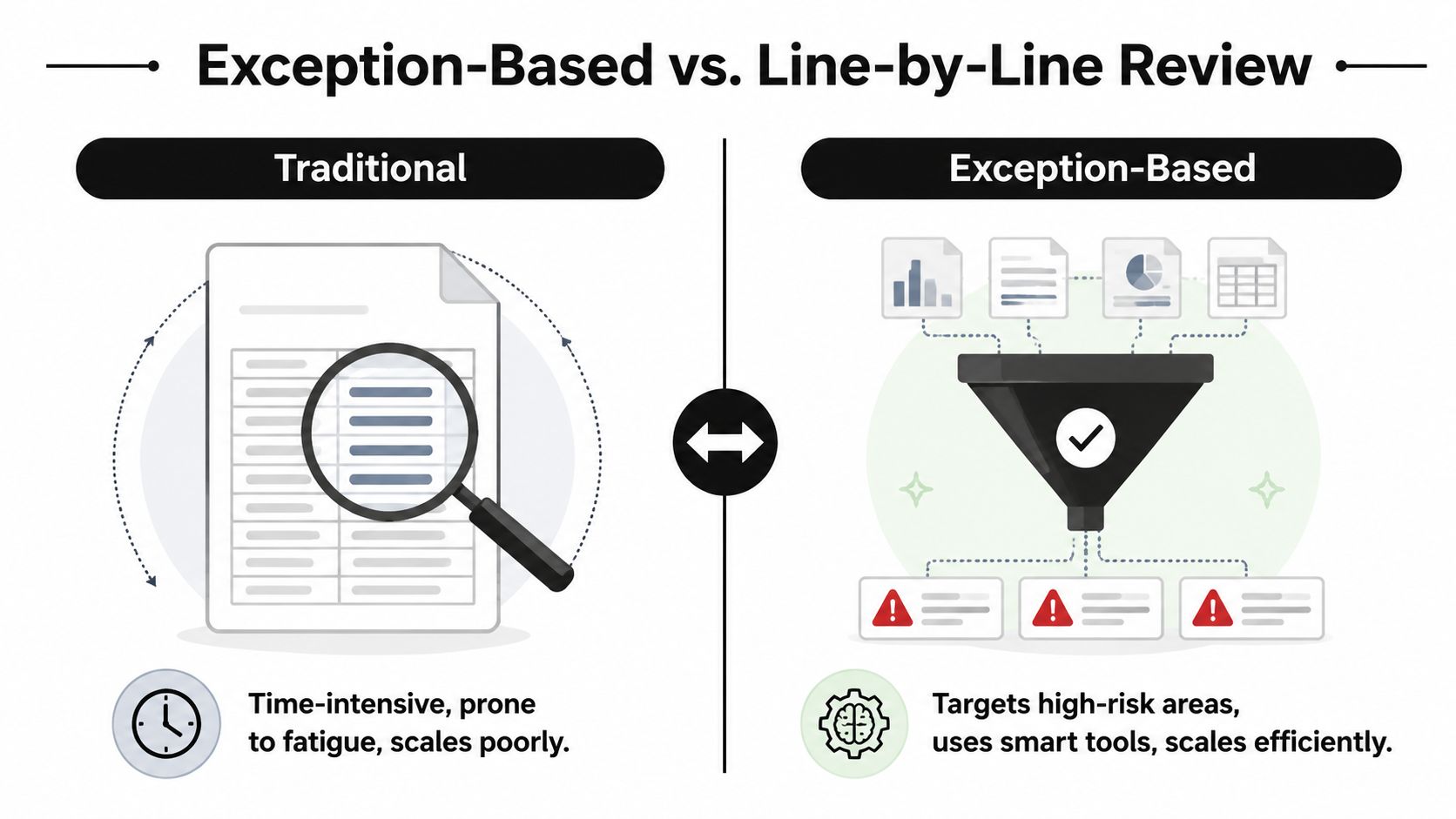
A return can receive a line-by-line review and still lack defensible evidence. The reviewer may have looked at every field, yet be unable to show which source supported a conclusion or why a difference was cleared. Exception-based review closes that gap by directing attention to items where evidence conflicts, information is incomplete, or judgment affects the filing position.
The practical trade-off is control versus capacity. A validated W-2 that maps cleanly to the draft does not require the same effort as a 1099-B total that differs from the workpaper, an expected form that never arrived, or an earned income credit calculation awaiting factual confirmation. The workflow should preserve evidence for both outcomes, including items that pass without an exception.
Build an exception queue reviewers can trust
An exception engine should compare validated source data with the drafted return and explain the result. It must distinguish expected tax treatment from an actual discrepancy. A source amount may flow through an adjustment, for example, while a brokerage statement may report gross proceeds and the return reflects the applicable treatment.
Each queue item should identify its reason:
- Income mismatch: Wage, interest, dividend, retirement, or brokerage amounts differ from the source.
- Missing form: A related return item lacks support, or the source set indicates that a form may be absent.
- Identity discrepancy: Names, addresses, taxpayer identification details, or filing status information disagree.
- Credit or deduction issue: Eligibility, calculation inputs, or supporting documents require confirmation.
- Payment difference: Estimated payments or withholding do not reconcile with client records.
- Unresolved judgment: The figures agree, but the tax position requires a documented conclusion.
A reviewer clears an exception by linking the relevant source, explaining the resolution, and recording the outcome. Automation narrows the search area. It cannot establish whether a client explanation is credible or whether a position is supportable in context.
Keep automation subject to control
Reviewers have reason to distrust a clean dashboard. Extraction can misread a document, and an unchecked status can create false confidence. The answer is a control framework: validate the rules that generate exceptions, sample items marked clear, and route uncertain data or tax treatment to human review.
The exception reporting approach is reliable only when the firm defines exception criteria, preserves the comparison behind each flag, and records why the reviewer cleared it. A green status without supporting evidence proves very little during an examination.
Human review still matters, but it should concentrate on the items most likely to affect correctness and defensibility. A process that documents why routine items passed and why unusual items were resolved gives the firm a stronger audit trail than universal eyeballing alone.
Reconciliation Techniques That Catch Real Errors
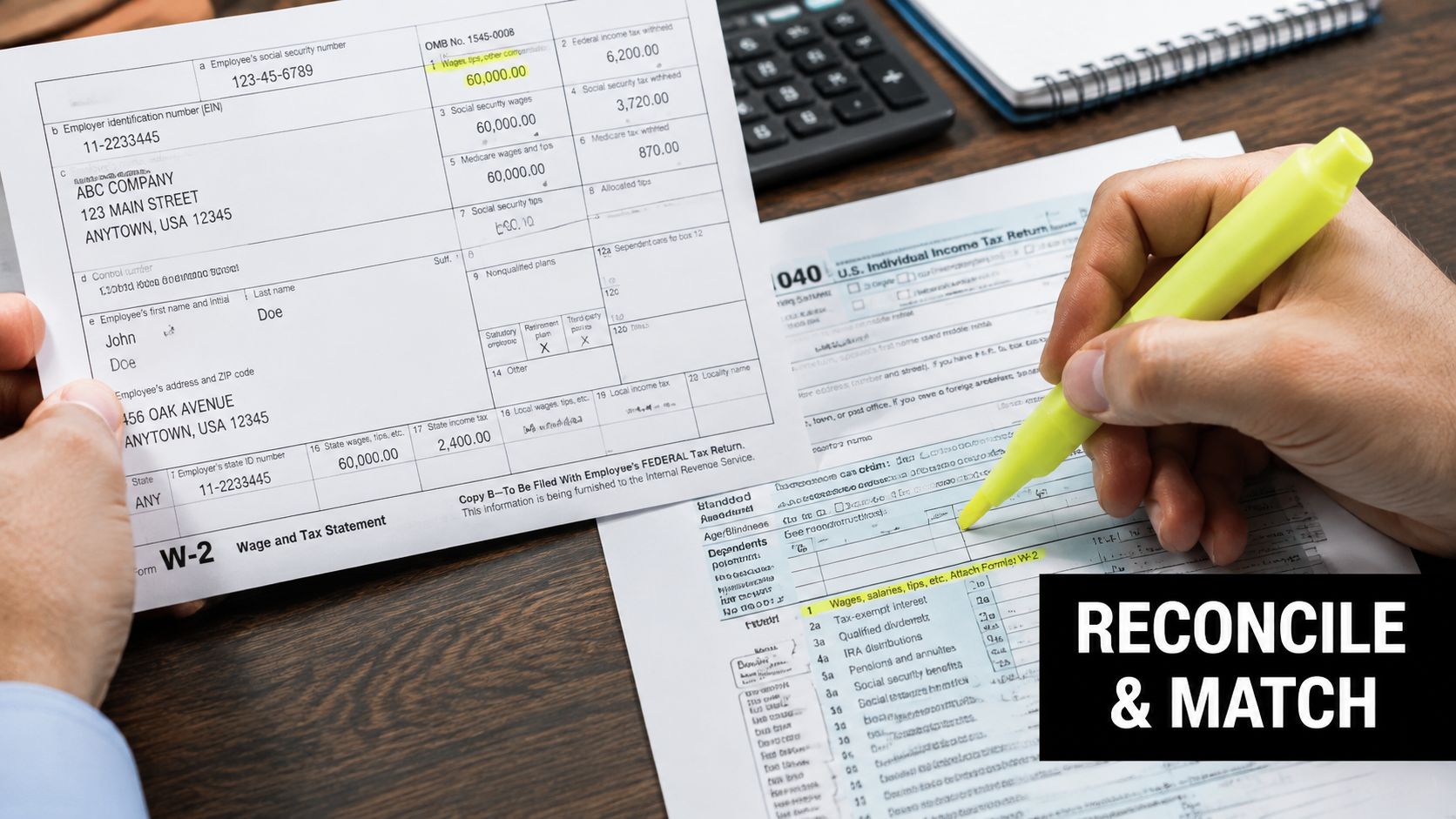
Reconciliation is where a review process earns its credibility. The reviewer isn't merely checking whether a number looks familiar. The reviewer is proving that a source document, a workpaper value, and a return entry represent the same fact or that a difference has a documented explanation.
Start with a three-point comparison
For each important item, compare original document, validated workpaper, and drafted return. If the workpaper differs from the document, correct the workpaper or record why the extraction is wrong. If the workpaper agrees with the document but the return differs, investigate the mapping or tax treatment. If all three agree, the reviewer can clear the item with a traceable reference.
For W-2 wages, compare employer identity, wages, federal withholding, state wages, state withholding, and retirement or dependent-care indicators where relevant. Don't stop at the wage total. A return can show the correct income while carrying an incorrect withholding amount or state allocation.
Work through recurring trouble spots
Multiple 1099 accounts require an account-level inventory. Tie each payer and account to the return, then reconcile the combined totals. Composite statements can obscure individual components, so retain the statement pages that support the final treatment rather than relying only on a summarized worksheet.
Brokerage statements deserve separate attention. Compare proceeds, basis information, holding-period classifications, and adjustments. If a later amended 1099 arrives, don't overwrite the original review. Preserve the initial document, add the amendment, identify the affected fields, and record whether the change requires an amended return or only an internal update.
Estimated payments create a different failure pattern. Compare client-provided payment dates and amounts with available account transcripts or confirmations, then map each payment to the correct tax year and jurisdiction. A payment can be real and still be applied incorrectly in the draft.
Resolve conflicts instead of averaging them
Third-party reporting and client records won't always match. Don't split the difference or choose the number that produces the more convenient result. Identify the reporting source, ask the client for evidence, determine whether an issuer correction is needed, and document the filing position.
A reconciliation is complete only when another reviewer can understand both the number filed and the reason competing information was rejected.
This discipline also helps with common data-entry mistakes. IRS review materials identify typos, transposed digits, missing information, improper 1099 or 1099-R entry, and incorrect earned income credit calculations as recurring pitfalls. The reviewer should therefore treat small-looking discrepancies as evidence to investigate, not as harmless noise.
Documentation and Audit Trail Best Practices
A review file should let a second reviewer answer five questions without arranging a conference call: what was reviewed, against which source, by whom, when, and why was the conclusion accepted? If those answers depend on memory or a search through personal email, the firm has a reconstruction task, not an audit trail.
Start the record when an exception is resolved, not after the return is released. Preserve the source document, page reference, comparison result, explanation, and approval event in the same workflow. The file should also distinguish an automated match from a human conclusion. They are separate control activities, and recording one as though it proves the other creates a gap during an examination.
A useful audit record captures:
- Source references: Identify the exact document and page used to resolve the exception.
- Comparison notes: Show the original value, drafted value, and reason for the difference.
- Decision rationale: Explain the tax treatment in plain language, especially where judgment affects the filing position.
- Time-stamped sign-offs: Record preparer, reviewer, and partner approval separately.
- Controlled storage: Retain the final binder and review history under the firm's access and retention rules.
The note must describe the work performed. “Checked” does not show what the reviewer examined. “Looks good” does not establish whether the source was verified, a client explanation was accepted, or no discrepancy was found. A concise entry such as “withholding agrees to the W-2; state amount corrected in draft” identifies both the evidence and the action.
Good documentation also reduces busy-season interruptions. Partners may resist detailed notes because they expect them to slow production, but the comparison, source bookmark, and sign-off should be created as the exception is handled. The firm is recording completed work, not writing a second report afterward.
That record pays off when a client calls, the original reviewer is unavailable, or an examination asks how a position was developed. Another team member can retrieve the decision and its support instead of interviewing the preparer and searching disconnected files. The result is less rework, faster responses, and a clearer explanation of the firm's controls.
A high accuracy rate does not eliminate residual errors. IRS review materials continue to identify issues such as typos, transposed digits, missing information, improper 1099 or 1099-R entry, and incorrect earned income credit calculations. Audit-ready documentation shows how the firm's exception process addressed those risks. It proves what the reviewers checked, what evidence they relied on, and why the final position was accepted, rather than merely asserting that review occurred.
Integrating Automation and AI Securely
A reviewer opens a return with hundreds of fields and limited time. An automated comparison may identify a mismatch in seconds, yet the firm still must show why the mismatch was accepted, corrected, or escalated. That distinction separates useful automation from an unsupported conclusion.
Use technology for repeatable comparison work and workflow visibility. It can ingest source documents, extract candidate values, compare them with a drafted return, group mismatches, assemble a binder, and record workflow events. The reviewer remains responsible for judging source reliability, expected differences, client explanations, and whether the final tax position is supportable.
Test the control environment before approval
Vendor demonstrations should answer operational questions, not just show extraction speed. Ask how the tool handles:
- Data protection: Is client data encrypted in transit and at rest, and how are access permissions enforced?
- Data use: Is submitted information used to train shared models, or restricted to the firm's workflow?
- Traceability: Can the system show the source page, extracted value, comparison result, and user action?
- Human override: Can a reviewer correct an extraction, explain the override, and preserve the original result?
- Exportability: Can the firm export a complete review history and retain it with the return file?
- Availability: What happens when a document type is unsupported or extraction confidence is inadequate?
The IRS Oversight report recommends better use of examination results in AI selection models and stronger governance over model evaluation, as described in its 2025 report on IRS artificial intelligence selection and governance. The comparable lesson for CPA firms is practical: assign ownership, test the system, define escalation rules, and preserve evidence of what the tool did.
Make machine decisions reviewable
A generic “approved” status hides too much. Require the reviewer to classify the exception, identify its support, and state whether the item was corrected, accepted, or escalated. The review record should distinguish machine-matched fields, manual changes, unresolved items, and the person responsible for the final decision.
WP TieOut illustrates this workflow. It accepts drafted individual returns and source documents, compares validated workpapers with the draft, surfaces discrepancies, and compiles a source-linked PDF binder with sign-offs. Firms should assess those functions against their own security, retention, access, and approval requirements. Automation supports review, it does not replace it.
Start with a limited return population, defined exception rules, and a parallel quality check. Expand only when the firm can explain false positives, missed items, overrides, and access behavior. Faster processing helps during filing season, but unexplained speed creates a control gap that becomes difficult to defend during an examination.
KPIs and Quality Controls for Continuous Improvement
A tax return review process improves when the firm measures where work stalls and where errors return. The metrics don't need to become a second production system. A small, consistent dashboard is enough to reveal whether the problem is intake, preparation, review capacity, partner approval, or client follow-up.
Track these measures by preparer, reviewer, return type, and exception category where practical:
- Review cycle time: Measure the period from reviewer assignment to completed sign-off.
- Exception resolution: Track open exceptions, aging, reassignment, and repeat issues.
- Return callbacks: Record client questions, notices, and post-filing corrections by root cause.
- Partner bottlenecks: Identify returns waiting for approval and the reasons they remain there.
- Sampling results: Recheck a controlled sample of cleared items to test whether the process catches what it claims to catch.
Don't use the dashboard to rank staff without context. A reviewer handling complex returns may generate more exceptions because the workflow is surfacing genuine risk. The useful question is whether exceptions are resolved accurately and whether the same preventable issue appears repeatedly.
A workable rollout
Begin with one return segment and standardize the intake snapshot, handoff rules, exception categories, and sign-off language. During filing season, review the dashboard briefly and fix the largest recurring source of rework instead of launching a broad redesign.
After the season, sample completed files, compare documented results with later notices and amendments, and update training or rules. If a mismatch repeatedly comes from 1099-R entry, improve that control. If returns sit in partner review, clarify approval thresholds or redistribute authority. Continuous improvement works when each finding produces a specific workflow change, not another general reminder to “be careful.”
WP TieOut helps CPA firms compare drafted 1040 returns with validated source documents, route genuine discrepancies to human reviewers, and preserve source-linked sign-offs for an audit-ready file. Visit WP TieOut to review the workflow and request an interactive demonstration for your firm.