
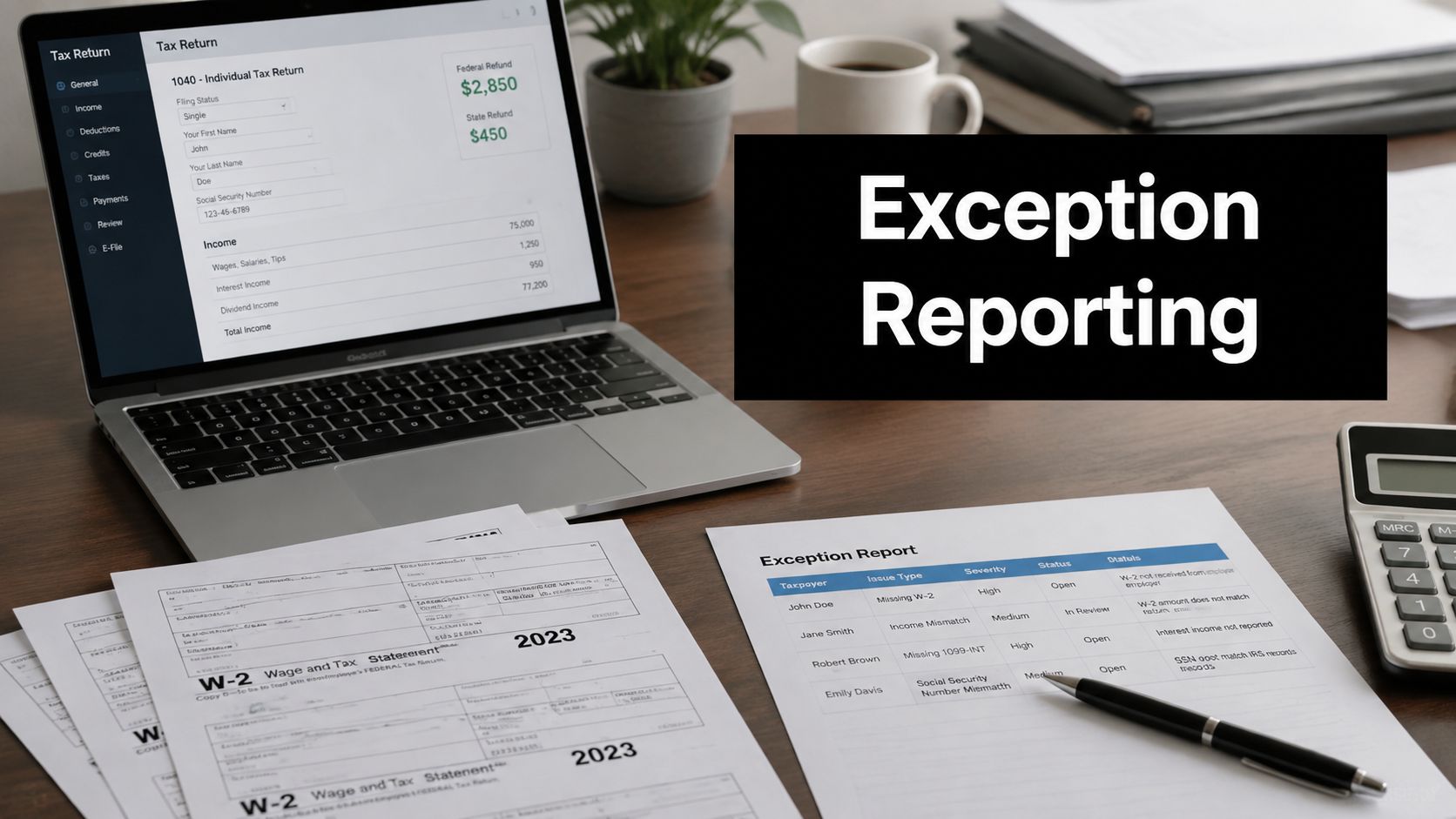
Peak season has a familiar rhythm. A reviewer opens a long individual return, places W-2s, 1099s, brokerage statements, and state documents beside it, then starts checking every field against every source. Hours later, the reviewer has worked hard, but the file may still show which items were checked, which required judgment, and how any discrepancy was resolved.
That's the problem exception reporting is designed to solve. Instead of asking a reviewer to give equal attention to every line, it applies defined rules to normalise routine items and surfaces deviations for investigation. In a tax practice, the shift is from broad visual inspection to controlled, documented attention.
Table of Contents
- Why Line-by-Line Review Is Breaking Tax Teams
- Understanding Exception Reporting as a Control Method
- Line-by-Line Review Versus Review by Exception
- Common Exception Types in Individual Tax Returns
- Building an Exception Handling and Escalation Workflow
- Benefits for Tax Preparers and Review Managers
- Adopting Exception Reporting with the Right Tools and Thresholds
Why Line-by-Line Review Is Breaking Tax Teams
A line-by-line review looks rigorous because it leaves little visibly untouched. In practice, it often turns a reviewer into a human comparison engine. The reviewer moves from a wage figure to withholding, from a brokerage statement to basis, then back to the return to confirm that nothing changed during preparation.
The weakness isn't effort. It's the structure of the work. Routine values consume the same attention as unusual values, even though they don't carry the same review risk. As the file gets longer, the reviewer's task becomes repetitive, and repetition makes it harder to distinguish a meaningful process failure from a harmless formatting difference.
Practical observation: A review can be comprehensive in scope without being attentive in substance.
The audit trail creates a second problem. A reviewer may leave notes in a workpaper, mark a PDF, or send a message to the preparer, but those records often remain disconnected from the source document, drafted return value, rule that triggered the concern, and final disposition. If a partner later asks why an item was accepted, the team may have to reconstruct the decision from scattered evidence.
Why more checking doesn't automatically mean better checking
Consider a return containing wages, investment activity, several information returns, and state allocations. A full-population review forces the reviewer to confirm both expected matches and genuine mismatches. That approach doesn't skip risk, but it buries risk inside a large volume of routine confirmations.
The operational consequence is predictable. Reviewers spend time proving that normal records are normal, while exceptions that require professional judgment compete for attention. The firm then faces a poor choice: slow the process further, or accept a workflow where the quality of review depends heavily on individual stamina.
Firms looking to reduce that pressure should treat efficiency as a control-design issue, not a staffing issue. Practical workflow guidance on improving tax team efficiency is most useful when it connects time savings to clearer ownership, evidence, and escalation.
Exception reporting changes the starting question. Instead of asking, “Did someone look at every line?” the manager asks, “What rules were applied, what broke those rules, and can we show how each break was handled?”
Understanding Exception Reporting as a Control Method
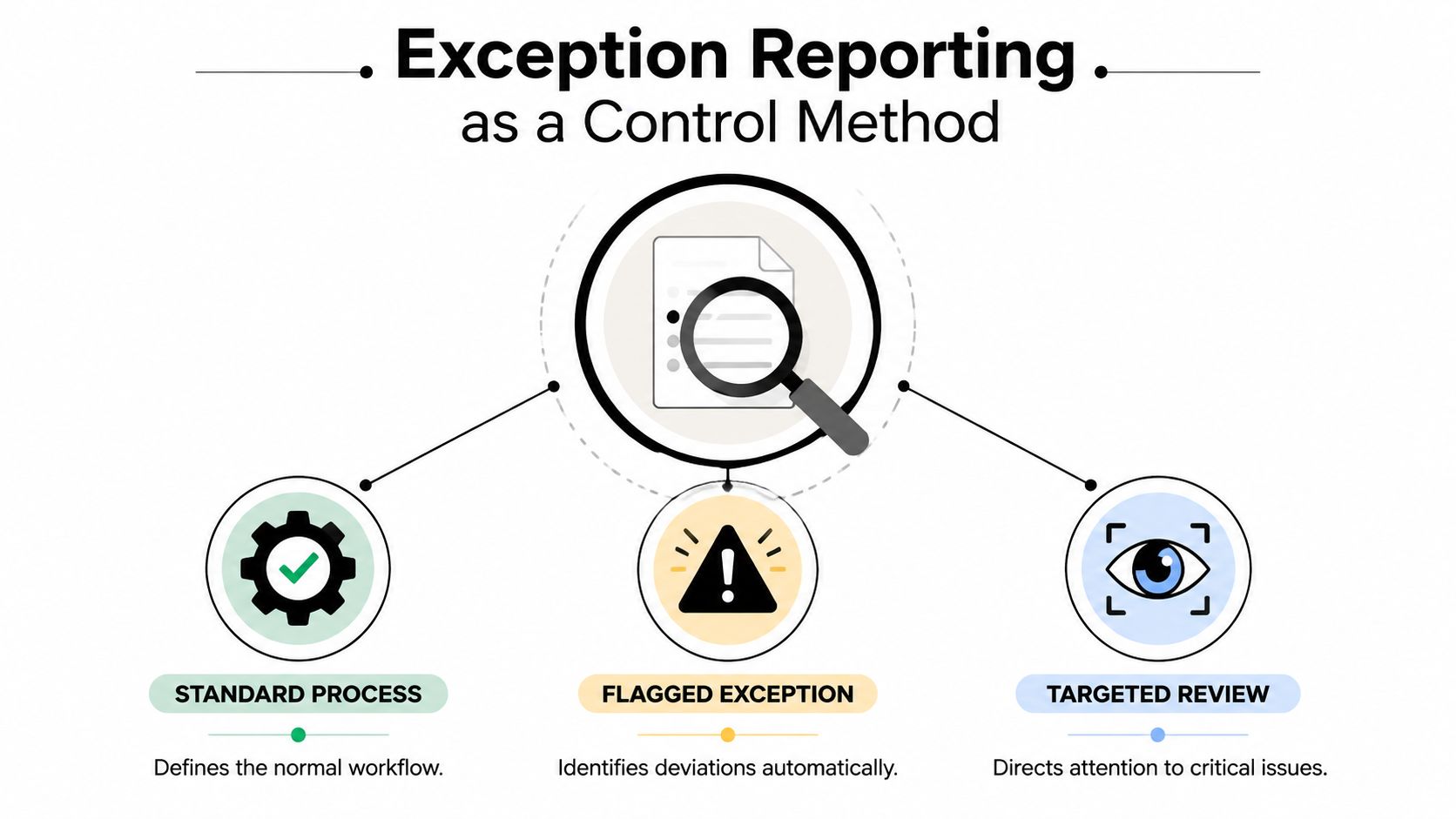
What is exception reporting? It's a control-and-oversight method that flags activity outside a defined standard or expected process for review, rather than requiring a person to examine every transaction line by line. The system applies rules to operational, financial, or governance data, suppresses records that meet the expected conditions, and presents the deviations that need human attention.
That distinction matters. An exception report isn't valuable because it labels something unusual. It's valuable because it filters out normal activity and directs a reviewer toward a defined control question. Infrastructure monitoring uses the same diagnostic logic, comparing telemetry against thresholds and presenting the exception list instead of every normal reading, as described in this standard reporting guide for exception-focused monitoring.
The control pattern behind the report
A useful exception control has four parts:
- Expected condition: The firm defines what a correct match, complete file, or approved process should look like.
- Triggering rule: The system identifies a variance, missing value, override, late entry, or other departure from that condition.
- Human review: A qualified person investigates whether the flag represents an actual error, an acceptable difference, or a data issue.
- Evidence of disposition: The firm records the decision, supporting explanation, responsible reviewer, and closure status.
Australian government fraud-control guidance frames exception reports as more than data outputs. It recommends checking whether thresholds are appropriate, whether reports are produced and used, whether the right staff review them, and whether report statistics show how many exceptions occur and how often. That guidance is available in the Australian government material on exception reporting controls.
The governance dimension is important for CPA firms. A well-designed report can support segregation of duties by separating preparation from review, surface activity that departs from the normal process, and preserve a record of the response. Audit practice also treats an exception as a control failure or deviation from an expected result. A single failed sample can therefore require documentation even when the broader control program remains intact.
Historically, the term was already established in public-sector auditing by the early 1990s, when a Minnesota legislative audit report referred to a “new style” replacing traditional reporting only on an exception basis. Financial-market supervision also adopted the concept, with India's securities regulator describing changes made to emphasize oversight and exception reporting. The Minnesota legislative audit report provides that historical context.
Line-by-Line Review Versus Review by Exception
The two approaches don't differ only in speed. They assign human judgment differently.
With line-by-line review, the reviewer checks every field on every page against the source documents. With review by exception, automated validation checks expected relationships and surfaces only the records that violate configured rules. The reviewer still makes the important decisions, but routine matches no longer consume the same review bandwidth.
Take a 1040 file with 15 source documents and 200 data points. Those figures are part of the example scenario, not a universal benchmark. Under a full-population method, the reviewer checks all available fields, including values that match cleanly. Under an exception workflow, the system compares the validated source data with the drafted return and presents the mismatches, missing items, and process events requiring investigation.

Where each method succeeds and fails
| Review dimension | Line-by-line review | Review by exception |
|---|---|---|
| Time allocation | Spreads effort across every field | Concentrates effort on flagged items |
| Reviewer attention | Requires sustained attention through routine matches | Reserves judgment for deviations |
| Error visibility | Depends on the reviewer noticing issues during repetitive checking | Depends on complete, well-designed rules |
| Audit evidence | Can become scattered across notes and marked documents | Can connect the rule, evidence, decision, and sign-off |
| Main weakness | Fatigue and inconsistent documentation | False positives, false negatives, or incomplete coverage |
The objection I hear most often is simple: “What if the system doesn't flag something?” That concern is valid. Exception reporting doesn't remove the need for professional review, rule maintenance, or periodic completeness checks. It changes the control model, so the firm must verify that the rules cover the risks it cares about.
A flag also isn't automatically an error. Audit analytics guidance from the Financial Reporting Council stresses the need for explicit procedures when data analytics identify potential exceptions. The FRC guidance on addressing exceptions in audit data analytics is a useful reminder that detection and conclusion are separate steps.
The strongest implementation combines automated comparison with documented human resolution. It doesn't claim that every flagged item is wrong. It proves that every relevant flag received an appropriate response.
Common Exception Types in Individual Tax Returns
In a 1040 workflow, exceptions usually fall into two groups. The first involves a value that doesn't agree with a source. The second involves a process or data condition that makes the return less reliable, even when no single number looks obviously wrong.
A W-2 mismatch is a straightforward example. The source form shows wages and federal withholding, while the drafted return carries a different amount. The difference might come from extraction, manual entry, an amended source, or a preparer adjustment. The report should show both values and send the reviewer to the source page and return field.
A missing 1099 creates a different risk. The system may identify an information document during intake, but no corresponding income appears in the draft. The reviewer then determines whether the item belongs on the return, was intentionally excluded with support, or was assigned to another filing position.
Exceptions that require tax judgment
Brokerage statements often generate more complicated breaks. Proceeds may appear to tie while basis, holding-period information, or transaction grouping doesn't agree with the drafted Schedule D. The issue isn't limited to arithmetic. The reviewer needs to understand which source data was used and whether the return treatment matches the available documentation.
State withholding allocation can also produce a structural mismatch. A source document may contain state wages and withholding, while the return allocates those amounts differently across jurisdictions. A small-looking difference can affect filing positions, credits, and the need for further support.
The broader categories are just as important:
- Missing signatures: The file lacks a required signature or approval event, so the return isn't ready for release.
- Late entries: A document or adjustment arrives after the normal preparation stage, increasing the risk that prior review conclusions no longer cover the final draft.
- Overrides: A preparer changes a system value or accepts a warning, creating a decision that needs a reason and reviewer visibility.
- Holds: The return contains an unresolved condition, such as missing support or an open client question.
- Data-integrity issues: The source is incomplete, duplicated, unreadable, or linked to the wrong taxpayer or return.
| Exception Category | Example Scenario | Risk Level |
|---|---|---|
| W-2 mismatch | Source wages or withholding differ from the drafted return | High |
| Missing 1099 | An information return is received but no corresponding income is present | High |
| Brokerage basis discrepancy | Statement basis doesn't agree with Schedule D treatment | High |
| State allocation error | State wages or withholding are assigned to the wrong filing position | High |
| Missing signature | Required approval or taxpayer signature isn't recorded | High |
| Late entry | A new document arrives after review has started | Medium to high |
| Override | A preparer accepts or changes a system result without a documented rationale | Medium to high |
| Hold | An unresolved question prevents clean completion | Medium |
| Data-integrity issue | A source is duplicated, incomplete, or associated with the wrong file | High |
A good exception report tells the reviewer what changed, why it matters, and where the evidence lives.
Building an Exception Handling and Escalation Workflow
An exception report becomes a control only when the firm defines what happens after the flag appears. A list sitting in a spreadsheet creates another queue. A workflow assigns responsibility, preserves evidence, and makes unresolved risk visible to the right person.
The record should begin at the moment automatic matching fails. Capture the triggering rule, source system, affected identifier, source value, return value, and reason for the mismatch. That information gives the reviewer a starting point instead of forcing a second investigation into how the flag was produced.
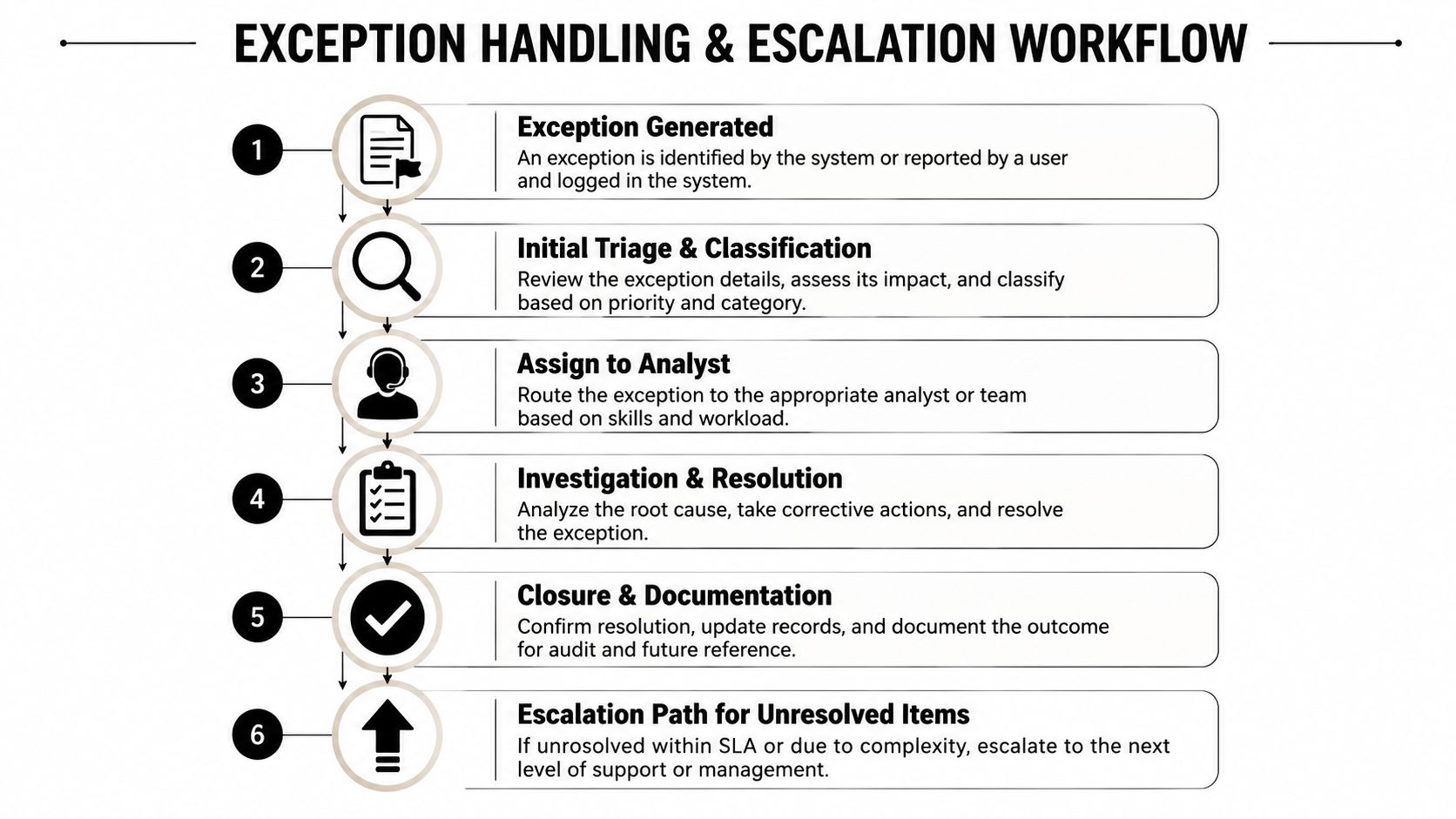
A workable lifecycle
- Generate the exception. The system records the failed comparison or process condition.
- Triage and classify. The reviewer separates likely data-quality issues, acceptable differences, tax-treatment questions, and urgent control failures.
- Assign ownership. The preparer may correct source mapping, the reviewer may resolve a judgment issue, and a partner may decide on a material or unresolved matter.
- Investigate. The assigned person checks the original document, return position, client correspondence, and relevant workpaper.
- Document and close. The record states what happened, what changed, who approved it, and when the item was closed.
- Escalate open risk. Items without adequate support move upward rather than disappearing into a completed status.
Roles matter because handoffs create risk. The preparer shouldn't be the only person who can close a discrepancy they created, and a partner shouldn't receive a vague queue with no classification or evidence. A controlled tax workpaper automation workflow can help firms connect source documents, review actions, and sign-off rather than treating each as a separate artifact.
The final record should be exportable and understandable to someone who wasn't present during the original review. That's what turns exception handling into audit-ready evidence.
Benefits for Tax Preparers and Review Managers
Preparers gain focus first. They can spend less time rechecking values that already agree and more time resolving missing documents, unusual source relationships, and decisions that require tax knowledge. That doesn't eliminate preparation work. It removes avoidable repetition from the review stage.
Review managers gain a more useful view of workload and risk. Instead of asking whether a return has been “reviewed,” they can see which files carry unresolved exceptions, which categories recur, and where a process needs correction. That visibility supports coaching and control improvement without relying entirely on informal impressions.
Partners gain defensibility. A structured record can show the source involved, the rule that raised the issue, the reviewer's conclusion, the corrective action, and the final approval. In an examination or internal review, that history is more useful than a generic sign-off stating that someone looked over the return.
Why the method matters beyond efficiency
Exception reporting also fits a broader governance pattern. Public-sector auditing and financial-market supervision have used exception-focused oversight as a way to direct attention toward departures from expected activity. Healthcare review literature has described exception reporting as significantly underused, despite its potential value for areas such as rotas, training, and patient safety. The lesson for tax firms is practical: a sound control can remain underused if it isn't connected to a workflow people trust.
The strongest firms treat the report as a management instrument, not just a preparer convenience. They review recurring exception categories, refine rules when processes change, and distinguish a clean return from a return that was closed without evidence.
Adopting Exception Reporting with the Right Tools and Thresholds
Threshold design is the hardest part of adoption. Set rules too narrowly and the queue fills with harmless differences. Set them too broadly and the system can miss issues that deserve attention. The right threshold depends on the risk of the item, the quality of the source data, and the action a reviewer should take when a flag appears.
Start with rules that are easy to explain and tie directly to a control objective. Then classify flags by severity, such as critical, review-required, informational, or data-quality. Revisit the rules when forms, processes, source quality, or filing practices change. A threshold that worked for one return category may not be appropriate for another.
A practical adoption checklist
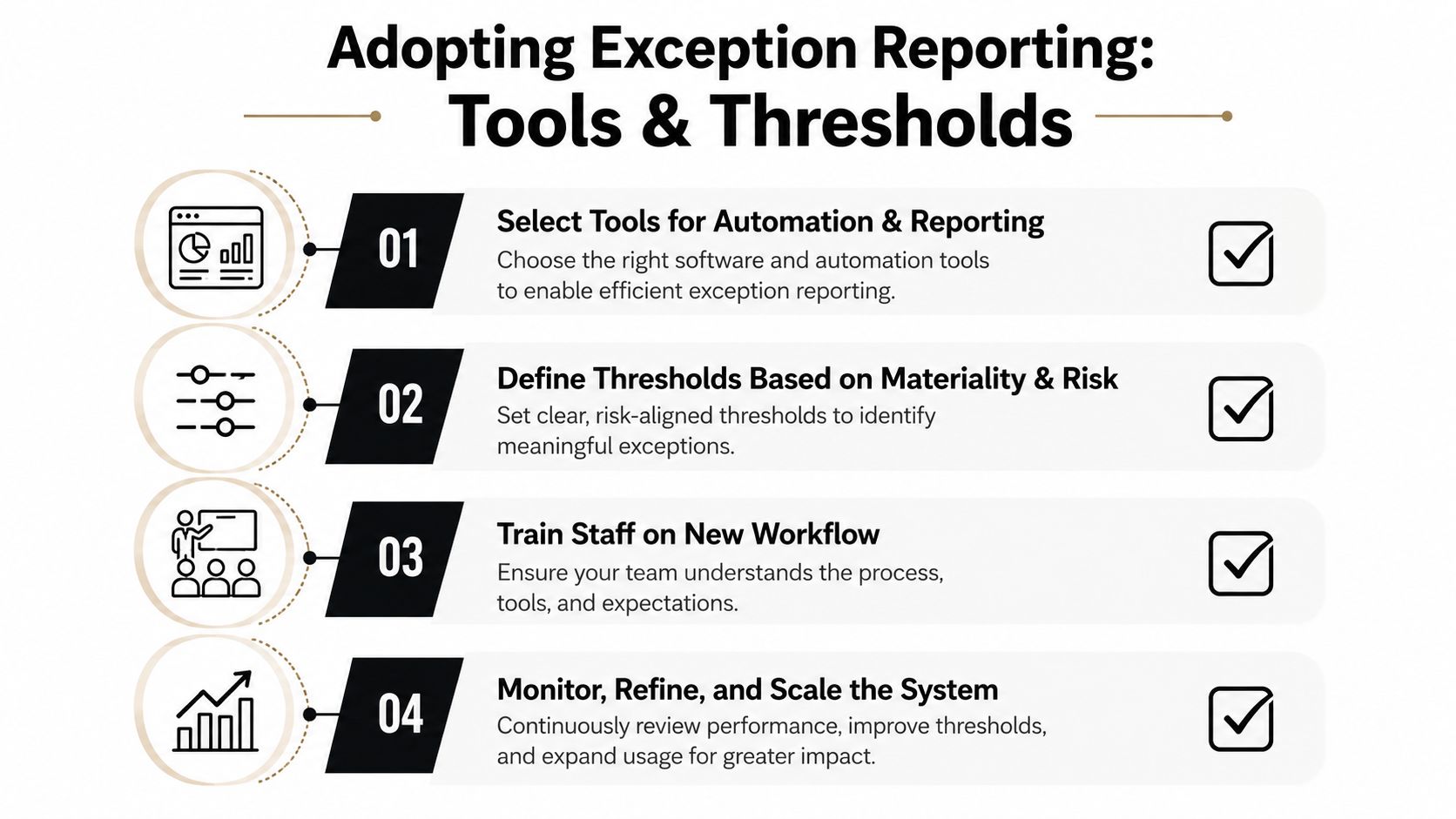
- Choose traceable automation: The tool should preserve source pages, return fields, comparison logic, and reviewer actions.
- Define risk-based rules: High-consequence items deserve tighter review conditions than low-risk routine differences.
- Train for disposition: Staff need to know how to accept, correct, explain, escalate, and close an exception.
- Monitor the queue: Review false positives and missed issues, then adjust the rule set instead of blaming users for noise.
For firms evaluating CPA review software, the essential question is whether the platform supports the entire control cycle. WP TieOut is one example of a platform that ingests W-2s, 1099s, brokerage statements, and other source documents, validates extracted data, compares it with a drafted 1040, and compiles a source-linked bookmarked PDF binder with stamps, annotations, and sign-off records. It's the connection between detection and evidence that determines whether exception reporting improves the review or creates another report.
WP TieOut gives CPA firms a review-by-exception workflow for validating source documents against drafted 1040 returns, linking discrepancies to their evidence, and preserving a clean sign-off history. Visit WP TieOut to evaluate the end-to-end process from document intake through partner approval.