
By 8:00 on Monday morning, the review queue already feels behind. Drafted 1040 returns are waiting beside completed W-2s, 1099s, brokerage statements, and follow-up emails. The review manager has to decide which return deserves attention first, which one can move forward, and which one only looks clean because nobody has tied the numbers back to the source documents.
That decision is where AI quality assurance earns its place in a tax practice. Used correctly, it doesn't replace professional judgment. It handles the repeatable comparison work, identifies exceptions that deserve scrutiny, and leaves the reviewer with evidence instead of another screen full of unexplained confidence scores.
Table of Contents
- A Review Manager's Monday Morning
- What AI Quality Assurance Actually Means in Tax Work
- The Four Pillars of AI QA for 1040 Review
- Governance and Validation Best Practices
- Review by Exception in Practice
- Evaluating AI QA Vendors for Your Firm
- A 30-60-90 Day Implementation Checklist
A Review Manager's Monday Morning
The queue shows 47 returns, three available reviewers, and a first hour that will determine how the rest of the day unfolds. One stack contains straightforward drafted 1040s with complete source documents. Another contains returns flagged from last week because a preparer still needs to answer questions. A return from a new preparer sits at the top of the manager's list, not because it has a known error, but because the manager doesn't yet know how consistently that preparer handles source-document tie-outs.
The first triage usually happens by instinct. A reviewer opens the return with brokerage activity because those files tend to hide more reconciliation work. Someone else takes the W-2-only return because it appears easy to clear. The manager sends two files back for missing explanations, then starts reading the new preparer's work line by line.
That routine feels responsible, but it mixes three different activities:
- Reconfirming clean work: Checking values that could have been compared automatically.
- Investigating exceptions: Following a discrepancy through a source document, workpaper, and drafted return.
- Managing uncertainty: Deciding whether a flagged item reflects a real issue, a document limitation, or an acceptable professional judgment.
The second and third activities need experienced reviewers. The first consumes their time without adding much judgment.
Practical rule: A reviewer should spend time deciding what a discrepancy means, not proving that every copied value was copied.
AI quality assurance changes the queue by placing a validation layer between document intake and human sign-off. The system reads the source documents, validates extracted fields, compares those fields with the drafted return, and routes only the items that need attention. A clean return still receives review, but the reviewer sees the checks that support the conclusion rather than starting from a blank page.
That distinction matters in a mid-sized CPA firm. A review process can't depend on the manager remembering which preparers need extra scrutiny or which return types tend to produce recurring errors. The platform must make the evidence visible, preserve the decision trail, and let the reviewer direct time toward material exceptions.
What AI Quality Assurance Actually Means in Tax Work
For tax practitioners, AI quality assurance means validating that an AI-produced or AI-assisted output is accurate, traceable, and defensible before it reaches the taxpayer. The output under review is the drafted 1040. The ground truth is the set of validated source documents, including W-2s, 1099s, 1098s, brokerage statements, and supporting workpapers.
The most useful comparison is bank reconciliation. Bookkeepers don't accept a ledger balance because it looks plausible. They compare the ledger with the bank statement, investigate differences, document adjustments, and preserve the reasoning behind the final balance. A 1040 QA workflow should apply the same discipline to return data.
A practical reconciliation sequence looks like this:
- Capture the source value. Extract the relevant field from the document and retain the page and location where it appeared.
- Validate the extraction. Check that the value, form type, taxpayer identity, and relevant tax year are consistent with the document.
- Compare against the return. Match the validated workpaper value to the corresponding return line or schedule.
- Route the difference. Send a meaningful discrepancy to a reviewer with the source excerpt and comparison context.
- Record the resolution. Preserve the reviewer decision, explanation, override, and sign-off details.
This isn't the same as claiming that an AI model is generally accurate. A fluent model response can still be factually fabricated, which is why LLM-focused QA should test grounding and faithfulness by comparing outputs with retrieved or source-linked evidence, as described in research on source-grounded LLM evaluation. For tax review, the equivalent is simple: every material value needs a traceable relationship to the document that supports it.
Generic data-quality dashboards also fall short. They may tell a firm that a field is populated or that a file passed a structural check. They won't necessarily show whether the wages on the drafted return agree with the W-2, whether a 1099-B basis value came from the right issuer, or whether a reviewer approved an exception after examining the original page.
The QA layer must therefore combine mechanical reconciliation and professional escalation. It should catch mismatches that rules can identify, rank the items that could affect the return, and preserve enough context for a reviewer to make a defensible decision.
A strong system also evaluates consistency across repeated runs and changing model versions. Broader hallucination testing guidance recommends combining accuracy, faithfulness, relevance, and consistency checks rather than relying on a single pass or one score, as outlined by the HaluEval evaluation framework. In a 1040 workflow, that means testing not just whether a value was extracted once, but whether the system continues to associate the same value with the same source evidence under controlled review conditions.
The Four Pillars of AI QA for 1040 Review
A reliable 1040 review workflow rests on four operational pillars. Together, they turn AI from a document-reading convenience into a controlled quality process.

Validation
Validation ties each return value back to a source document through structured field-level checks. For a W-2, the workflow should identify the employer form, capture the relevant box, retain the document location, and compare the validated value with the corresponding drafted-return data. If the figures don't agree beyond the firm's defined tolerance, the system should flag the difference instead of automatically accepting the populated field.
The same logic applies to a 1099. A reviewer needs to know whether the amount came from interest, dividends, proceeds, or another reported category, and whether the platform linked that value to the correct issuer and source page. A tool that only extracts text without validating context leaves the reviewer with another transcription risk.
Firms evaluating AI document extraction for tax workflows should ask whether extraction and reconciliation are connected. OCR alone can read a document. QA must prove how the read value supports the return.
Exception surfacing
Not every difference deserves equal attention. A system should rank exceptions according to risk, materiality, confidence, and the kind of source involved. A buried cost-basis discrepancy on a brokerage statement may deserve earlier review than a minor rounding difference on a routine deduction.
The system should show the reviewer the exception, the relevant source excerpt, the return value, and the rule that triggered the alert. It shouldn't force the reviewer to search through the entire PDF packet to reconstruct the issue.
Audit trail
Every check and decision needs a durable record. That record should include the source document, extracted value, comparison result, reviewer identity, timestamp, comments, and any override. If a reviewer changes the disposition, the platform should preserve both the original alert and the reason for the change.
This evidence supports internal review, peer review, and later questions about how the return moved from intake to approval. A final green status without the underlying history isn't an audit trail. It's only a status label.
Governance
Governance determines who controls the rules and who can approve exceptions. The firm should define who sets tolerances, who can change a validation rule, who reviews recurring false positives, and which matters require partner involvement.
Model and workflow changes also need version control. If a vendor changes extraction behavior or scoring logic, the firm should know which version evaluated a return and whether the change affects prior validation results. Governance makes the process repeatable when staff, documents, and software behavior change.
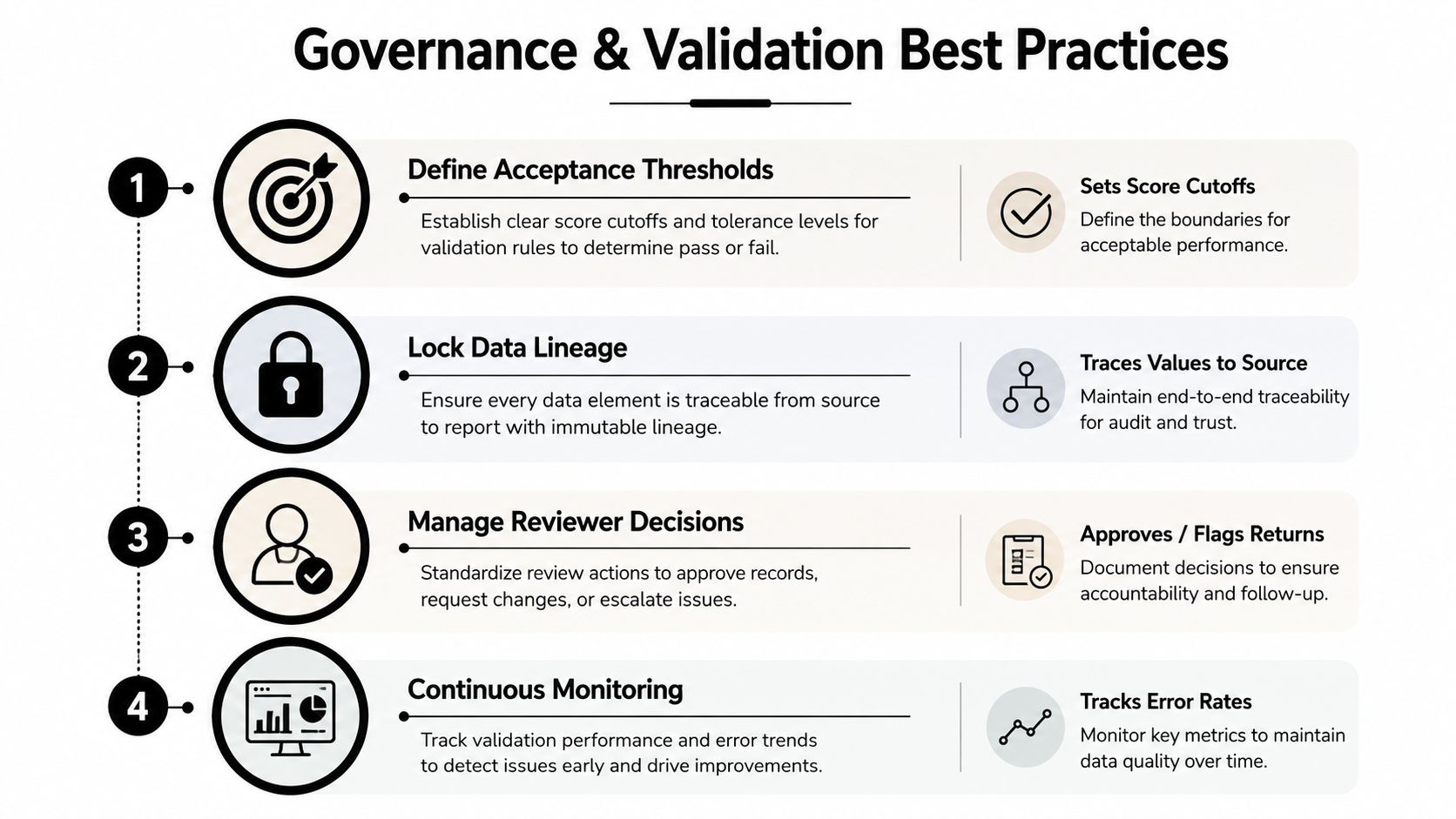
Governance and Validation Best Practices
Governance works best as a sequence of decisions made by identifiable people. A compliance binder can't decide whether a reviewer should accept a difference between a W-2 and a drafted return. The operating process has to define what happens before, during, and after that decision.
Set acceptance thresholds before live review
Start by defining what counts as an automatic match, a reviewable variance, and a mandatory escalation. The threshold may differ by field and document type. A firm might treat a straightforward W-2 match as low risk while requiring additional scrutiny for a brokerage value affected by basis reporting or issuer inconsistencies.
Don't let the model's confidence score become the acceptance rule by default. Calibrate that score against prior review notes and known exceptions. The firm should understand which score ranges historically produced clean matches and which ranges frequently required human intervention.
Lock the lineage
A reviewer should be able to move from a return value to the validated workpaper, then to the exact source-document page. That chain needs to remain intact when a preparer edits the return or a reviewer adds a note.
A defensible review doesn't just show the final number. It shows where the number came from and who accepted it.
For each exception, retain the original value, the comparison result, the source excerpt, the reviewer explanation, and the final disposition. Audit trail practices for tax review provide a useful reference point for designing that evidence trail around actual reviewer actions rather than generic activity logs.
Route decisions by risk
Tier returns and exceptions by complexity, not by preparer preference. A clean W-2-only file may need a standard reviewer sign-off. A return with multiple brokerage statements, unusual transactions, or unresolved document ambiguity may need a senior reviewer or partner decision.
Escalation rules should also respond to workflow behavior. If a particular document type suddenly generates an unusual number of exceptions, pause expansion and investigate the cause. The issue may be a changed form layout, an extraction problem, a new preparer habit, or an overly sensitive rule.
Monitor overrides
An override isn't a failure. It can represent correct professional judgment. The failure occurs when the firm can't see how often overrides happen, who makes them, or why the system's alert was rejected.
Review override patterns during regular QA meetings. Repeated overrides may justify a rule change, better source-document handling, or additional preparer training. A recurring missed exception, by contrast, may require tighter thresholds or a new validation test.
The broader evaluation literature identifies an evaluation gap between controlled benchmark performance and messy production behavior, especially when systems handle outdated information or multi-step workflows, as discussed in AI quality assurance reporting on production evaluation gaps. For tax firms, continuous monitoring closes part of that gap by testing the workflow on the returns and documents the firm processes.
Review by Exception in Practice
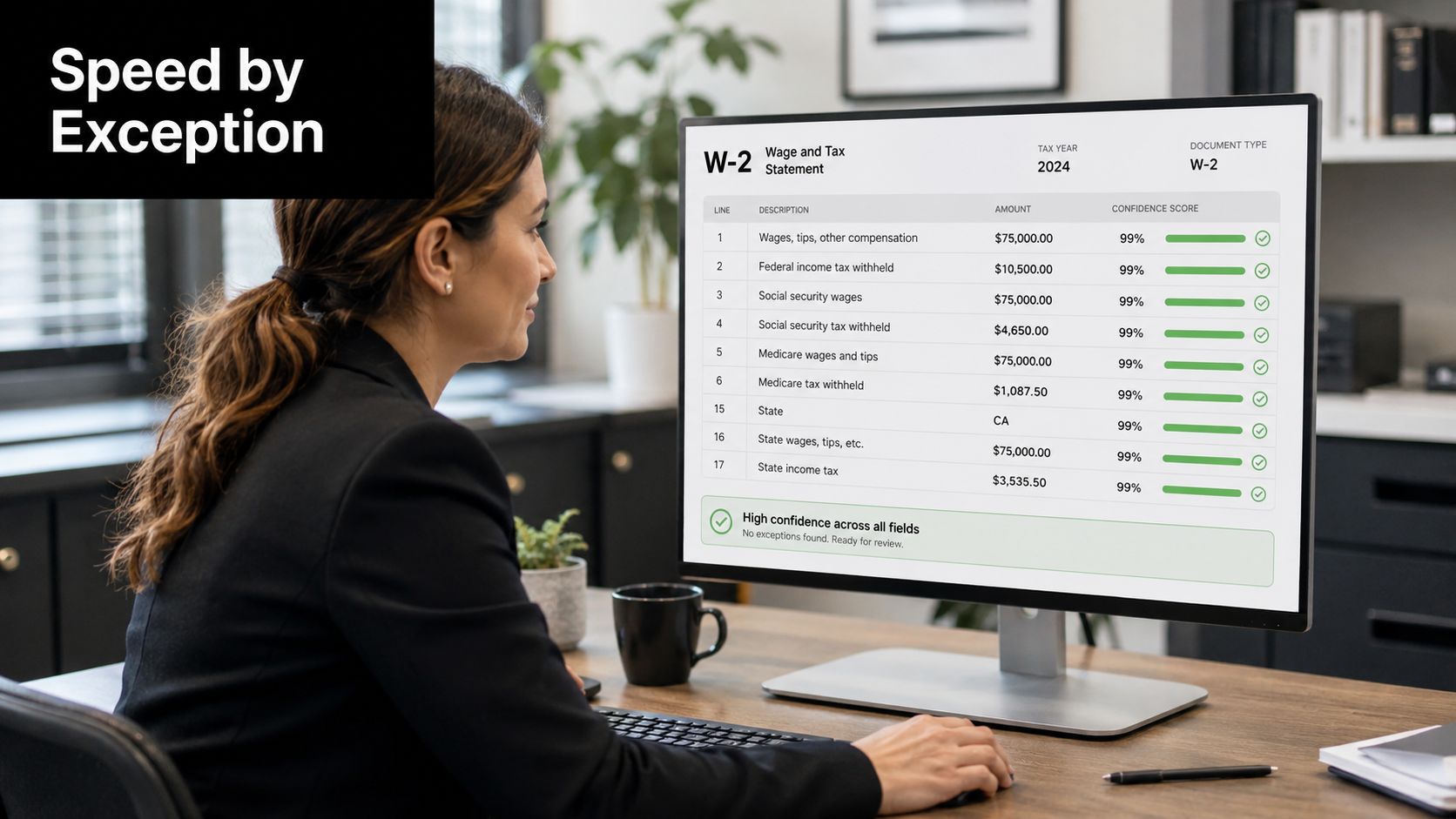
The value of review by exception becomes obvious when two returns enter the queue together.
The first is a W-2-only return with complete, legible source documents. The system validates the extracted values, compares them with the drafted 1040, and shows no material discrepancies. The reviewer opens the evidence panel, confirms the linked fields, checks the preparer's notes, and signs off in under five minutes. The reviewer hasn't skipped the return. The reviewer has avoided repeating mechanical checks that the system already documented.
The second return includes brokerage activity reported across more than one issuer. A cost-basis value on the drafted workpaper doesn't agree with the corresponding value associated with another statement. The exception isn't presented as a vague warning. The reviewer sees the disputed field, a linked source-document excerpt, the drafted-return value, and the reconciliation rule that produced the alert.
The reviewer drills into the documents and determines whether the difference reflects a real mismatch, a duplicated record, or a legitimate treatment that needs explanation. After confirming the appropriate treatment, the reviewer records an override with a note and signs the exception. The system keeps the original alert and the resolution, so a later reviewer can understand why the return moved forward.
That contrast defines good AI QA. The clean file moves quickly because its evidence is organized. The complicated file receives more attention because the platform has isolated the issue, not because the reviewer had to reread every page.
The approach also addresses a wider operational concern. Analysis of 8.1 million pull requests by LinearB found that AI-generated code was associated with 91% longer pull-request review times, while related 2026 QA reporting found that 52% of QA engineers reported higher bug volume and 58% reported a larger testing workload after developers adopted AI, as summarized in 2026 AI quality assurance industry reporting. The lesson transfers to tax operations: automation can increase the amount of material requiring review unless the QA layer separates clean outputs from genuine exceptions.
Evaluating AI QA Vendors for Your Firm
A vendor demo should end with evidence, not enthusiasm. Give each vendor the same representative return packet, including a clean W-2 file and a document set with known discrepancies. Ask the vendor to show the source excerpt, comparison logic, confidence record, reviewer action, and final export.
The scoring matrix below gives a managing partner a consistent basis for comparison. Use a defined internal scale for each qualitative column, and agree on the weights before demos begin. Put the greatest emphasis on audit trail depth, security and compliance, and accuracy reporting, because a fast workflow that can't explain its decisions creates a different kind of risk.
| Vendor | Audit Trail Depth | Security & Compliance | Accuracy Metrics | 1040 Reconciliation Fit | Weighted Score |
|---|---|---|---|---|---|
| Vendor A | |||||
| Vendor B | |||||
| Vendor C |
What to test during the demo
- Per-return confidence log: Can the platform show confidence by field, document, and comparison, or does it provide one overall score?
- Source-linked evidence: Can a reviewer open the exact document page and see the value used in the reconciliation?
- Validation methodology: Does the vendor explain how it tests extraction, matching, semantic alignment, and repeated-run consistency?
- False-positive testing: Will the vendor run your synthetic or historical 1040 dataset and disclose how often the system flags acceptable differences?
- Override handling: Does the platform preserve the original alert, the reviewer identity, the timestamp, and the explanation for the override?
- Model versioning: Can your firm identify which model and rules evaluated a return?
- Security controls: Ask about encryption, access controls, retention, role permissions, and the firm's ability to export or delete records.
- Workflow fit: Confirm that the system handles W-2s, 1099s, brokerage statements, workpapers, drafted returns, and partner sign-off without forcing reviewers into disconnected tools.
A platform such as WP TieOut's AI workflow automation is relevant to this evaluation because it compares validated source-document workpapers with drafted returns and supports review-by-exception. Treat that description as a starting point for testing, not a reason to skip your own data, security, and audit-trail review.
The strongest vendor is the one that performs predictably on your documents and makes its limitations visible. A polished dashboard matters less than a reviewer being able to answer, “Why was this return accepted?”
A 30-60-90 Day Implementation Checklist
A managing partner can hand the following rollout to a review manager without turning the pilot into an enterprise-wide experiment.
Days 1 to 30, scope the pilot
Choose one return type, usually individual 1040 work, and define the review question the system must answer. Establish a baseline from the firm's prior review notes, then select a controlled group of prior-year returns containing known exceptions, including source-document mismatches and reviewer overrides.
Write down the acceptance criteria before anyone evaluates the results. The pilot should measure whether the platform finds the issues reviewers already know about, whether it creates distracting false positives, and whether its evidence is usable during sign-off.

Days 31 to 60, validate without production dependence
Run the selected returns through the AI QA workflow while human reviewers continue their normal assessment. Compare the system's exceptions with the reviewers' findings. Record false positives, false negatives, missing source links, extraction failures, and decisions that required tax judgment.
Tune thresholds only after reviewing the underlying examples. A lower threshold may catch more questionable items while overwhelming the queue. A higher threshold may reduce noise while allowing meaningful discrepancies through. The right setting is the one reviewers can use consistently and explain.
Days 61 to 90, introduce controlled production
Move into live work with a capped volume, a named escalation owner, and a weekly QA huddle. Review exception patterns, override reasons, source-document failures, and changes in model or workflow behavior. Don't expand the pilot just because the first returns look clean.
Before adding return types or broader preparer groups, require documented evidence that the system links values to source documents, routes meaningful exceptions, preserves reviewer decisions, and supports partner sign-off. The firm should also know who pauses the workflow when quality signals deteriorate.
A major 2025 to 2026 benchmark found that 89% of organizations were piloting or deploying generative-AI-augmented quality engineering workflows, while only 15% had scaled those workflows across the enterprise, based on a survey of more than 2,000 executives across 22 countries in the industry benchmark on AI quality assurance adoption. That scale gap is a useful warning for CPA firms. Adoption is easy to announce. Reliable rollout requires controlled scope, documented evidence, and governance that keeps working after the pilot team changes.
At the end of the 90-day period, make the expansion decision from the review record, not from general impressions. If the platform reduces repetitive checking while improving traceability, expand deliberately. If it produces noise or hides uncertainty, fix the workflow before adding volume.
WP TieOut helps CPA firms compare validated W-2s, 1099s, brokerage statements, and other source documents with drafted 1040 returns, then route discrepancies for documented human review. Visit WP TieOut to examine the intake, reconciliation, source-linked binder, and sign-off workflow against your firm's own review requirements.