
At 8:12 on Monday morning, a manager at a 35-person CPA firm opens an email from a reviewer. The reviewer wants the W-2 supporting an adjustment on a 1040 prepared nine months earlier. A state notice has already arrived, the original PDF isn't in the engagement folder, and the preparer remembers forwarding it as an email attachment. Someone may have saved a copy to the shared drive. The partner may still have another copy on a local computer.
The firm has files. It doesn't have a vault.
That distinction matters. A defensible record must connect each reported amount to its source, preserve the review history, control access, and remain retrievable long after the return leaves active production. A document matching workflow can help firms organize that evidence, but the technology only works when the firm treats documentation as an operational record rather than leftover storage. Document matching software for tax review workflows is one example of the category, not a substitute for a documented governance process.
Table of Contents
- The Monday Morning a Vault Would Have Saved
- What Audit Vault Documentation Actually Means
- The Four Pillars of a Defensible Vault
- Retention Windows Every CPA Firm Should Know
- What Goes Inside a Source-Linked Audit Binder
- How AI Tie-Out Tools Reshape Vault Requirements
- A Practical 90-Day Implementation Roadmap
- Checklist and Closing Thoughts
The Monday Morning a Vault Would Have Saved
The manager starts with the engagement folder. She finds the final return, a spreadsheet with a revised wage figure, and a note that says “client confirmed.” The note doesn't identify which client document supported the change, who reviewed it, or whether the figure came from the original W-2 or a later correction.
She searches email next. Three threads contain attachments with similar filenames. One attachment is a scan of the W-2, another is a draft export, and the third has no obvious indication that it was the document used for the adjustment. The preparer is out of the office, and the partner's local drive isn't available to the review team.
A file's location is not its history. A reviewer needs to reconstruct the evidence path, not merely find something that looks familiar.
A real audit vault documentation process would have preserved the source document, the exact line or field used, the adjustment, the person who made it, the reviewer's response, and the time of each relevant action. It would also show whether the document was replaced, annotated, or removed after upload. The manager could open the adjustment and follow a source link directly to the supporting page instead of rebuilding the file trail from memory.
The problem isn't limited to one missing W-2. The same weakness appears when a brokerage statement is replaced after a corrected 1099 arrives, when a reviewer clears an exception in a spreadsheet, or when a client explains a discrepancy by email but nobody attaches that explanation to the workpaper. Each event leaves a gap between the number on the return and the evidence behind it.
A shared drive may provide backup and collaboration. Email may provide communication. Neither one, by itself, provides a retention-managed, access-controlled, source-linked record that another person can reconstruct on demand. That is the practical purpose of an audit vault.
What Audit Vault Documentation Actually Means
Audit vault documentation is a controlled archive of source documents, workpapers, correspondence, review notes, sign-offs, and activity metadata that supports an engagement from preparation through later examination. The vault should answer five basic questions for every material item:
- What: Which document, value, calculation, or decision is being preserved?
- Who: Which client, preparer, reviewer, or partner handled it?
- When: When was it uploaded, changed, reviewed, approved, or superseded?
- Where: Which source page, system, device, or workflow step produced the evidence?
- Why: Why was an adjustment accepted, rejected, or escalated?
Generic cloud storage answers only part of that list. It may show a filename and a modified date, but it often doesn't establish whether the document is the original source, whether the change was authorized, or whether the file can be protected from later alteration. A vault adds role-based access, retention enforcement, chronological audit trails, integrity safeguards, and reviewer-ready indexing.
Federal controls illustrate the difference between casual storage and controlled records. NIST SP 800-53 AU-11 treats audit-record retention as an organization-defined obligation and connects retained records to investigations, legal needs, FOIA requests, subpoenas, and law-enforcement actions. The point for a CPA firm is straightforward: records must remain available for the period that the engagement, law, policy, or hold requires.
The vault also needs chain-of-custody metadata. A defensible audit trail records access and modification activity in chronological form, including who acted, what changed, and when the event occurred. Forensic Notes' explanation of audit trails describes this metadata as support for authenticity and for showing that an underlying document remained substantially unchanged.
Don't confuse a vault with a single exported PDF. A PDF may be the review deliverable, but the vault should preserve the underlying source files, linked workpapers, annotations, approvals, and event history. The final binder is the readable presentation. The vault is the controlled record that makes the presentation credible.
The Four Pillars of a Defensible Vault
A defensible vault has four separate disciplines. Firms often combine them under “document management,” but each answers a different review question.
Retention policy
Retention starts with a written schedule, not a folder structure. The policy should identify the record class, the start event, the required holding period, legal-hold treatment, permitted disposition, and evidence that disposition occurred. It should also distinguish an engagement file from temporary duplicates, superseded drafts, client-provided originals, and records that must remain available because of a dispute or examination.
A system that stores everything forever may avoid premature deletion, but it can create an uncontrolled archive. A governed vault should surface upcoming disposition decisions and prevent deletion when a hold applies.
Access control
Access control determines who can view, download, annotate, approve, or delete a record. A preparer may need to upload and update workpapers, while a reviewer may need to clear exceptions and a partner may need final approval. The firm should provision access by role and engagement, then remove or change it when responsibilities change.
Least privilege protects confidentiality and strengthens accountability. If every employee can edit every document, an activity log may show that a change occurred without proving that the change was authorized.
Audit trail
The audit trail records the chronology of activity. It should capture uploads, views where relevant, edits, replacements, annotations, approvals, rejected items, reopened exceptions, and exports. Each event should connect to a user identity and the affected record.
A log that says “file updated” is weak. A useful entry identifies the specific file, the action, the actor, the time, and the relationship between the old and new versions.
Integrity controls
Integrity controls help demonstrate that the record wasn't altered after the relevant event. Time-stamped versioning, cryptographic hashes, immutable storage, and write-once controls can support that objective. The right implementation depends on the firm's systems and risk profile, but the design principle is stable: the vault must preserve evidence of change while limiting unauthorized change.

A firm can have excellent retention and still fail because unauthorized users can modify records. It can have detailed logs and still fail to establish integrity if the records themselves can be replaced. Audit trail best practices for tax review are most useful when treated as part of this wider control system, not as an isolated logging feature.
Retention Windows Every CPA Firm Should Know
Retention decisions become easier when managers separate the governing event from the calendar date. The question isn't “How long should we keep this folder?” It is “Which rule applies, when did its clock begin, and has a hold changed the disposition decision?”
The verified federal examples show why a single firm-wide period can be misleading. Federal award records may follow one schedule, accounting originals another, and issuer audit workpapers a different schedule. The federal records examples summarized in the audit-trail reference include a 3-year period for certain federal award records, while the SEC's audit and review retention rule requires certain issuer workpapers to be retained for 7 years after the engagement concludes.
| Record Type | Minimum Retention | Governing Rule | Vault Action |
|---|---|---|---|
| Certain federal award records | 3 years from the Federal Financial Report submission, subject to later closing or reporting events | U.S. Office of Justice Programs requirements | Start the schedule from the applicable reporting event, then flag holds and later-triggering events |
| Certain federal accounting originals | 3 years old, or until audited by the Government Accountability Office, whichever is earlier | U.S. Department of Commerce handbook | Record the controlling event and preserve disposition evidence |
| Certain issuer audit and review records | 7 years after the engagement concludes | SEC 2003 retention rule | Keep workpapers and documents containing conclusions, opinions, analyses, or financial data searchable and protected |
| Tax engagement records | Firm-defined schedule based on applicable law, engagement policy, and holds | Engagement policy and applicable tax requirements | Assign a record class, review the trigger date, and block disposition while a hold applies |
The table doesn't replace tax counsel or the firm's records policy. It shows the operating model: retention is a schedule, not a folder. A vault should calculate or display the relevant trigger, identify the disposition date, and require an authorized decision before destruction or extension.
Source and workpaper treatment also needs care. The final engagement file may include the evidence needed to support the work, but a firm shouldn't assume that every receipt, duplicate, or transient draft has the same status. Classify records deliberately, document exceptions, and preserve the evidence needed to explain why a file was retained, superseded, or destroyed.
What Goes Inside a Source-Linked Audit Binder
A source-linked binder begins with the client's evidence, not with the preparer's conclusion. For a 1040 review cycle, the binder should let a manager start at a return line, locate the related workpaper, and open the exact source page supporting the amount.
The source layer
This layer contains original documents or controlled copies, such as W-2s, 1099s, brokerage statements, mortgage interest statements, charitable contribution records, and signed client representations. The record should preserve the original page structure and identify the document type, tax year, client, receipt date, and source relationship.
A filename like final_1099.pdf isn't enough. If a corrected statement arrives, the vault should preserve the earlier version, identify the replacement, and show which version supported the filed or reviewed amount.
The workpaper layer
Workpapers explain how the source became a return entry. They may include extraction results, calculations, classification decisions, reconciliation steps, review comments, and explanations supplied by the client. A reviewer should be able to distinguish machine extraction from human judgment and see which person accepted the final treatment.
Tie-outs belong here too. If wages on the return differ from the total of the source documents, the workpaper should show the reconciliation, the reason for the difference, and the reviewer's disposition of the exception.
The approval layer
Sign-offs should identify the role and action, not just display a checkmark. The record should show who performed the preparation review, who cleared an exception, who approved the final binder, and whether a later reopening changed the approval status.
Reviewer's test: Pick one important line on the return. If you can't reach the supporting source and the decision history without searching email, the binder isn't source-linked enough.
The metadata wrapper
The metadata wrapper makes the evidence defensible. It should preserve timestamps, user identities, version relationships, access events, annotations, exports, and integrity information. Where the workflow supports it, the record should also identify the relevant device or location, as chain-of-custody metadata can help establish authenticity during later review.
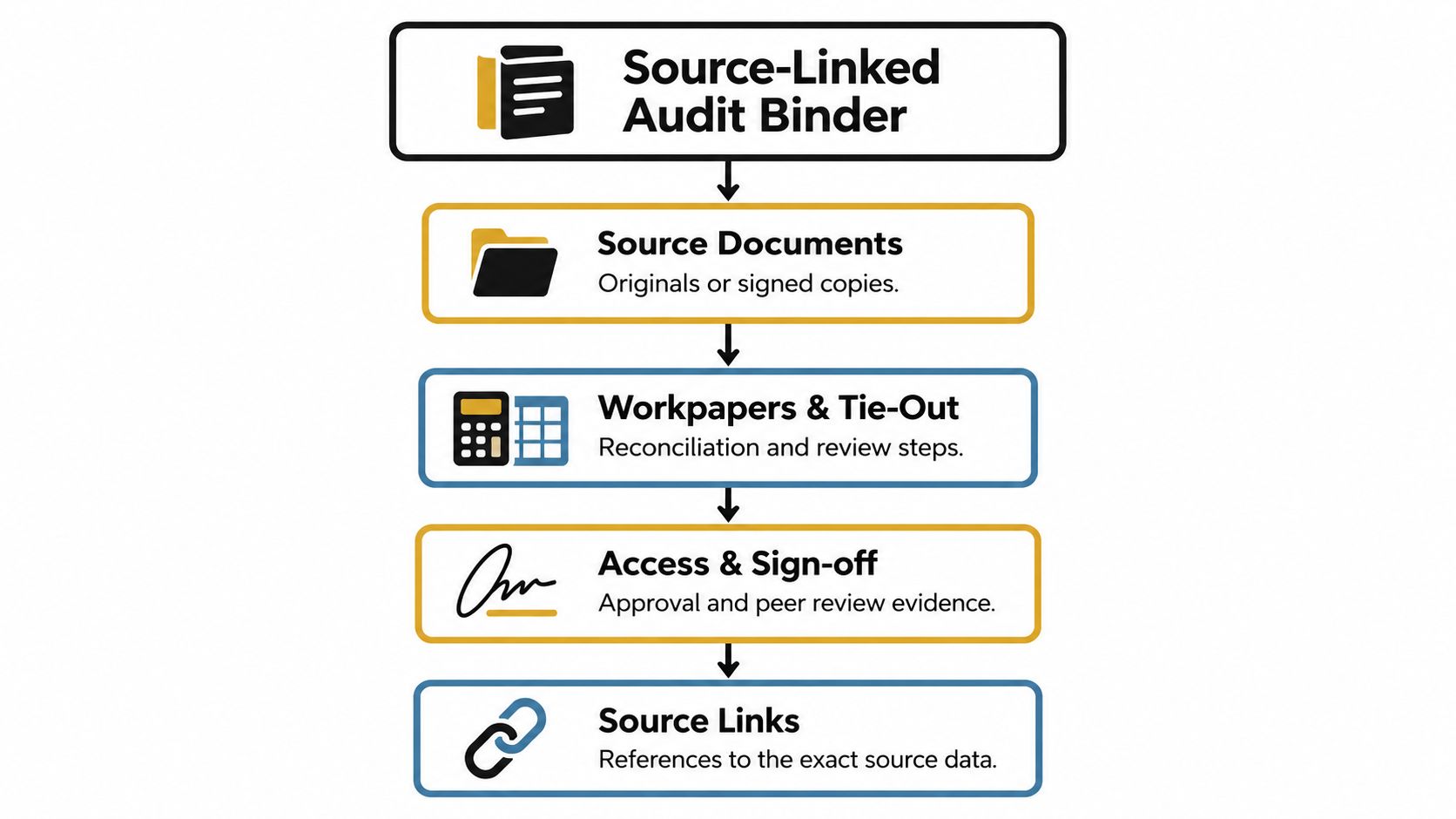
The result isn't merely a static PDF stack. It is a queryable record with source links, exception history, reviewer decisions, and controlled versions. That structure becomes especially important under PCAOB AS 1215, which requires final audit documentation to be assembled within 14 days of report release for engagements under that regime, as described in the PCAOB standard). Even when a 1040 engagement isn't governed by that standard, the assembly principle is useful: evidence should be organized during the work, not reconstructed after a request arrives.
How AI Tie-Out Tools Reshape Vault Requirements
AI changes the vault because it changes where review decisions originate. In a manual process, a preparer may compare a W-2 with a draft return in a spreadsheet, send a question by email, and paste a conclusion into a workpaper. The final binder may contain the conclusion without preserving every comparison, skipped item, or intermediate judgment that led to it.
An AI-assisted tie-out workflow can capture those events as they occur. It may record which source field was matched to which return field, which items were treated as exceptions, what confidence or validation information accompanied an extraction, and when a human accepted or rejected the result. The vault therefore needs room for machine-generated evidence and human review evidence, not just the final answer.
The reviewer's role changes
AI doesn't eliminate review responsibility. It changes the reviewer's task from repeating every comparison to validating the system's evidence, resolving exceptions, and testing whether the workflow handled the source correctly.
For example, a reviewer might open an investment-income exception, inspect the linked statement page, confirm that the extracted amount belongs to the correct taxpayer, and document why the return treatment is appropriate. The vault should preserve the source, the machine result, the exception, the reviewer's reasoning, and the approval event as one connected chain.
A platform such as WP TieOut describes a workflow that ingests tax source documents, validates extracted data, compares it with a drafted return, and compiles source-linked review evidence. Firms evaluating any AI tool should ask whether it exports the underlying evidence trail, preserves original pages, distinguishes automated output from human judgment, and supports role-based sign-off.
Speed creates a governance obligation
The 14-day PCAOB assembly requirement raises the value of real-time capture. A tool that produces a result quickly but discards its reasoning leaves the firm with a faster unexplained conclusion. A tool that preserves comparisons, exceptions, links, and approvals can raise the evidentiary quality of the binder, provided a qualified reviewer validates the output.

Be honest about the trade-off. AI adds metadata that firms must retain, interpret, protect, and explain. It also requires a policy for model-generated outputs, human overrides, corrected source documents, and exceptions that remain unresolved at sign-off. AI isn't a shortcut around documentation. It is a forcing function that makes undocumented reasoning harder to defend.
A Practical 90-Day Implementation Roadmap
A firm can introduce audit vault documentation without converting every active engagement at once. The safest approach is a controlled rollout with a small pilot, clear ownership, and a readiness decision at the end of each phase.
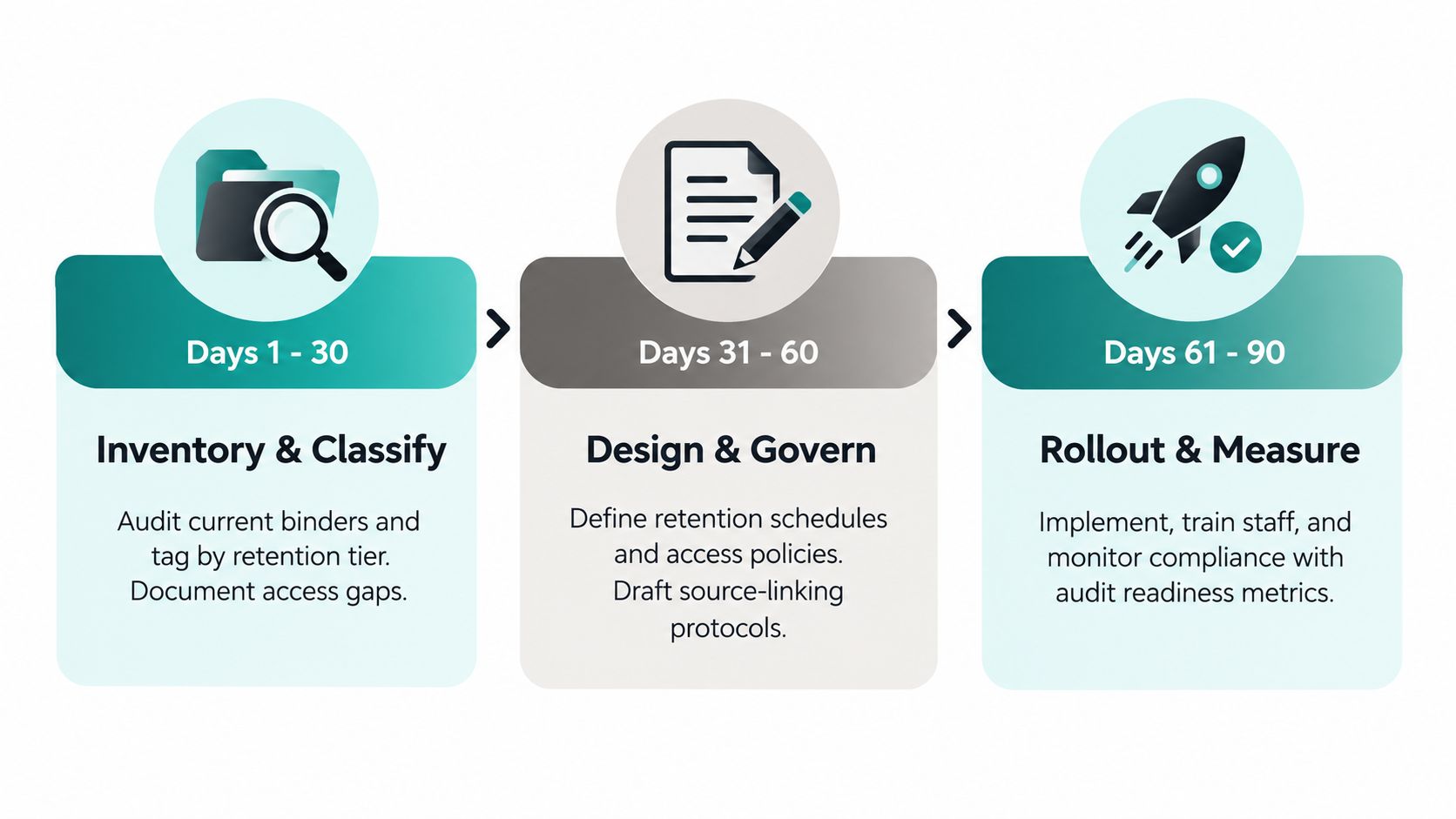
Days 1 through 30
Start with inventory. The operations or quality leader should select representative 1040 binders and document where source documents, workpapers, review notes, and approvals currently live. Classify records by retention tier, note duplicate storage locations, and record access-control gaps without changing the live workflow.
The deliverable is a current-state register. Move forward when the manager can identify the owner, location, record class, and retention trigger for each major binder component.
Days 31 through 60
Design the control layer. The firm's quality or security owner should define role-based permissions, establish the audit-event categories that must be captured, and document how the system protects versions and prevents unauthorized deletion. Select one 1040 engagement with one preparer, one reviewer, and one manager for the source-linking pilot.
The pilot binder should contain original or controlled source documents, linked workpapers, exception notes, sign-offs, and an exportable activity history. The readiness question is practical: can the reviewer explain every cleared exception without opening an unrelated email thread?
Days 61 through 90
Expand cautiously. Apply the workflow to three engagements, connect chain-of-custody metadata to review notes, and run a tabletop assembly drill against the PCAOB-style 14-day clock. The manager should act as the requesting reviewer, while the operations owner measures whether the team can produce the binder, explain its evidence path, and identify any unresolved gaps.
Don't judge readiness only by whether staff adopted a new screen. Look for operational evidence: source links open correctly, exceptions have dispositions, role permissions match responsibilities, exports contain the activity history, and the manager can reconstruct the final decision without relying on personal memory.
Checklist and Closing Thoughts
Before approving a binder, a manager should be able to answer yes to each of these questions:
- Retention: Is every record assigned to a documented retention class with a clear trigger and hold process?
- Access: Do preparer, reviewer, manager, and partner permissions match their responsibilities?
- Audit trail: Does the system record meaningful activity, including changes, reviews, approvals, and exports?
- Integrity: Can the firm show that versions and timestamps are protected from unauthorized alteration?
- Source linkage: Can every material return amount be traced to the exact supporting document or page?
- Exceptions: Does each discrepancy have a documented disposition, including unresolved items?
- Chain of custody: Does the binder preserve who handled the record, what happened, and when?
- AI evidence: Where automation is used, does the vault retain the machine output, validation context, human judgment, and override history?
- Assembly: Can the team export and explain the complete binder without searching scattered email accounts or local drives?
The central lesson is simple. An audit vault isn't a folder of PDFs. It is an operational binder with enforced retention, controlled access, source-linked evidence, integrity protection, and a review history. The quality of that binder becomes visible when a reviewer asks an apparently small question and the firm must answer it months later.
Expectations will continue to move toward contemporaneous, exportable evidence as formal audit documentation requirements influence broader review practices and AI tools make detailed workflow capture more practical. Before the next engagement begins, ask one question: Could this binder be assembled, explained, and defended within two weeks?
WP TieOut helps CPA firms review drafted 1040 returns by validating source documents, comparing them with the return, surfacing exceptions, and compiling a source-linked PDF binder with sign-offs and review history. Visit WP TieOut to evaluate whether its workflow fits your firm's audit vault documentation process.