
The worst advice about a CPA quality control manual is to treat it like a binder you finish once and then shelve. That mindset fit the old compliance era. It doesn't fit a profession that has moved from SQCS No. 8 into a quality management model that expects firms to assess risk, monitor execution, and document remediation as part of daily operations, not as an afterthought (AICPA SQMS current resources).
For a tax practice, the key question isn't whether the manual exists. It's whether the manual can prove the firm follows its own rules when a preparer, reviewer, or partner touches a return. A static template can describe policy, but it can't generate the evidence needed to show who checked what, when they checked it, and what happened when something failed review.
Table of Contents
- Rethinking the CPA Quality Control Manual
- Core Elements of a Tax Practice Quality Framework
- Defining Roles and Responsibilities for Tax Teams
- Integrating AI Workflows into Engagement Performance
- Documenting Audit Trails and Sign-Off Requirements
- Monitoring, Remediation, and Peer Review Readiness
- Navigating the AICPA and PCAOB Transition Timelines
- Quick Reference Manual Evaluation Checklist
- Common Implementation Questions for Tax Operations
Rethinking the CPA Quality Control Manual
A CPA quality control manual should produce evidence, not merely describe obligations. With SQCS No. 8 (2012) superseded by SQMS Nos. 1 and 2 (2022), the manual must function as the firm's operating system for quality (AICPA SQMS current resources). Its value depends on whether it captures how work is assigned, reviewed, escalated, corrected, and checked again.
Static policies fail when execution drifts
A policy may require return reviews, consultations, and exception escalation. The firm still needs to demonstrate that those controls operated on individual files. A signed policy page cannot establish who reviewed a return, what the reviewer examined, or how an identified error was resolved.
Practical rule: if the manual cannot show how the firm detects, corrects, and rechecks errors, it has not become a quality management system.
The manual should connect risk assessment to workflow records. Review checklists, approval logs, consultation notes, exception queues, and remediation records can create an audit trail as staff complete their work. AI can support that process by identifying missing fields, routing unusual items for human review, and preserving a record of the prompts, outputs, and final decisions. Human judgment remains accountable, particularly when an AI recommendation conflicts with the preparer's facts or the reviewer's professional assessment.
A reviewer's memory is not a control.
What changed for tax firms
Tax-only firms often relied on a policy binder covering ethics, retention, and review standards. The stronger approach documents the firm's actual decision points, including where source data enters, which conditions trigger escalation, and how completion is confirmed. The AICPA tax practice guide describes the manual as a record of the firm's policies and procedures rather than a generic template (AICPA tax practice quality control guide and template).
That distinction matters in 1040-heavy practices, where repeated engagements can expose weaknesses in informal review habits. Controls should identify ownership, preserve evidence, and account for staffing and technology changes. A manual that changes only during an annual update will soon diverge from the workflow it is supposed to govern. A living system instead uses operational records to show whether its controls work and where remediation is required.
Core Elements of a Tax Practice Quality Framework
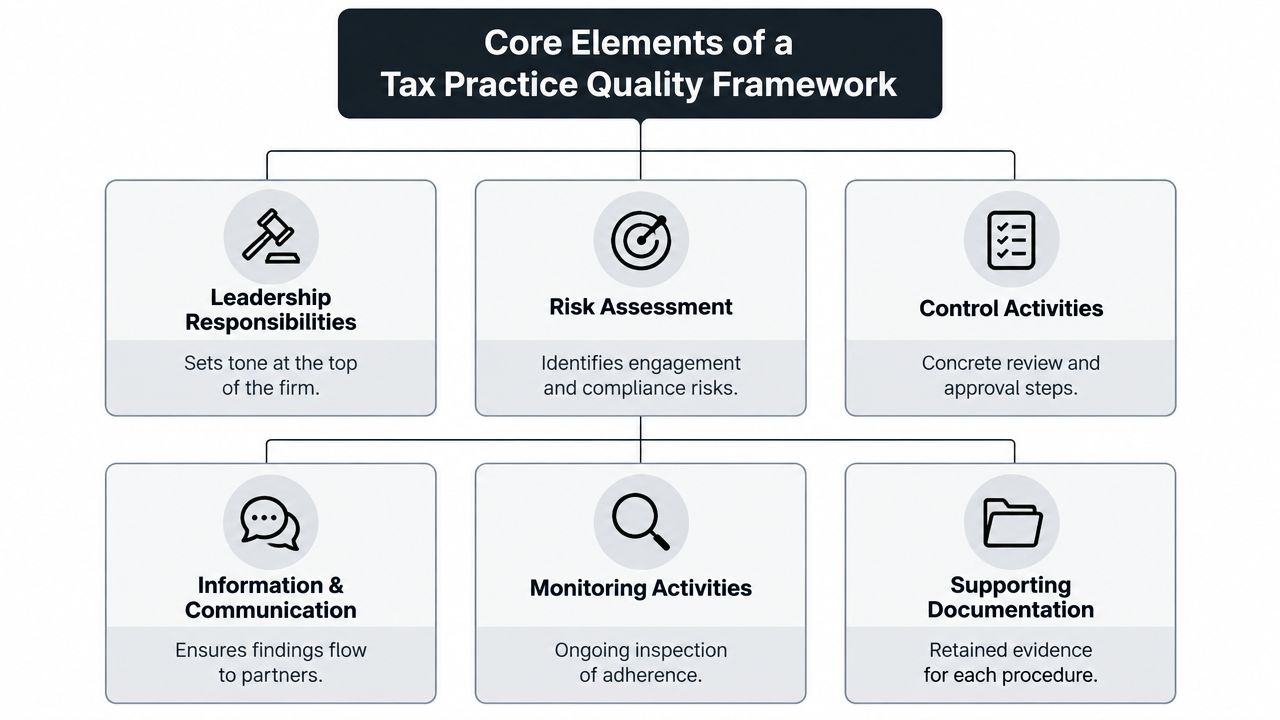
A CPA quality control manual should operate as a control system, not sit unchanged in a compliance binder. The AICPA tax guidance organizes that system around six elements, leadership responsibilities, ethical requirements, client acceptance and continuance, human resources, engagement performance, and monitoring (AICPA tax practice quality control guide and template). The framework is principles-based, so each element must connect to a decision, an owner, and retained evidence. With appropriate workflow tools, completed reviews and exception decisions can also generate much of the audit trail the firm needs.
Map ownership before you write controls
Assign an accountable owner to each element before drafting procedures. Leadership owns tone, resources, and escalation. Designated staff can own ethics checks, acceptance decisions, reviewer coverage, and monitoring follow-up, with a partner retaining authority over high-risk exceptions.
Put that ownership in the manual and the workflow. If a client fails acceptance criteria, identify who may decline, pause, or accept the engagement with safeguards. If an independence or ethics concern appears, specify the required consultation, documentation, and approval. The response should not depend on which employee happens to be available.
Make scalability concrete
A five-person 1040 practice can assign one partner as quality owner, use a one-page acceptance checklist with three hard stops, missing source information, scope changes, and an independence flag, and store approvals in one designated client-file location instead of email threads. That design preserves control without copying a national firm's staffing model. Larger practices may distribute ownership across specialists, but the same decision logic should remain visible.
Retain evidence where reviewers and peer reviewers can retrieve it. Acceptance notes, review sign-offs, monitoring findings, and remediation decisions should sit in the engagement file or a controlled quality repository. AI can check required fields, route unusual items, and preserve prompts, outputs, and final decisions, while a qualified professional remains responsible for the conclusion.
Build around exception handling
Acceptance and continuance procedures should state decision rules rather than rely on vague professional judgment. An incomplete source document, changed client condition, or unresolved ethical concern should trigger a defined escalation path, a named decision-maker, and a recorded outcome. The manual becomes useful when those exceptions produce evidence automatically and reveal where controls need revision.
Defining Roles and Responsibilities for Tax Teams
A quality manual fails when roles stop at job titles. Each handoff needs a named owner, a defined decision right, and an artifact that proves the work moved forward. The AICPA tax practice quality control guide and template supports this operational approach, but the firm must translate it into role-specific procedures rather than copy generic responsibilities.
The preparer creates the first control record
The preparer validates source data, confirms required inputs are present, and records exceptions before the file reaches review. The completeness standard should appear in a checklist or intake record, with missing documents, conflicting client information, and unresolved questions clearly identified.
The handoff artifact is a completed source-completeness checklist plus an exception log. If a W-2 is missing, a brokerage statement is partial, or a client note conflicts with the draft return, the preparer records the issue and routes it through the designated workflow. Filling the gap without documentation creates no reliable evidence for the reviewer.
The reviewer clears exceptions with support
The reviewer receives the checklist, exception log, and supporting documents. The reviewer confirms that required evidence exists, tests unusual entries, and records how each exception was resolved. A reviewer's completion record should identify the cleared item, the evidence considered, and any question sent back to the preparer.
For a 1040 engagement, the review artifact can be a structured exception report linked to source documents and the draft return. Open items return to the preparer when more support is needed. Judgment items that exceed the reviewer's authority move to the partner with the relevant documentation attached.
The partner approves judgment items
The partner's role is to approve decisions that require firm-level judgment, not to repeat every preparer check. The approval record should identify the position considered, the evidence reviewed, the consultation obtained when required, and the reason the firm accepted the conclusion. Independence concerns, unusual tax positions, and recurring exceptions belong in this record when they affect final approval.
Final approval should be tied to evidence, not trust in workflow memory.
A practical RACI handoff looks like this:
| Role | Responsibility | Handoff artifact |
|---|---|---|
| Preparer | Validate completeness and flag exceptions | Source checklist and exception log |
| Reviewer | Clear exceptions with evidence | Resolved exception report and review sign-off |
| Partner | Approve judgment items and final release | Judgment approval record and final sign-off |
Backup coverage belongs in the same role matrix. If the assigned reviewer is unavailable, a qualified substitute should have documented authority to accept the handoff, clear permitted items, and route judgment matters to the partner. That keeps work moving without creating undocumented shortcuts.
Integrating AI Workflows into Engagement Performance
AI changes the engagement-performance section only when the manual treats it as a control, not a gadget. In a 1040 workflow, source documents can be ingested, extracted, and matched against the draft return so the reviewer focuses on true discrepancies instead of line-by-line hunting. WP TieOut is one example of a tool built around that model, including source-linked validation and reviewer handoff documentation, and its workflow overview is laid out at WP TieOut's AI quality assurance page.

Write the manual around review by exception
The manual should say what the AI validates, what it flags, and who clears the exception. That's the practical difference between automation and control. A reviewer shouldn't spend time re-reading everything the system already reconciled.
The strongest workflow is one where the AI performs the first-pass comparison, then produces a short exception list for human judgment. That doesn't remove reviewer responsibility. It sharpens it. The reviewer spends time on the items that matter instead of redoing the preparer's work.
Preserve the evidence trail automatically
A good AI-enabled workflow should create the binder as it works, not after the fact. Source-linked pages, stamps, annotations, and sign-off history need to travel with the file so the engagement can be reconstructed later. That's what turns a review process into auditable evidence.
Quality management isn't only about catching errors. It's about proving the firm caught them, routed them, and resolved them in a consistent way. If the manual says the reviewer approved a file, the system should be able to show the underlying path.
Keep AI bounded by human authority
The manual should never imply that software makes the final call. AI can validate, compare, surface, and organize. The partner still owns the engagement outcome, and the reviewer still owns the quality conclusion. That boundary should be explicit.
If the system flags a discrepancy, the manual should say how the discrepancy gets resolved and where the explanation is stored. That prevents teams from treating automated exceptions like noise. The point is fewer false positives, clearer decisions, and stronger file-level support.
Documenting Audit Trails and Sign-Off Requirements
A quality manual earns trust through reconstructable evidence. The file should show who performed each action, what changed, which exceptions were addressed, and when approval occurred. Define sign-off rules precisely enough for a reviewer to rebuild the engagement record without relying on memory or informal messages.
Require traceable actions, not informal approvals
Record data intake, exception review, preparer completion, reviewer clearance, partner approval, and remediation after a file issue. Define retention and sign-off rules that meet audit trail requirements for tax engagements and require an exportable, timestamped history. The authoritative binder should preserve the event log alongside the final workpapers, so exporting a PDF does not erase the underlying sequence.
Use role-based permissions rather than shared access. For example, the preparer can edit, the reviewer can annotate and clear exceptions, and the partner can approve. Retain timestamped sign-off history for seven years in the authoritative binder location, with read-only access for other staff. This model limits unauthorized changes while allowing each role to complete its assigned work.
Tie source pages to the final file
A source-linked, bookmarked binder gives reviewers a direct path from the drafted return to supporting evidence. Make that structure part of the retention standard, particularly for review-by-exception engagements. Each material conclusion should point to its source page, calculation, or documented explanation.
The manual should also identify the authoritative version and define how the firm preserves sign-off evidence, including retention, accessibility, and integrity controls. If a correction occurs after approval, the system should preserve the original record, identify the person making the change, capture the reason, and route the revised item for renewed approval. Deleting or overwriting the first sign-off destroys useful evidence.
If the evidence can't be traced, it can't be defended.
A disciplined audit trail reduces partner time spent reconstructing events. It also makes internal inspections and peer review less disruptive because the binder already records the work performed, decisions made, exceptions cleared, and approvals granted.
Monitoring, Remediation, and Peer Review Readiness
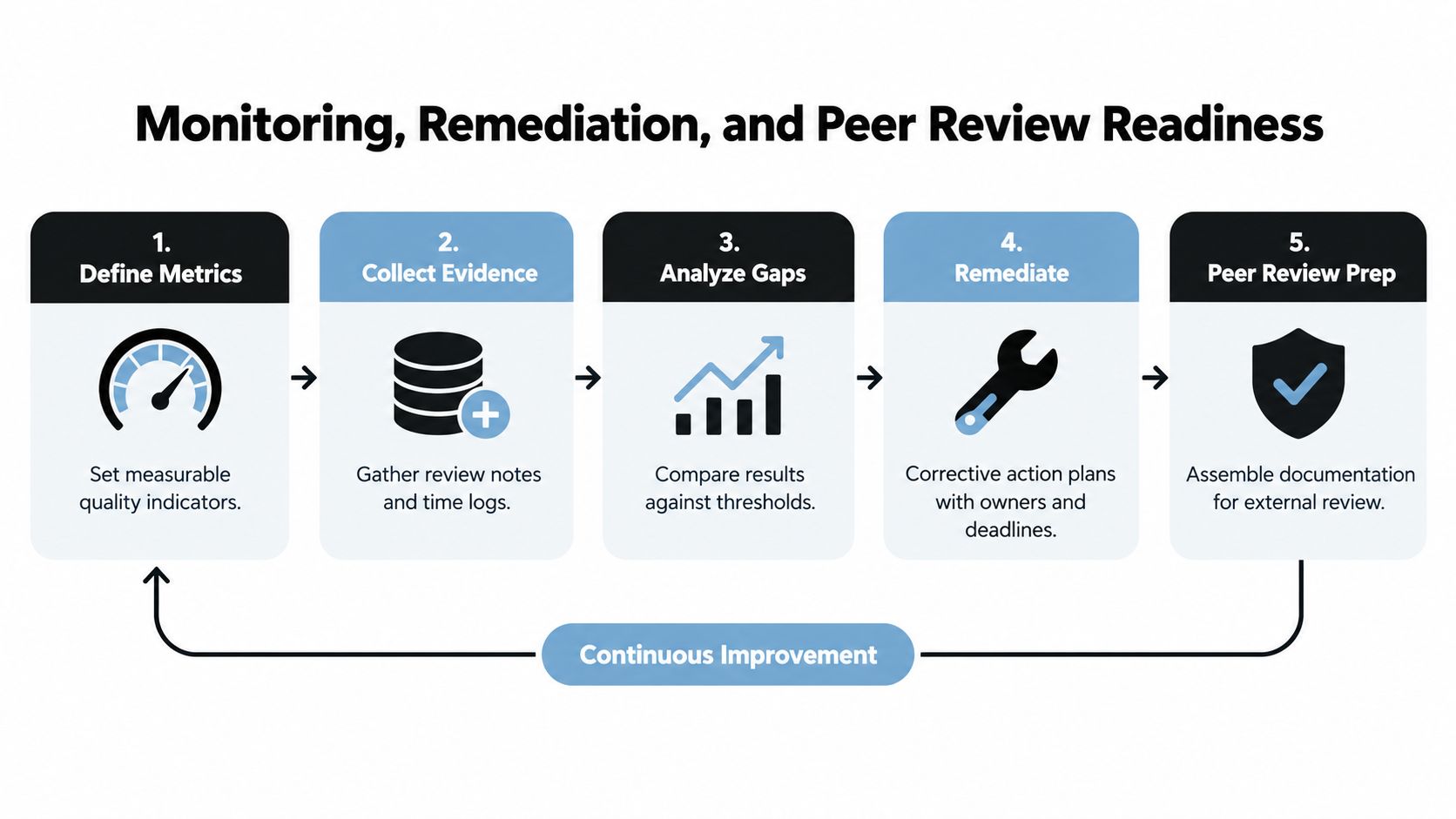
A mature quality system is measured by what happens after problems appear. The AICPA tax materials and related commentary describe the shift from static compliance documents to monitored systems with documented remediation, and they stress that firms need measurable monitoring, evidence retention, and corrective-action workflows, not just policy language (The Tax Adviser on tax quality management). That's the part of the manual many firms underbuild.
Make monitoring measurable
The manual should specify what gets inspected, how often the inspection occurs, and what counts as a finding. Vague phrases like “periodic review” don't help a manager decide when the system is slipping. Review frequency, file selection, and sampling method should be spelled out.
Monitoring also needs evidence. If the reviewer found recurring omissions in source support, that fact should be captured in a way the firm can trend over time. Without that record, the firm will keep solving the same problem twice.
Remediation needs an owner and a deadline
When monitoring finds a defect, the manual should require a named owner, a due date, and a follow-up check. The fix is not complete when someone says they'll be more careful next time. The fix is complete when the corrected process is back in use and the issue isn't recurring.
The manual should also require root-cause thinking. If the same issue appears across multiple files, coaching alone is probably not enough. The firm may need to rewrite the workflow, adjust the checklist, or retrain the team.
Peer review readiness is just disciplined evidence
Peer reviewers look for proof that the system works, not just that the policies sound reasonable. That means the manual should make it easy to show monitoring results, remediation, and the link between findings and updated procedures. It's also where a stronger evidence trail pays off.
For firms wanting a structured dashboard, quality control metrics for tax teams can help frame what to track in practice, especially around exception rates, turnaround, and documentation strength. The metric itself is only useful if the firm uses it to drive correction.
Navigating the AICPA and PCAOB Transition Timelines
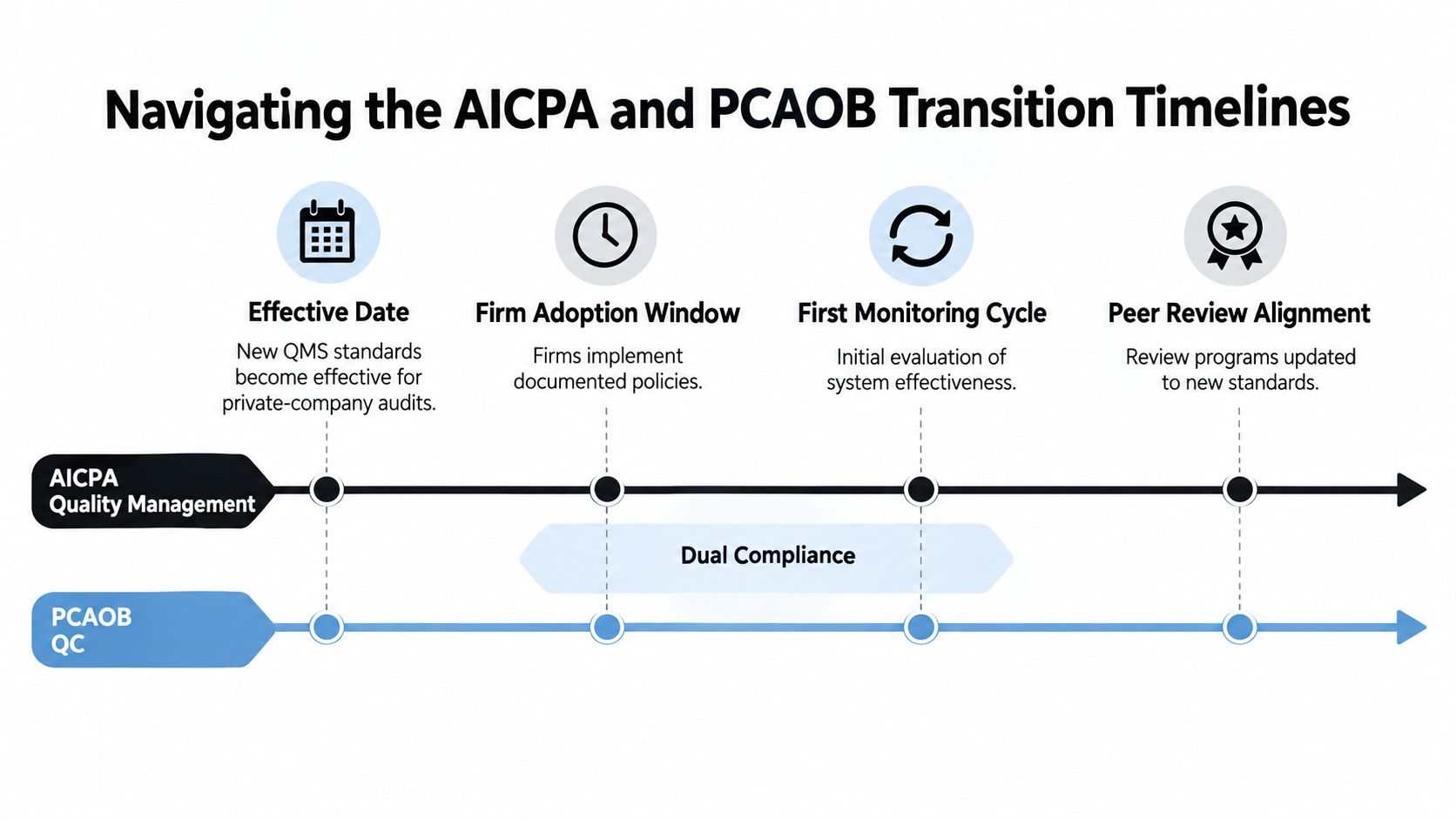
Firms handling both tax and attest work must prepare for two related regulatory transitions. The AICPA's new quality management standards became effective December 15, 2025. The first system evaluation is expected within one year after implementation, or by December 15, 2026, according to Wolters Kluwer's summary of the AICPA quality management standards. The PCAOB has indicated that its interim QC standards, including QC 20, are scheduled to be rescinded on December 15, 2026 and replaced by QC 1000, pending final implementation. Firms should monitor the PCAOB's QC 20 details rather than treat the transition as complete.
One framework needs two mappings
The practical challenge is maintaining one control framework that maps to both systems without creating duplicate manuals. Document each core process once, then show how it applies to tax, review, and attest engagements.
Separate control logic from engagement type. Acceptance, performance, monitoring, and remediation can share a common structure while retaining different procedures where the work requires them. A digital manual can also connect each control to responsible staff, required evidence, and review status, allowing the system to generate an audit trail as work occurs.
Risk assessment must reflect the firm's work
A 1040-heavy tax practice faces different risks from an audit practice. The manual should reflect that mix while preserving the broader quality-management structure. Generic risk language will not help staff decide whether to accept an engagement, escalate an issue, or document a review exception.
Implementation requires evidence in working files, review notes, and deficiency follow-up. Adopting new terminology without changing workflows leaves the firm exposed when reviewers ask how the system operates.
Keep dual compliance workable
Where requirements overlap, reduce duplicate documentation and preserve clear traceability. The objective is a system staff can operate consistently and leadership can inspect without reconstructing decisions from scattered files.
A workable manual connects one ownership model, one monitoring calendar, and one remediation path to the relevant engagement types. That structure supports regulatory change while giving the firm a living source of evidence instead of a static compliance binder.
Quick Reference Manual Evaluation Checklist
A good manual review starts with blunt questions. If the answer takes a committee meeting to explain, the control probably isn't documented well enough yet. If the answer can't be supported with evidence, the manual still lives more on paper than in practice.
Leadership and ownership
- Is one person clearly accountable for the quality system, with backup coverage documented?
- Are ethics, acceptance, engagement performance, and monitoring assigned to named owners rather than departments?
- Does the manual show escalation paths when a return, source document, or client issue fails acceptance criteria?
Engagement performance
- Does the manual define preparer, reviewer, and partner duties in enough detail to create consistent handoffs?
- Are review steps repeatable, or do they depend on individual judgment without a written framework?
- Do sign-offs tie back to evidence, not just completion status?
AI and automation
- Does the manual describe where AI fits in source validation and exception review?
- Can the firm preserve a source-linked binder and sign-off history without manual reconstruction?
- Are human review responsibilities clearly retained, even when automation handles first-pass comparison?
Monitoring and remediation
- Are monitoring activities measurable, with review frequency and file selection rules?
- Does the firm record findings, corrective actions, and follow-up checks in a retrievable form?
- Are lessons learned fed back into the workflow, or do the same errors keep recurring?
Transition readiness
- Does the manual distinguish tax-only controls from attest controls without duplicating the whole framework?
- Can leadership explain how the firm will meet the current evaluation cycle under the new quality management standards?
- Is the manual updated when staffing, technology, or service mix changes, or only when someone remembers to edit it?
Common Implementation Questions for Tax Operations
A partner once told me the hardest part of updating a quality manual wasn't writing it. It was getting people to stop treating review like a habit and start treating it like a controlled process. That's the right instinct, because most implementation failures come from workflow drift, not from a missing policy paragraph.
How should independence checks work for complex 1040 clients
The manual should define who checks independence, when the check happens, and what gets documented before the file moves forward. For a complex 1040 client, that can mean adding a mandatory intake checkpoint before work begins and a final confirmation before sign-off. The key is that the check has to be repeatable, not improvised.
If a relationship or service change affects eligibility, the manual should say who decides whether the engagement continues. That decision shouldn't sit in a preparer's inbox or rely on memory from last season. The file needs a visible decision record.
What if staff are new to AI-driven exception reporting
Train them on the exception, not on the software interface alone. People learn faster when they see how a flag changes the review path, what evidence clears it, and when they need to escalate. If the team understands the control objective, the tool becomes easier to trust.
The firm should also keep the reviewer in charge of judgment. AI can reduce the search burden, but it can't decide whether a discrepancy is acceptable. That distinction should be written into the manual and reinforced in training.
What happens when a peer reviewer questions the binder
The answer should be in the file, not in a scramble to explain it. If the binder is source-linked, bookmarked, and signed off in sequence, the reviewer can follow the path from intake to approval without chasing missing pages. If the path is unclear, that's a documentation issue the manual should already address.
The best defense is a consistent record of how the firm handles every engagement. That's why audit trails, monitoring, and remediation belong in the same system, not in separate silos. Once those pieces are connected, the manual becomes easier to defend because it reflects real operating discipline.
If your firm is modernizing its CPA quality control manual, WP TieOut gives you a way to tie source documents, exception review, and sign-off history into one controlled workflow. Visit WP TieOut to see how an AI-augmented review process can help turn quality management into a live evidence trail instead of a static binder.