
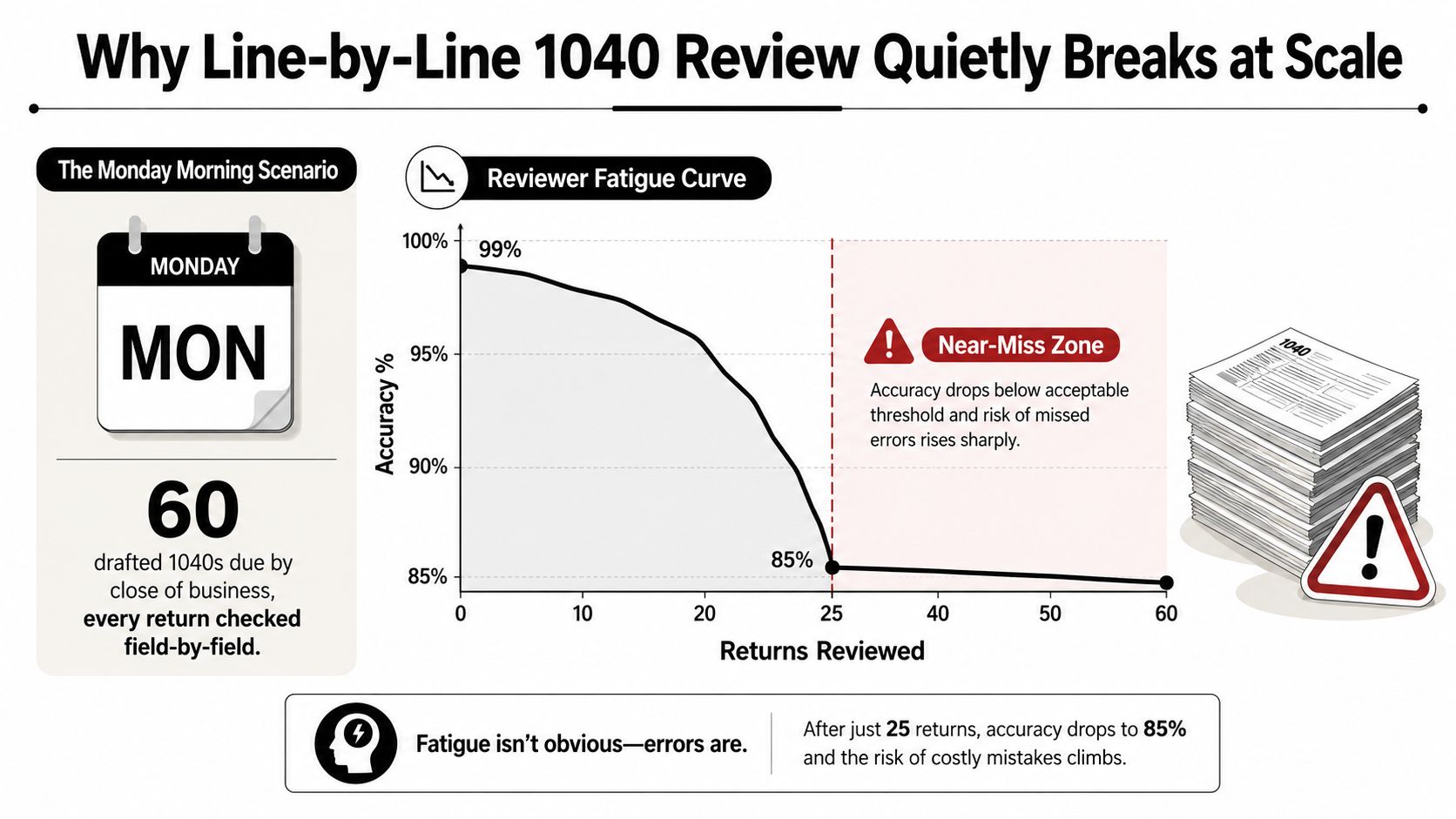
Monday morning starts with a familiar tax-operations problem. A reviewer has 60 drafted 1040s due by close of business, and the firm's standard says every field must be checked. By the middle of the stack, the reviewer is still moving line by line, but routine numbers receive less scrutiny, source documents blur together, and a structural discrepancy can hide behind a perfectly completed form.
That failure isn't a lack of diligence. It's a weak control design. A defensible CPA tax review should prove that the right risks were identified, assigned, resolved, and accepted by the right people. It shouldn't force a reviewer to spend equal effort on every field.
Table of Contents
- Why Line-by-Line 1040 Review Quietly Breaks at Scale
- The Three Roles Behind Every Defensible Tax Review
- Validating W-2s, 1099s, and Brokerage Sources Before Reconciliation
- Review by Exception Using Real IRS Error Patterns
- Adopting AI-Assisted Review Without Losing the Trail
- KPIs, Sign-Off Logs, and Audit-Ready Documentation
Why Line-by-Line 1040 Review Quietly Breaks at Scale
The near-miss usually appears on a return that looked ordinary. Wages, withholding, interest, dividends, and a brokerage statement are present. The preparer completed the workpapers, the reviewer confirmed that the return had no obvious blanks, and the file moved toward partner approval. The problem was buried in the relationship between documents, not in a visibly incomplete line.
That's where line-by-line review starts to fail. A reviewer can verify that a number appears on a form without asking whether the number belongs there, whether it agrees with the originating document, or whether another entry changes its tax treatment. Rechecking familiar lines creates the appearance of control while consuming the attention needed for exceptions.
The historical evidence explains why this matters. In a limited GAO undercover study of paid preparers, only 2 of 19 preparers calculated the correct refund amount, and identified refund errors ranged from $52 less than the correct amount to $3,718 more. The same source reported an estimated error rate of 60% for preparer returns versus 50% for self-prepared returns, based on IRS National Research Program data from tax years 2006 through 2009.
The cost function is the control problem
Line-by-line review creates a one-to-one cost function. Every additional return demands another complete pass, even when the preparer's workpapers already establish that routine fields agree with source data. As volume rises, reviewers learn to move quickly through low-risk lines, which makes the process both expensive and vulnerable.
The IRS Taxpayer Advocate reported that paid preparers handled 53% of the 146 million individual income tax returns received by the IRS through September 29, 2022, while non-credentialed preparers represented about 58% of the paid-preparer segment. That scale means a small improvement in exception handling can affect a very large population of 1040 returns, as summarized in this CPA tax preparation industry analysis.
Practical rule: Don't ask a reviewer to prove the same routine fact twice. Ask the reviewer to investigate the relationships, judgments, and mismatches that the preparer's workpapers can't conclusively clear.
Review by exception doesn't mean reviewing less responsibly. It means defining which evidence clears a field automatically, which discrepancy requires investigation, and which judgment must reach a partner. Firms comparing workflow options should also distinguish document validation, reconciliation, and sign-off capabilities in a reconciliation software comparison. The payoff comes from concentrating human judgment where the return's structure makes an error plausible.
The Three Roles Behind Every Defensible Tax Review
A strong review process begins with ownership. The preparer, reviewer, and partner should form a handoff chain, not a group of people vaguely responsible for the same return.
The preparer establishes the evidence
The preparer owns source ingestion, document completeness, workpaper assembly, and self-review. That means the preparer's file should show which W-2s, 1099s, brokerage statements, K-1s, and other documents were received, which were unreadable or incomplete, and how each source was mapped to the draft return.
The preparer's sign-off shouldn't say only “prepared.” It should confirm that source documents were loaded, extracted values were checked, open questions were documented, and the draft reflects the approved tax treatment. A source checklist gives the next reviewer something concrete to test instead of asking that reviewer to reconstruct the entire intake process.
The reviewer clears exceptions
The reviewer owns exception triage, reconciliation verification, and resolution notes. This role isn't a second preparer. The reviewer should challenge mismatches, test high-risk relationships, assess whether the explanation is supported, and record why an item was cleared, adjusted, or escalated.
A reviewer's note should identify the issue, the evidence examined, the conclusion, and the person who approved any judgmental treatment. “Reviewed, no issue” isn't a defensible explanation because it doesn't tell a partner or examiner what was tested.
The partner accepts residual risk
The partner owns scope decisions, final risk acceptance, and sign-off. A partner shouldn't be asked to rediscover every cleared exception. The partner needs a concise view of unresolved items, unusual positions, late-arriving documents, and matters that exceed the reviewer's authority.
Role overlap is where accountability disappears. If everyone can clear an exception, nobody clearly owns it. The workflow should enforce the handoff and prevent a return from entering the partner queue until required exceptions have an assigned disposition.
| Role | Validation | Reconciliation | Exception Handling | Sign-Off Artifact |
|---|---|---|---|---|
| Preparer | Confirms source identity, completeness, and extraction | Builds workpapers and maps source values to return lines | Documents questions and preliminary explanations | Preparer source checklist |
| Reviewer | Tests key source fields and classification | Verifies tie-outs and investigates mismatches | Clears, reopens, or escalates exceptions | Reviewer exception log |
| Partner | Reviews scope and significant judgments | Assesses unresolved financial and tax relationships | Accepts residual risk or sends the return back | Partner sign-off memo |
The final file should make the sequence visible. A partner, peer reviewer, or examiner should be able to answer three questions quickly: what did the preparer establish, what did the reviewer challenge, and what risk did the partner accept?
Validating W-2s, 1099s, and Brokerage Sources Before Reconciliation
Reconciliation is only useful when the inputs are trustworthy. If a document was assigned to the wrong taxpayer, extracted incorrectly, or classified under the wrong income type, clean arithmetic can still produce a wrong return.
Start with identity and completeness. Confirm the taxpayer, payer or employer, tax year, account details, and document type before comparing amounts. A reviewer should treat duplicate documents, amended statements, missing pages, and unreadable fields as intake exceptions, not as reconciliation problems.

W-2 validation
For each W-2, verify the employer EIN, employee identity, state information, and the relationship among Box 1, Box 3, and Box 5. Differences can be legitimate, but they should have a workpaper explanation. Review retirement contributions, pretax deductions, dependent-care amounts, and state allocation before tying wages and withholding to the return.
The reviewer shouldn't assume that an extracted value is accurate because it resembles the printed document. Compare the extracted data against the original page, especially for employer identifiers, withholding, state wages, and boxes affected by pretax treatment.
1099 validation
For 1099s, confirm the payer TIN, recipient details, income character, and withholding. Interest, ordinary dividends, qualified dividends, nonemployee compensation, retirement distributions, and other categories must flow to the correct return schedules and lines.
A 1099-R deserves focused attention because pension and IRA classifications can affect the treatment of the distribution. For 1099-B statements, check whether basis is reported, whether basis was carried forward correctly, and whether the transaction belongs in a category requiring additional analysis.
Brokerage statement validation
Brokerage packages often combine consolidated forms, supplemental schedules, and transaction detail. Tie the 1099-B proceeds and basis to the workpaper, confirm transaction dates, identify wash-sale adjustments, and flag Section 1256 contracts for appropriate treatment. Interest and dividends from the same payer should also reconcile to the related 1099-INT and 1099-DIV rather than being accepted as unrelated totals.
A source document should earn trust through validation, not through familiarity. The reviewer's job is to confirm that the document is genuine, complete, correctly classified, and faithfully represented in the workpaper.
Firms evaluating this stage should look for document validation software that preserves the original page while linking extracted values to the return and workpaper. That link is what lets a reviewer move from an exception to evidence without rebuilding the file.
Review by Exception Using Real IRS Error Patterns
A risk-weighted review starts with a simple question: which discrepancies are most likely to create a tax, filing, or downstream processing problem? The answer shouldn't come from reviewer preference. It should reflect known error patterns, the return's facts, and the consequences of a mismatch.
IRS and TIGTA data show why exception routing matters. During the 2019 filing season, 13.9 million of 155.8 million individual returns, or 9%, were routed to manual Error Resolution System review. The same Tax Notes summary of TIGTA's error-resolution findings reported 17,117,031 identified errors for paper returns versus 9,065,385 for e-filed returns.
Those figures point to practical control points: source-document ingestion, exception triage, and validation of fields that can trigger manual handling. They don't justify checking every line with equal intensity.
Assign review effort by risk
| Tier | Line Items / Fields | Review Action | Example Exception |
|---|---|---|---|
| Tier 1 | AGI, taxable income, withholding, refundable credits, K-1 income | Mandatory secondary review and documented reconciliation | W-2 withholding does not agree with the draft return |
| Tier 2 | Schedule entries, basis tracking, AMT triggers | Review when an exception or return fact activates the control | 1099-B basis differs from the brokerage workpaper |
| Tier 3 | Formatting, bank information, state-only entries | Validate through automated checks and sampling | State allocation appears inconsistent with the source document |
The tier should guide attention, not replace judgment. A Tier 3 item can become important when it changes filing jurisdiction or payment instructions. A Tier 1 item may clear quickly when the source and workpaper agree and the reviewer records the evidence.
Build checkpoints around relationships
Useful checkpoints include wage tie-outs against W-2 Box 1 and Box 5, 1099-NEC amounts against Schedule C gross receipts, brokerage proceeds and cost basis against the transaction workpaper, and estimated-tax payments against Form 2210-related triggers. These checks test whether the return tells one coherent story across forms.
A practical exception log might read:
- Issue: Brokerage basis on the draft differs from the validated 1099-B workpaper.
- Evidence: Original consolidated statement, transaction detail, and preparer basis schedule.
- Resolution: Reviewer confirmed a wash-sale adjustment and updated the workpaper and draft.
- Disposition: Cleared by reviewer, with partner visibility because the adjustment changed reported gain.
That note is more valuable than a completed checklist because it captures the reasoning. The review standard should define which exceptions require partner approval, which the reviewer can clear, and which must remain open until client support arrives.
Adopting AI-Assisted Review Without Losing the Trail
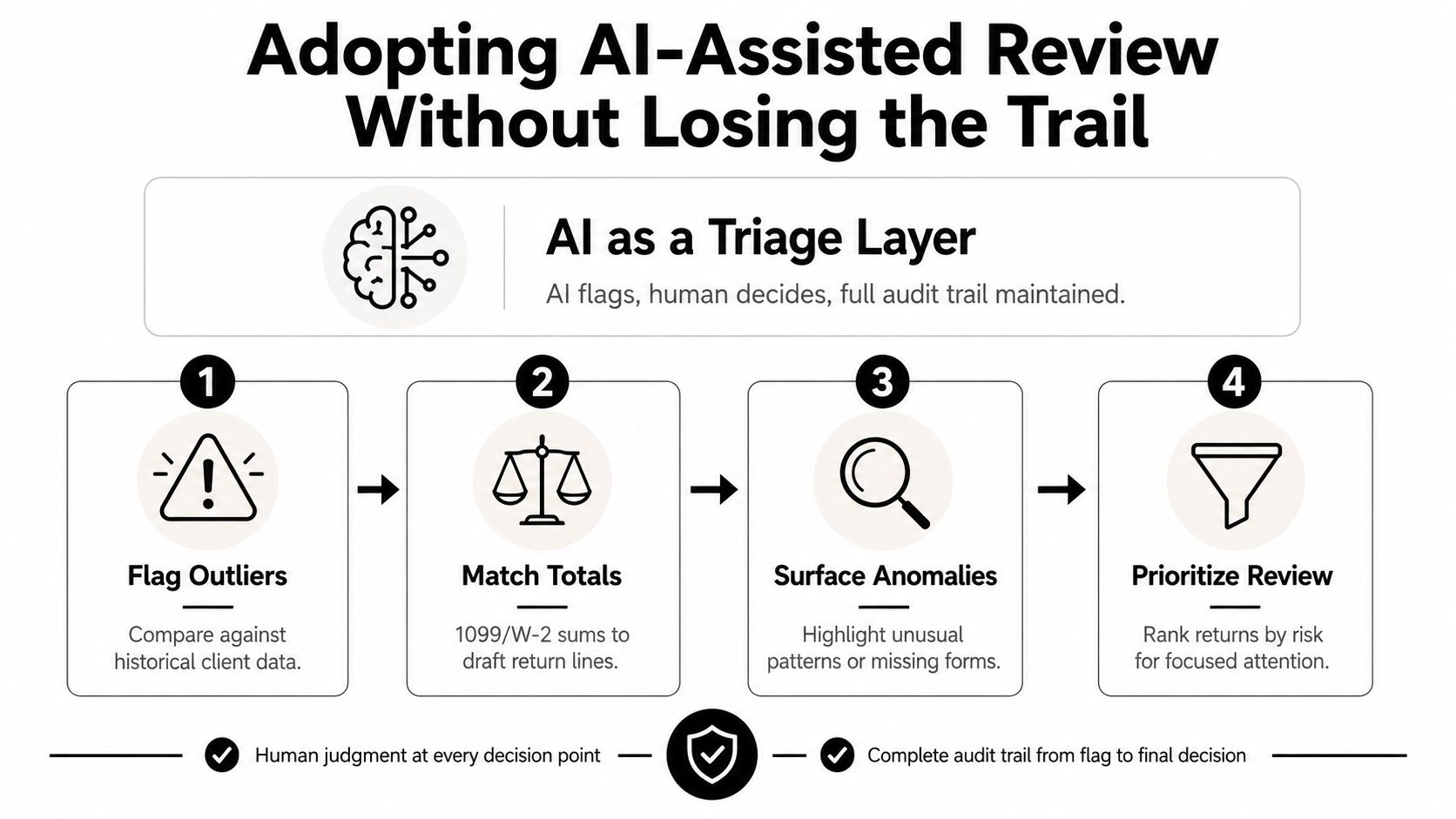
AI belongs in the triage layer. It can compare, classify, rank, and draft, but it shouldn't become the unaccountable decision-maker behind a filed return.
A useful AI-assisted review system can flag outliers against a client's historical data, match W-2 and 1099 totals to the draft return, surface missing schedules when the return's facts suggest one should exist, and draft reviewer notes from the evidence it examined. Those tasks reduce search time while leaving the tax conclusion with a human reviewer.
Keep judgment with people
AI shouldn't own final judgment on basis, passive activity, at-risk limitations, or other matters where facts and authority require interpretation. It also shouldn't own partner sign-off, client communications, or representations to a tax authority.
The governance question is explainability. Recent literature on AI in tax compliance emphasizes human oversight, explainability, and governance, while IMF analysis describes GenAI tools handling routine compliance checks and financial-record reviews with limited oversight. That combination makes the control boundary more important. A faster flagging engine doesn't make an unsupported conclusion defensible.
Use controls that preserve the chain of evidence:
- Source integrity: Hash source documents and preserve the original files so later reviewers can establish what the system saw.
- Interaction logging: Store prompts, model outputs, rule versions, and timestamps for each AI-assisted review event.
- Human disposition: Require a reviewer to accept, reject, or escalate every AI flag, with a written reason.
- Model documentation: Maintain a model card describing training-data limits, intended use, known failure modes, and prohibited decisions.
Roll out narrowly
Pilot AI on one return type or one defined source-to-return comparison. Compare its exception detection with the firm's existing review process, then ask reviewers whether the flags were understandable, relevant, and easy to resolve. Expand only after the firm can show that the tool improves triage without weakening documentation or reviewer confidence.
Tools such as AI workflow automation for tax review should be evaluated against these controls, not only against processing speed. The right question is whether the system helps a reviewer defend a decision after the return leaves production.
KPIs, Sign-Off Logs, and Audit-Ready Documentation
A partner can defend a review process only when its measurements describe the process, not when they merely rank employees. The useful KPIs are the ones that reveal whether the control design is working and tell management when to investigate the workflow.
Track the exception-to-return ratio, average exceptions per reviewer, rework after sign-off, sign-off cycle time, and sampled findings after filing. Don't set arbitrary targets that encourage reviewers to clear issues prematurely. Define thresholds internally, and use a breach to trigger process analysis, source-quality analysis, training review, or rule tuning rather than an automatic performance judgment.
For example, a sudden increase in exceptions may indicate a new document format or extraction problem. A sudden decline may mean reviewers are clearing too aggressively. A rise in post-sign-off rework suggests that the review boundary, escalation rules, or evidence requirements need attention.
Make the sign-off log reconstructable
Every engagement file should contain a chronological record with enough detail to recreate the decision path:
- Preparer identity: Record the preparer ID, completion timestamp, source checklist, and unresolved intake questions.
- Reviewer identity: Record the reviewer ID, review timestamp, exception list, evidence examined, and resolution notes.
- Partner approval: Record the partner's sign-off, timestamp, scope decisions, and accepted residual risks.
- Document integrity: Store the supporting documents, workpapers, and their hashes in a controlled location.
- AI activity: Preserve AI-generated flags and the reviewer's disposition for each one.
The log should connect to the actual evidence. A note saying “basis reviewed” is weak if it doesn't identify the brokerage statement, transaction schedule, or adjustment that supported the conclusion. A source-linked binder with preserved original pages, annotations, and sign-off history gives the reviewer a usable working file and gives the partner a concise control record.
Set an e-file gate
Before transmission, the file should contain source documents, reconciled workpapers, reviewer notes, and a completed checklist mapped to the firm's review standard. The preparer's questions should be closed or explicitly escalated. High-risk exceptions should have an authorized disposition, and the partner should know what remains judgmental or unusual.
That same record can support an examination response. Instead of asking staff to reconstruct who saw which document and why a number changed, the firm can produce the source, reconciliation, exception, and approval history as one connected trail.
A good KPI tells you where the control is weakening. A good sign-off log tells you what the firm did about it.
WP TieOut provides CPA firms with a workflow that ingests W-2s, 1099s, brokerage statements, and other source documents, validates extracted data, compares workpapers with drafted 1040s, and records preparer, reviewer, and partner actions. Visit WP TieOut to evaluate an exception-based review process with source-linked documentation and an exportable sign-off trail.