

Review by exception shifts 1040 quality control from checking every line to automatically verifying routine, conforming data and routing predefined deviations to human reviewers. The practical answer is to tune the exception net around meaningful risk, then preserve clear evidence of what the system checked and what a person resolved.
The pressure is familiar. A return queue grows faster than reviewer capacity, preparers wait for feedback, and senior staff spend long hours scanning consistent figures because the process treats every field as equally deserving of attention. Fatigue doesn't eliminate the need for judgment. It makes the timing and structure of that judgment more important.
For high-volume individual tax work, the question isn't whether people should review returns. They should. The question is whether experienced reviewers need to recheck routine, validated data line by line, or whether a controlled system can filter the routine work and direct attention to missing signatures, unusual values, overrides, cross-form inconsistencies, and data-integrity concerns.
Table of Contents
- What Review by Exception Means for 1040 Review
- Why Manual 1040 Review Is a Fragile Model
- How Review by Exception Works in Practice
- Benefits of Exception-Based Tax Review
- Manual Review versus Review by Exception for 1040 Returns
- Implementation Pitfalls and How to Avoid Them
- Building an Audit-Ready Exception Review Workflow
What Review by Exception Means for 1040 Review
A return queue can contain two files that look similar at first glance. One is properly sourced and consistent with prior work. The other contains a missing document, an unsupported override, or a mismatch between a source statement and the draft. A traditional process sends both through the same field-by-field review because it cannot reliably separate routine compliance from meaningful risk.
Review by exception changes that operating logic. It is a risk-based quality-control method in which a validated system verifies routine, conforming data and routes predefined deviations to a human reviewer. Those deviations can include missing signatures, out-of-range values, sequence violations, overrides, and data-integrity alerts. The system keeps low-risk “green path” work out of the active review queue while recording which checks ran automatically and which items required escalation, as described in this review by exception definition.

The operating distinction
Generic automation completes a task faster. Review by exception sets a controlled boundary between automatic verification and human intervention. Reviewers need to know why an item entered the queue, which source record supports it, what decision cleared it, and which routine checks required no manual action. Without that record, faster review can become an un-auditable filter.
Exception sensitivity requires calibration. Rules set too loosely allow meaningful discrepancies through. Rules set too tightly flood the queue with harmless differences, forcing reviewers back into manual eyeballing and weakening confidence in the alerts. Each rule should identify a defined event, the evidence to inspect, and the resolution to document.
“Review unusual information” is too vague. “Escalate an unsupported override, a missing required signature, or a value that conflicts with the validated source record” gives the reviewer a specific trigger and a defensible response path.
The method concentrates professional skepticism where the workflow identifies a deviation. Firms can use exception reporting in tax workflows to distinguish a complete review record from a long list of fields that merely appear unchecked.
Why Manual 1040 Review Is a Fragile Model
Manual review feels safe because it creates visible activity. A reviewer opens the return, reads the forms, compares figures, and checks the workpapers. The weakness isn't a lack of care. The weakness is that exhaustive checking gives identical attention to routine information and high-risk deviations, even though those items don't carry identical review value.
Repeated visual comparison also creates fatigue. A reviewer can recognize the same patterns quickly, but speed introduces its own risk. The person may skim a familiar page, assume a figure is supported because neighboring fields look correct, or overlook a discrepancy that appears in an unexpected form. More time spent reviewing doesn't automatically mean more effective risk discrimination.
Practical rule: If every item receives the same review treatment, the process hasn't defined where human judgment matters most.
Why digitizing the old process isn't enough
A firm can replace paper files with electronic screens and still preserve the same fragile model. If the reviewer must open each document, manually compare every value, and record conclusions in a separate tracker, the firm has digitized movement rather than redesigned control.
The economic problem is equally direct. Reviewer capacity gets consumed by conforming records, leaving less time for questions that require tax judgment, source investigation, client follow-up, or partner involvement. During a compressed filing cycle, that trade-off can produce both delays and superficial review.
Manual review also makes evidence inconsistent. One reviewer may annotate the source page, another may write a short note, and a third may clear an item in an email. The return may be correct, but the firm struggles to reconstruct who checked what and why.
Risk needs to be defined before it can be filtered
Exception review works because the firm decides which deviations matter before the queue fills. That requires rules tied to actual workflow controls, not a general instruction to “look for errors.” The rules should identify missing evidence, conflicting records, unauthorized changes, and other events that warrant human attention.
The source-linked exception model is therefore different from a simple checklist. A checklist asks whether someone looked. An exception workflow asks what the system verified, what it couldn't verify, what it surfaced, and how the reviewer resolved the issue.
How Review by Exception Works in Practice
A workable 1040 process begins before the reviewer opens the return. Source documents enter a controlled intake process, extracted data is validated, and the validated workpaper becomes the reference point for comparison with the drafted return. Each stage should produce evidence that the next stage can use.
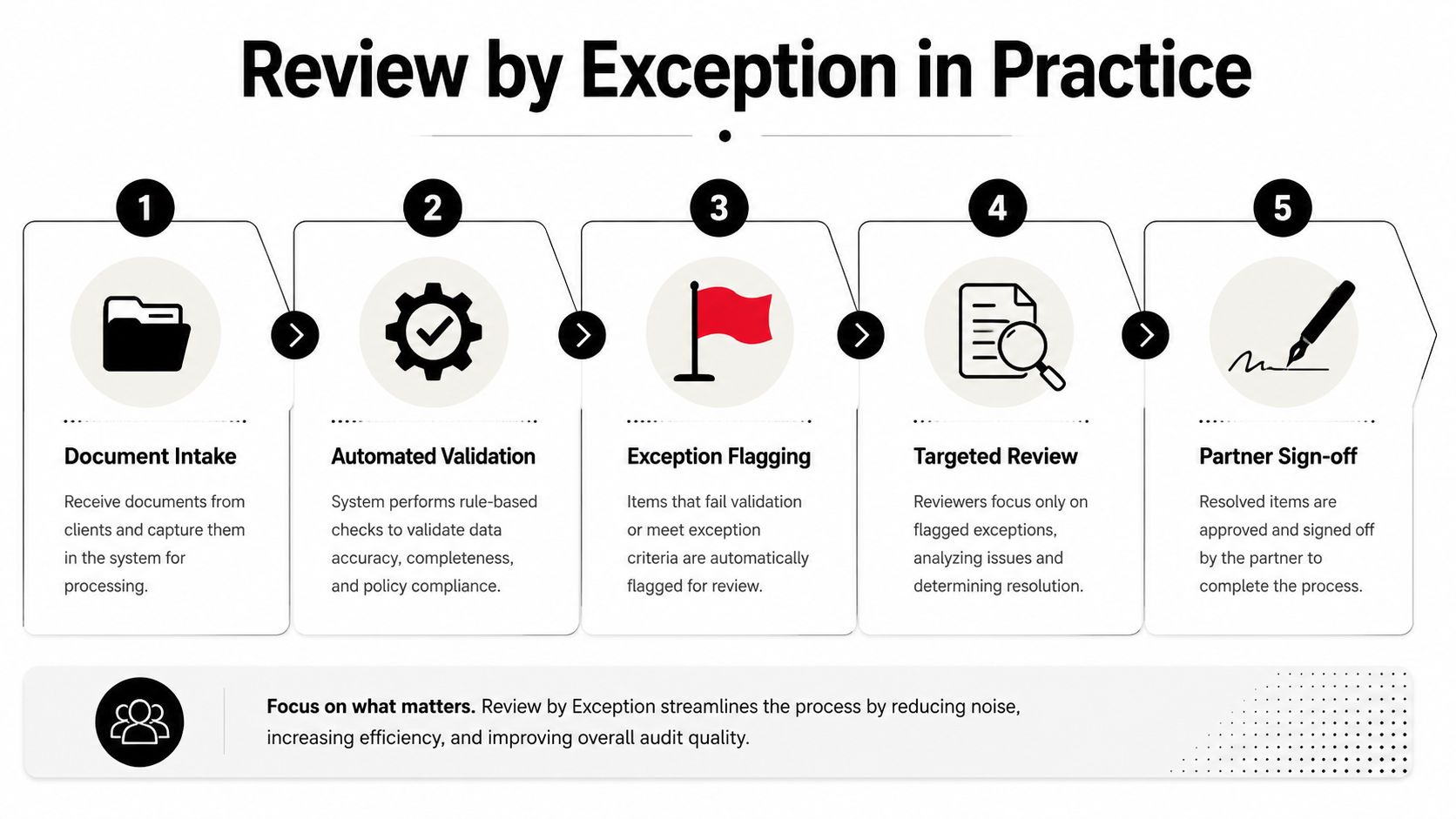
A five-part workflow
Document intake: The system receives W-2s, 1099s, brokerage statements, and other source records, preserving the connection between extracted values and original pages.
Automated validation: Rules check completeness, expected fields, calculations, and data relationships. Critical steps should be enforced rather than left to memory.
Exception flagging: The platform compares validated source data with the draft and identifies predefined discrepancies, such as conflicting amounts, missing information, or unsupported changes.
Targeted review: A reviewer opens the flagged item with its supporting record, evaluates the issue, requests clarification when needed, and records the resolution.
Partner sign-off: The completed review history supports final approval, with clear ownership of preparation, review, escalation, and sign-off.
The handoff is the control
The most important design choice is the handoff between automated verification and human review. If an exception appears without a linked source record, the reviewer spends time rebuilding context. If a reviewer clears an item without recording the reason, the firm loses defensibility. If a preparer can bypass a required escalation without documentation, the workflow's risk boundary is meaningless.
A technically sound process needs hard system controls, structured exception rules, complete electronic evidence capture, record-level linking, and an exportable audit-ready packet, according to this technical guide to review by exception. Those controls turn an exception queue into a quality system rather than another inbox.
Teams evaluating AI workflow automation for tax operations should ask whether the tool records both sides of the process. It should show the automated check and the human disposition, not just display an alert.
Benefits of Exception-Based Tax Review
A high-volume 1040 queue exposes the value of focus quickly. Reviewers should not spend equal effort confirming conforming items and investigating unusual ones. A validated system can run routine checks, while professionals examine discrepancies that require interpretation, supporting evidence, or a judgment about tax treatment.
That focus can improve cycle time while preserving the review standard. The process achieves efficiency by assigning routine controls to a validated system and reserving professional time for exceptions. The trade-off depends on calibration. Loose thresholds create false positives, while aggressive thresholds can leave meaningful issues unseen.

Three benefits reinforce one another
Accuracy improves through division of labor. Rule-based screening can compare values consistently and identify defined patterns. Human reviewers can then assess context, materiality, and tax treatment instead of repeating mechanical comparisons. This division does not guarantee perfection, but it assigns each task to the method better suited to perform it.
Defensibility grows from the same evidence that supports speed. When the platform connects an exception to its source record, identifies the reviewer, captures the resolution, and preserves the review history, the firm gains a usable account of the work performed. The audit trail exists during the review rather than being reconstructed after the return is complete.
Reviewer experience affects control quality. Repetitive scanning can reduce attention, including among experienced professionals. A queue centered on meaningful discrepancies gives reviewers a clearer reason to investigate, document, and escalate. That benefit disappears if sensitivity is set so high that reviewers spend their day clearing harmless alerts.
The business case is therefore broader than faster automation. A calibrated workflow lets speed, accuracy, and audit readiness support one another. Routine work follows defined controls, exceptions receive deliberate attention, and the firm retains evidence of both activities.
What the model does not promise
Review by exception cannot correct incomplete source documents, weak tax preparation, vague rules, or unclear ownership. It also cannot make every flagged discrepancy material. Trained reviewers and defined escalation paths remain necessary.
The boundary requires ongoing calibration. A system that flags nearly everything recreates manual review through a noisier interface. One that flags almost nothing creates false confidence. Firms should review alert volumes, disposition patterns, and missed issues, then adjust rules with documented reasoning. Sensitivity is an operating control, not a set-and-forget configuration.
Manual Review versus Review by Exception for 1040 Returns
The operational difference appears in how each model allocates reviewer attention. Manual review spreads human coverage across the return. Review by exception directs that coverage toward deviations identified by validated controls.
| Dimension | Manual Review | Review by Exception |
|---|---|---|
| Review focus | The reviewer checks the return broadly, often line by line | The reviewer investigates predefined deviations |
| Cycle management | Capacity depends heavily on reviewer hours and queue discipline | Routine conforming data follows a controlled path, while exceptions receive targeted attention |
| Error exposure | Fatigue and repetitive comparison can obscure unusual discrepancies | Structured rules surface defined mismatches, missing evidence, overrides, and integrity alerts |
| Documentation | Notes and checklists may vary by reviewer | Exceptions can link to source records, resolutions, users, and timestamps |
| Handoffs | Email, spreadsheets, or informal status changes can fragment ownership | Role-based routing can separate preparation, review, escalation, and sign-off |
| Scalability | Additional volume tends to require additional manual review capacity | Validated screening can absorb routine work while reviewers concentrate on deviations |
| Audit readiness | The firm may need to reconstruct what happened from multiple records | An exportable review packet can show automatic checks and human dispositions |
The trade-off is control design
Manual review provides familiarity and flexibility. An experienced reviewer may spot an issue that no rule anticipates, particularly when a return contains unusual facts. That judgment matters, yet broad coverage also creates variation between reviewers and leaves throughput tied to attention and stamina.
Exception review provides repeatability and traceability. Its performance depends on rule quality, source completeness, and the context available when a reviewer receives an alert. Poorly tuned sensitivity produces false positives that consume the time the workflow was meant to save. Rules set too narrowly can leave material discrepancies undiscovered. Calibration therefore requires review of alert volumes, dispositions, and missed issues, with changes documented so the queue remains explainable.
A platform such as WP TieOut operationalizes this model by ingesting source documents, validating extracted data, comparing the workpaper with the draft return, and surfacing discrepancies for review. In practice, that pattern removes line-by-line comparison from routine work while preserving reviewer judgment and a record of the resulting decision.
Human authority remains necessary for unusual facts, disputed evidence, and issues outside configured conditions. Validated controls can handle routine checks, route genuine exceptions, and preserve the evidence needed to explain what happened. The strongest firms retain that authority while removing unnecessary human effort, so reviewers spend their capacity on matters that require professional judgment.
Implementation Pitfalls and How to Avoid Them
The most common mistake is treating review by exception as an installation project. A firm activates a tool, accepts default rules, and expects the queue to identify the right work automatically. That approach fails because exception sensitivity depends on data quality, preparation habits, risk tolerance, and reviewer capacity.
False positives appear first. If a rule flags harmless formatting differences, expected variations, or items already supported by source documents, reviewers stop trusting the queue. They clear alerts quickly, export lists for manual checking, or reopen every return. The firm has paid for exception review and recreated line-by-line review under a different name.

Calibrate the exception net
Start with events that clearly require attention. Missing signatures, unsupported overrides, source-to-return mismatches, incomplete disclosures, and cross-form inconsistencies provide a better starting point than broad anomaly language. Existing 1040 review tools commonly emphasize math checks, prior-year variance, missing disclosures, and cross-form comparisons. Firms still need an operating playbook for setting sensitivity, as discussed in this analysis of AI tax return review.
Use a calibration loop instead of treating the initial configuration as permanent:
- Classify each flag: Separate material exceptions, explainable exceptions, and noise.
- Record the resolution: Capture whether the preparer corrected the return, supplied evidence, documented an acceptable difference, or escalated the matter.
- Review queue behavior: Identify repeated flags that reviewers clear without meaningful action.
- Adjust deliberately: Narrow noisy rules and widen rules where known discrepancies are being missed.
- Protect unusual cases: Provide a manual escalation path for facts outside the rule set.
The useful measure is whether the queue produces meaningful work and reduces rework without weakening coverage. Firms should compare reviewer time saved with the time spent investigating and clearing unnecessary alerts. Sensitivity settings should change only when dispositions and missed issues support the change, with the rationale recorded for later review.
Preserve an explainable record
An un-auditable black box creates a second failure point. The firm needs evidence showing who reviewed an item, when the review occurred, what supported the decision, and whether the issue was corrected or accepted with a rationale.
That requirement matters as automated analysis becomes more prominent in tax enforcement. The IRS had 126 active AI use cases as of June 2025, compared with 10 in August 2022, and 61% were still in development, according to a law-firm alert summarizing GAO data on IRS artificial intelligence in tax enforcement. The workflow should therefore document clean handoffs, human oversight, and defensible decisions.
The model succeeds when the firm validates its rules, preserves the evidence, and sends professional judgment only where the system cannot decide.
Building an Audit-Ready Exception Review Workflow
A mature workflow starts with a written definition of risk. The firm should specify which events automatically pass, which events create exceptions, who owns each exception, what evidence must be attached, and when a partner or specialist must intervene. If the team can't explain a rule in operational language, the rule isn't ready for production.
Design the evidence path first
Source-linked documentation should remain attached to the issue from intake through sign-off. The reviewer should see the relevant statement page, the extracted value, the drafted-return value, the discrepancy, and the resolution in one traceable chain. A separate spreadsheet may summarize status, but it shouldn't become the system of record for the decision.
Role separation also matters. Preparers need a clear correction path, reviewers need authority to clear or escalate, and partners need a reliable sign-off view. Each action should retain the user and timing information necessary to reconstruct the review.
A practical design includes:
- Defined exception criteria: Rules cover missing evidence, conflicting values, overrides, completeness failures, and other known control risks.
- Structured dispositions: Reviewers choose or write a reason for clearing, correcting, accepting, or escalating an item.
- Complete electronic capture: The system preserves original documents, extracted information, annotations, and review history.
- Exportable evidence: The final packet can support internal quality review, partner approval, or an examination without rebuilding the file manually.
- Controlled access: Permissions limit who can change data, clear exceptions, approve work, or view sensitive records.
Test the workflow under pressure
Don't validate the process only on clean returns. Run representative files with missing documents, conflicting source values, prior-year differences, manual overrides, and unusual combinations. Watch where reviewers lose context, where rules create noise, and where a handoff leaves ownership ambiguous.
The standard should be fast, accurate, and explainable at the same time. Speed without evidence creates a black box. Evidence without usable routing creates administrative drag. Sensitivity without calibration overwhelms the people expected to resolve the exceptions.
Firms evaluating their control design can use audit trail best practices for tax review as a reference point, then adapt the evidence requirements to their own engagement policies and risk profile.
Review by exception is a durable operating model because it treats human attention as a scarce control resource. It doesn't ask reviewers to trust automation blindly. It asks the firm to validate the rules, preserve the evidence, and send professional judgment to the records that need it.
WP TieOut ingests source documents, validates extracted data, compares that workpaper with drafted 1040 returns, and routes discrepancies into a review workflow with source-linked evidence and sign-off history. Visit WP TieOut to explore the end-to-end process and assess whether it fits your firm's next review cycle.