

A rigorous sign-off process separates preparation, independent review, and partner approval into distinct gates, each requiring a named user, timestamp, and evidence link before a return is released. The final signature should confirm a completed review, not substitute for one.
The return is sitting in the release queue. The client is waiting for Form 8879, the preparer has answered the obvious questions, and the partner has several more files to approve before the day ends. That's when sign-off can shrink into a name, a date, and a click.
The trouble usually appears later. A brokerage figure was entered on the wrong schedule. A dependent's taxpayer-identification number was transcribed incorrectly. A reviewer asked for a correction, but the revised return replaced the earlier version without preserving what changed. No one can say exactly which source document was checked, who cleared the exception, or whether the partner approved the corrected file.
A defensible sign off process treats approval as a reconstructable evidence workflow. The return advances only when the firm can show what was prepared, what was reviewed, which discrepancies were resolved, and who authorized release.
Table of Contents
- The Real Pressure Behind Every Sign Off
- Five Gates That Make Sign-Off Defensible
- Roles, Responsibilities, and Where Overlap Creates Risk
- How WP TieOut Turns Sign-Off Into an Audit Trail
- IRS Due Diligence, AI-Assisted Prep, and the Reconstructability Test
- Minimal Signature Versus Evidence-Based Sign-Off
- Your 30-60-90 Day Sign-Off Implementation Plan
The Real Pressure Behind Every Sign Off
Near the end of a busy filing period, a preparer may have several returns open, a reviewer may be working from a shared queue, and a partner may be approving files between client calls. The pressure creates a familiar shortcut: if the return looks ordinary, approve it and move on.
That shortcut fails in ordinary ways. A Schedule B amount doesn't agree with a source statement. A credit was carried to the wrong form. A client explanation is buried in an email thread rather than attached to the workpapers. The return may still look polished when it reaches the signing screen, but the firm can't reconstruct the decisions behind it.

Why the last click carries so much weight
A preparer who approves their own work removes the independent challenge that sign-off is meant to provide. A reviewer who checks only the final PDF may miss the source-document gap. A partner who sees “no exceptions” without the underlying review record is approving a status, not evaluating evidence.
The historical development of formal approval supports a stronger interpretation. After the Sarbanes-Oxley Act of 2002, the PCAOB established requirements for concurring or second-partner review and approval of audit reports. PCAOB Auditing Standard No. 7 later required an independent engagement quality reviewer to evaluate significant judgments, assess conclusions, and determine whether the report could receive concurring approval. The engagement partner couldn't serve as that reviewer during a two-year cooling-off period. PCAOB Auditing Standard No. 7 shows why approval became a documented control point rather than an administrative signature.
Tax work doesn't become defensible merely because a second person clicks approve. The reviewer needs a defined scope, access to the evidence, and a way to record the conclusion.
Practical rule: Slow the workflow at the points where judgment, identity, source completeness, or unresolved discrepancies can affect release. Keep routine movement fast everywhere else.
What a useful sign-off record proves
A strong record answers practical questions without requiring the team to search inboxes or interview the original preparer:
- Who prepared the return: The preparer is identifiable, along with the version submitted for review.
- What evidence was used: Source documents, intake responses, and supporting explanations are connected to the relevant workpaper or return field.
- What the reviewer checked: The review scope covers required categories and material judgment areas.
- What changed: Corrections retain a version history and a documented resolution.
- Who released the return: The final approver and approval time are recorded before filing or delivery.
The IRS frames due diligence as an evidence-producing process that starts before approval. That perspective is useful for every return, not only those subject to specific due diligence rules. If a reviewer can't trace a material conclusion back to evidence, the signature is thinner than it appears.
For firms formalizing this discipline, a practical CPA tax review workflow should make preparation, review, exception clearing, and release visibly distinct. The objective isn't more paperwork. It's a record that still makes sense when the people involved no longer remember the file.
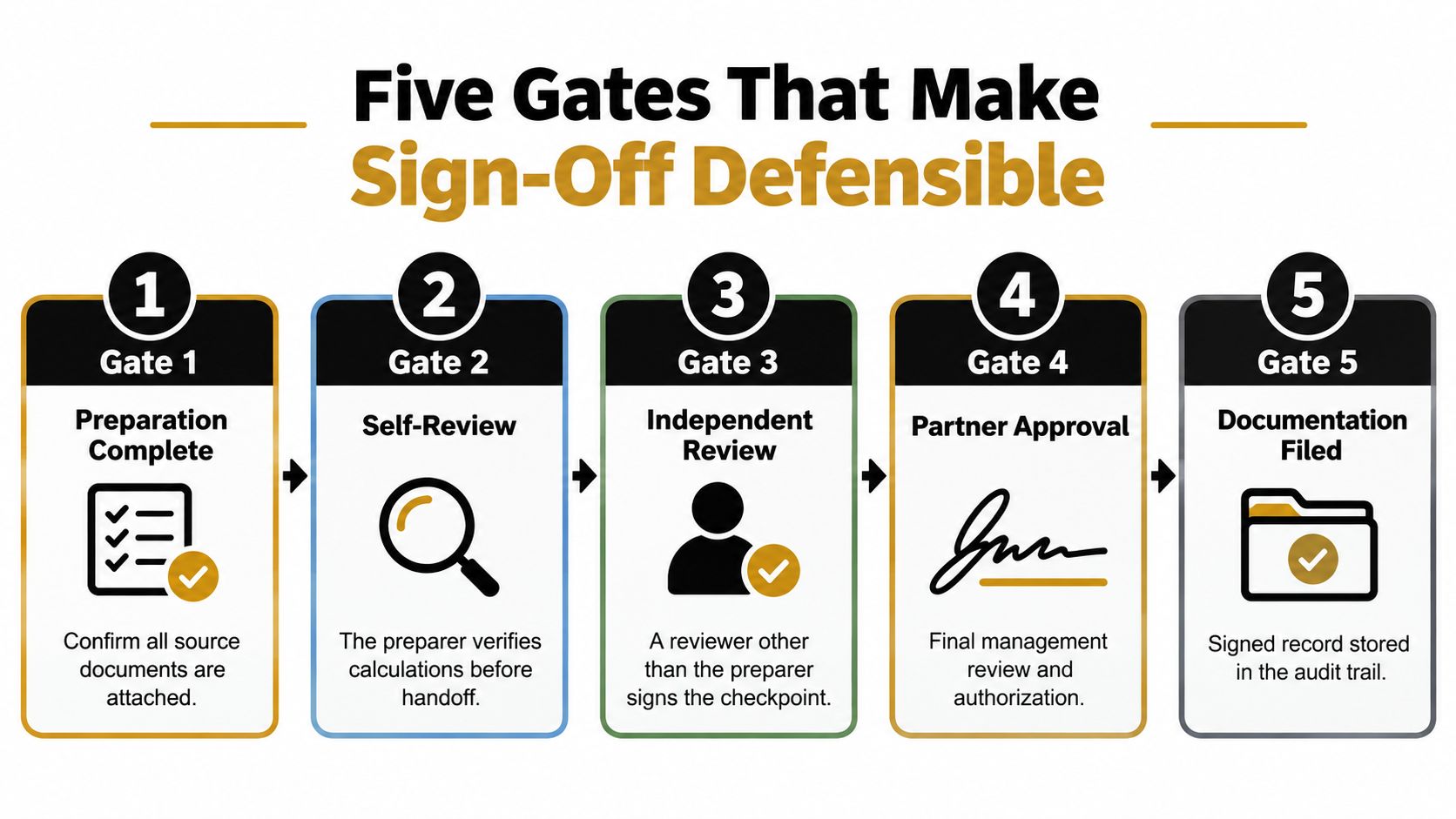
Five Gates That Make Sign-Off Defensible
A reliable workflow uses gates, not a single approval button. Each gate has an owner, an entry condition, and evidence required before the return advances.
Gate one, complete intake and interview records
The preparer starts with the taxpayer's information, interview answers, and source documents. Missing information remains an open issue rather than an assumption. The output is a complete intake record that identifies what the taxpayer supplied and what still requires follow-up.
Gate two, prepare from validated evidence
The return is prepared from that record, not from memory or scattered email instructions. Source documents should be attached or linked to the relevant workpapers. The preparer performs a self-review of calculations, transfers, and obvious omissions before requesting independent review.
Gate three, perform an independent comparison
A reviewer other than the preparer compares the drafted return with the intake record, taxpayer responses, and source documents. The checklist should cover:
- Identity: Confirm the taxpayer's identity and taxpayer-identification numbers.
- Filing position: Check filing status and dependents against the documented facts.
- Amounts: Verify income, deductions, credits, and source totals.
- Forms and schedules: Review schedules, calculations, and transfers between forms.
- Completeness: Confirm that required documents and review categories were addressed.
The reviewer records findings as conclusions, not vague comments. An item marked “unsure” isn't cleared. It must become a documented yes or no, supported by evidence or an explanation of the judgment.
Gate four, clear exceptions and repeat the review
Every discrepancy needs an owner, correction, resolution note, and completion time. After the preparer makes a correction, the reviewer checks the corrected item again and determines whether the change affected another form, schedule, or calculation.
The IRS guidance recommends independent quality review before Form 8879 is signed, including correction of identified errors and completion of the review before taxpayer signature. IRS quality review guidance supports the practical rule that a corrected return must return to review. A status change alone doesn't prove the correction was evaluated.
Gate five, obtain partner approval and release
The partner or designated senior reviewer receives a return only when the exception log is clean, the required categories are complete, and the final version is identifiable. A useful status path is:
Drafted → Source-validated → Exception-cleared → Reviewer-approved → Partner-approved → Released
Each transition should require a named user, timestamp, resolution note where applicable, and evidence link. The taxpayer signs only after the review is complete. That ordering prevents a signed authorization from being treated as permission to finish the review later.
Roles, Responsibilities, and Where Overlap Creates Risk
A sign-off process can contain every recommended step and still fail if responsibility is blurred. The preparer, reviewer, and partner need different jobs, not merely different labels in a workflow system.
The preparer owns intake completeness, initial preparation, source-document attachment, and first-level investigation. That person knows the return's history best, but familiarity is also the reason the preparer shouldn't be the final approver. People naturally defend conclusions they made themselves, especially when the deadline is close.
The reviewer owns independent verification. This includes checking whether the return reflects the taxpayer's information and supporting documents, determining whether identified errors were corrected, and recording or communicating discrepancies before processing. Independence doesn't mean the reviewer knows nothing about the file. It means the reviewer can challenge the preparer's work without approving their own conclusions.
The partner or designated senior reviewer owns release authority for higher-risk, material, or judgment-heavy returns. That role isn't to repeat every keystroke. It is to evaluate whether the review evidence supports release and whether the remaining judgments are acceptable under firm policy.
Where the handoffs break
Three failure patterns recur:
- Self-approval: The preparer completes and approves the same return. The firm has a signature, but no independent challenge.
- Evidence-free review: The reviewer marks the return approved after looking only at the final output, without testing source documents or intake responses.
- Rubber-stamp partner approval: The partner sees a completed status but doesn't inspect significant exceptions, judgmental items, or the reviewer's rationale.
Professional auditing guidance distinguishes meaningful review evidence from mechanically adding a second signature to every document. The partner should document the extent and timing of review, focusing on critical judgments, difficult or contentious matters, significant risks, and other important areas. CPA Journal guidance on workpaper sign-offs explains why documentation quality matters more than a signature on every individual workpaper.
A second signature doesn't create independence if the second person didn't have a defined question to answer.
Exception-based review is the practical balance. The reviewer doesn't need to reperform every unchanged automated step, but should examine unusual items, missing evidence, overrides, material discrepancies, and areas requiring professional judgment. The record should show what was reviewed and why the reviewer accepted the conclusion.
How WP TieOut Turns Sign-Off Into an Audit Trail
A policy document won't stop email threads, overwritten PDFs, or unclear handoffs. The workflow needs a working record that connects source evidence to review decisions.
WP TieOut is one example of a platform designed for this operating model. It ingests W-2s, 1099s, brokerage statements, and other source documents, validates extracted data, and compares the validated workpaper with the drafted return. The comparison is intended to surface true discrepancies so the reviewer can focus on exceptions rather than manually eyeballing every line.

A practical operating sequence
Start by uploading the source documents and confirming that the document set is complete. Review extracted values against the original pages, then connect those values to the relevant return destinations. Extraction can accelerate preparation, but the human reviewer remains responsible for deciding whether the evidence supports the conclusion.
Next, work from the exception report. Assign each item to a preparer or reviewer, record the disposition, and retain the supporting explanation for accepted differences. A corrected return should be identifiable as a new version, not an invisible replacement.
The platform can compile a source-linked, bookmarked PDF binder that preserves original pages, adds stamps or annotations, and records the sign-off trail. The useful output isn't just a neat binder. It is the connection between the original source page, extracted value, return destination, comparison result, reviewer disposition, and approved version.
A tax audit trail workflow should also preserve access boundaries. Preparer, reviewer, and partner roles should support sequential handoffs, while encryption and access controls protect the underlying client information.
Use the final export for the client file, internal quality review, or examination readiness. Before release, confirm that every exception has a disposition, the final version matches the approved version, and the sign-off history identifies who checked each required area.
The video below provides a visual view of the workflow and helps teams evaluate how source review and approval can fit together.
IRS Due Diligence, AI-Assisted Prep, and the Reconstructability Test
Automation changes the reviewer's task. It can extract values, compare documents, flag anomalies, and draft work, but it doesn't remove the human responsibility to investigate information that appears incomplete, inconsistent, or incorrect.
For returns involving EITC, CTC, ACTC, ODC, AOTC, or head-of-household status, the IRS requires preparers to interview the taxpayer, ask adequate follow-up questions, review supporting information, complete Form 8867, and document questions and responses contemporaneously. Records must show who supplied information, when it was supplied, what documents were relied on, and how eligibility or amounts were determined, with retention for at least three years, according to the IRS tax preparer due diligence rules.

Apply the reconstructability test
Before approval, ask whether a reviewer who wasn't involved in the file could answer these questions later:
- Source: Where did each material value come from?
- Responsibility: Who extracted, prepared, reviewed, and approved it?
- Timing: When did each check and correction occur?
- Exceptions: What differed, who investigated it, and why was the resolution accepted?
- Version: Which return was approved and released?
AI governance makes those questions more urgent. In 2025, 21% of tax, audit, and accounting firms reported enterprise-level GenAI use, up from 8% in 2024, while 70% of tax firms lacked policies governing GenAI use, according to Thomson Reuters' report summary for tax professionals. The same source reports that 79% of surveyed tax professionals expected AI to have a high or transformational impact within five years, while only 14% of firms reported a formal, actionable AI strategy.
The sign-off record should therefore identify the system-assisted work, the evidence the human reviewed, and any manual override. Reviewers should focus on source completeness, extraction confidence, unusual values, material discrepancies, accepted exceptions, and judgmental conclusions. They don't need to pretend automation wasn't used. They need to document where professional judgment remained decisive.
Minimal Signature Versus Evidence-Based Sign-Off
Minimal sign-off is easy to recognize. It records a name, date, and approval status, often against a final PDF that has no linked sources or meaningful exception history. It may move a return through the queue quickly, but it leaves the firm with little evidence when someone later asks how the approval happened.
Evidence-based sign-off treats the approval as the end of a controlled chain. The record connects intake, source documents, preparation, review findings, corrections, final approval, and release. It also preserves version history so the firm can distinguish the reviewed return from an earlier draft.
| Minimal signature | Evidence-based sign-off |
|---|---|
| Name and date | Named user, timestamp, scope, and evidence |
| Final PDF only | Source-linked documents and approved version |
| “No exceptions” status | Recorded review categories and dispositions |
| Corrections may overwrite drafts | Version history preserves changes |
| Difficult to reconstruct | Designed for later reconstruction |
The real trade-off
Minimal sign-off saves effort at the moment of approval. The cost arrives during internal quality review, peer review, client questions, or examination, when staff must reconstruct decisions from memory and scattered files. That investigation consumes senior time and can expose gaps that the original shortcut concealed.
Evidence-based sign-off requires discipline at each handoff. The reviewer must record more than “looks good,” and the preparer must close exceptions with evidence rather than informal reassurance. Exception-based comparison and source linking make that discipline workable because the reviewer concentrates on differences and risk instead of performing an identical line-by-line exercise on every unchanged item.
The right question isn't whether the firm can create a signature. Every firm can do that. The question is whether the firm can prove that the signature followed a reasonable review, that corrections were completed, and that the released version was the approved version.
For a small practice, the first implementation can be simple. Use a controlled folder structure, a required checklist, named roles, a correction log, and read-only final binders. Technology can improve the workflow later, but the governing principle shouldn't wait for a software purchase.
Your 30-60-90 Day Sign-Off Implementation Plan
Start with the current workflow, not the ideal workflow. In the first 30 days, map how returns move from intake to release, identify where one person prepares and approves the same file, and define the required evidence for each gate. Adopt the status path from drafted through source validation, exception clearing, reviewer approval, partner approval, and release.
Use days 31 through 60 to configure the operating tools. If you adopt dedicated tax workflow software, assign preparer, reviewer, and partner roles, establish source-document intake, and train staff to resolve exceptions inside the workflow. Without a dedicated platform, use structured checklists, controlled document permissions, and version-controlled binders.
During days 61 through 90, pilot the process on a defined group of returns. Ask reviewers where evidence is missing, ask preparers which gates create avoidable delay, and adjust the checklist without weakening independence. Review the resulting trails periodically and track operational measures such as exception-resolution time, source-linkage completeness, and returns released with open discrepancies.
The process is working when a partner can open the final record and understand the return without relying on the original preparer's memory. That standard keeps sign-off practical, reviewable, and ready for scrutiny.
WP TieOut helps CPA firms and tax preparers compare source documents with drafted 1040 returns, review exceptions, and preserve a source-linked PDF binder with preparer, reviewer, and partner sign-off history. Visit WP TieOut to explore a workflow built around accountable handoffs and a reconstructable approval record.