

You're probably staring at the same scene every filing season. A stack of W-2s on one side, brokerage statements on another, a drafted 1040 on screen, and a reviewer trying to prove every line matches before the next return lands in the queue. The work feels familiar because it is familiar, but the pressure has changed. The IRS says approximately 93.3% of individual income-tax returns were filed electronically in calendar year 2024, with the share projected to reach 93.9% in 2025 and 97.0% by 2032 (IRS projection and filing data). That's the context for tax forms software now, not just speed, but whether your firm can reconcile, document, and defend what got filed.
Table of Contents
- The Monday Morning Every CPA Firm Knows
- What Tax Forms Software Actually Means for Preparers
- Core Capabilities That Matter in a 1040 Practice
- Why Review by Exception Beats Line by Line
- Buyer Criteria for Firms Evaluating Tax Forms Software
- Comparing Traditional Review With Reconciliation-Led Review
- Implementing New Software Without Disrupting Filing Season
- The Audit-Ready Firm in 2026 and Beyond
The Monday Morning Every CPA Firm Knows
The partner walks into the office, drops a marked-up return on a desk, and asks the same question she asked last week, “Did anyone verify the brokerage carryover against the source packet?” The preparer thinks so. The reviewer isn't sure. The binder is half digital, half paper, and the line-by-line check is already behind because three other returns are waiting.
That's the hidden problem with modern 1040 work. E-filing scaled fast, but human review didn't become magically elastic just because submission moved online. The IRS's electronic filing trajectory shows the shift clearly, from millions of returns in the early era to a dominant digital filing environment now, and the practical burden moved with it. The bottleneck is no longer getting a return into the system. It's proving the return is right before it goes out.
Practical rule: If your reviewers are still spending their energy hunting for mismatches one line at a time, your workflow is doing clerical work where it should be doing control work.
A lot of software comparisons miss that distinction. They talk about supported forms, import speed, and e-file transmission as if those features settle the matter. They don't. The firms that are keeping up are the ones that treat tax forms software as a reconciliation system, not a typing assistant.
That means the central question changes. Not “Can the software complete the return?” but “Can it surface true discrepancies, preserve evidence, and tell the reviewer exactly what needs judgment?” Once you ask that question, the category looks very different.
What Tax Forms Software Actually Means for Preparers

For a CPA firm, tax forms software isn't consumer tax prep software with a cleaner interface. It's a workflow layer that starts with source documents and ends with a return that's ready to file, review, and defend. If you use it correctly, every W-2, 1099, brokerage statement, and prior-year carryover becomes a controlled input, not an unchecked attachment.
The workflow in plain English
First comes document intake, where the system pulls source files into one place. Then comes field-level extraction, where the software reads the numbers and maps them into structured data. After that, the system needs validation, which is where it checks totals, formats, missing fields, and obvious conflicts before anyone wastes time reviewing noise.
The last layer is where many products fall short. A serious firm also needs workflow orchestration, which means the software routes items to the right person, preserves who touched what, and keeps a review trail. Without that, you've just moved the mess from paper piles into a digital pile.
Picture a quality-controlled assembly line. A raw form comes in, the software identifies parts of it, checks them, and sends only the questionable pieces to a human. That's the right mental model because tax work isn't one task, it's a sequence of controlled decisions.
The IRS's filing environment makes that sequence essential. With electronic filing now the norm, software sits earlier in the process than many firms admit. It isn't only the final transmit button. It's the place where source data gets normalized, compared, and prepared for review.
A good system should reduce guesswork before review starts, not after the reviewer finds the mistake.
The practical test is simple. If the software can't show where a number came from, who checked it, and what happened when it didn't match, it's not really tax forms software for a preparer. It's just a form editor.
Core Capabilities That Matter in a 1040 Practice
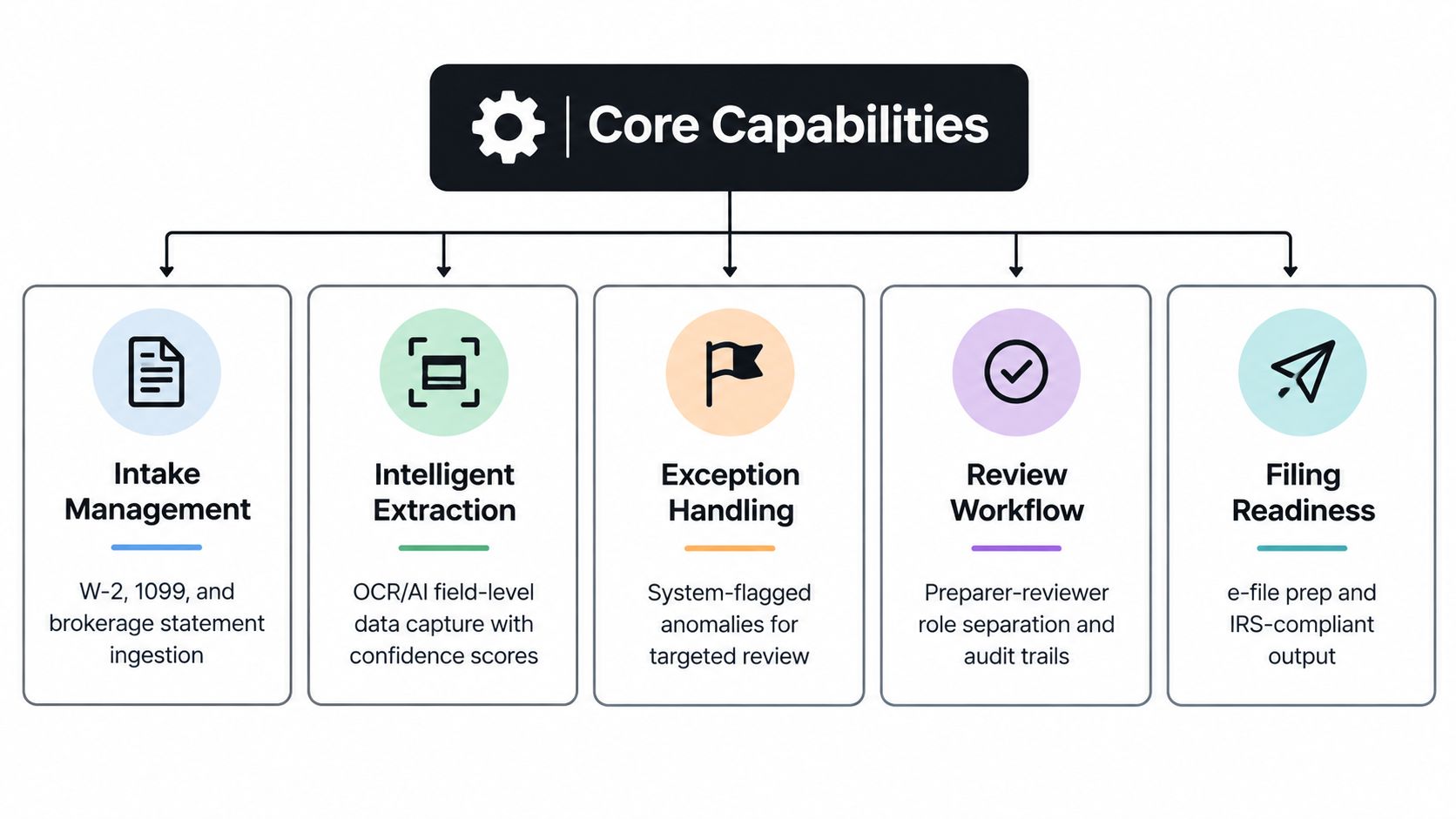
Start with intake, because everything else depends on it. If the system can't reliably ingest W-2s, 1099s, brokerage statements, and similar source documents, every downstream control weakens. Intake isn't glamour work, but it decides whether your team is building on structured inputs or on a pile of manual re-entry.
What each capability should answer
- Intake Management: Can the firm bring in source documents cleanly, without re-keying everything by hand?
- Intelligent Extraction: Does the system read fields from the source and assign confidence so a reviewer knows where to look first?
- Exception Handling: Does it isolate mismatches instead of burying them in a long checklist?
- Review Workflow: Can it separate preparer, reviewer, and partner responsibilities so ownership is clear?
- Filing Readiness: Can it produce output that supports e-file submission and keeps the audit trail intact?
The next layer is extraction, and marketing often overpromises here. OCR and AI are useful, but transcription accuracy and tax treatment accuracy are different problems. A system can read a number correctly and still put it in the wrong place or mis-handle the tax treatment.
That's why validation matters. The software should compare normalized values against the return draft, catch missing totals, and flag contradictions before the reviewer ever opens the file. When firms skip validation, they push judgment work onto reviewers who are already overloaded.
Then comes exception handling, which is where strong software earns its keep. A flagged item should preserve the source value, the return value, the form and line location, and the reviewer's disposition. If those fields don't exist, you've got noise, not control.
That control layer matters because the IRS processing environment is full of exceptions of its own. As of April 18, 2025, the IRS had received 140.6 million individual income-tax returns, processed 138.1 million, and still had 5.7 million awaiting processing for reasons including error resolution, identity-theft review, rejects, and unpostables (IRS processing review). Firms should take the hint. Software needs to catch the exception before it becomes an IRS problem.
Why Review by Exception Beats Line by Line

The old habit is to make a reviewer re-check every line because that feels safer. It isn't. It's slower, more tiring, and easier to miss the one item that matters. Review by exception is better because it tells the reviewer where the risk lives instead of asking them to rediscover it from scratch.
Among FY2025 math errors flagged by the IRS, 25.6% involved adjusted gross or taxable income and 24.2% involved tax calculations or other taxes, categories that often trace back to multiple upstream inputs rather than one arithmetic slip (IRS math error data). That's the point. The issue is usually reconciliation, not raw calculation.
What good exception review looks like
A useful system doesn't just shout “problem.” It shows the source document, the extracted field, the drafted return line, and the reason it's being flagged. Then the reviewer can decide whether the issue is a transcription error, a missing form, a classification choice, or a legitimate tax position.
That's also why AI in this space should be judged on explainability, not hype. Recent professional research shows that 79% of tax, accounting, and audit professionals expect AI to have a high or transformational impact, yet only 14% report having a defined AI strategy, with security, privacy, and training cited as major barriers (professional AI readiness research). Firms don't need a black box that guesses faster. They need review that leaves a trail.
A missed 1099-R line shows the difference. In a line-by-line model, a reviewer may or may not spot the mismatch after staring at the whole return. In an exception-led model, the software flags the specific source item, shows the discrepancy, and records who resolved it. That's a better control than hoping somebody catches the issue by eye.
If you want a direct framework for that kind of workflow, the idea is laid out clearly in review by exception.
Good review software should make the reviewer's judgment sharper, not heavier. If it doesn't reduce the amount of pointless scanning, it's missing the point.
Buyer Criteria for Firms Evaluating Tax Forms Software

Most buying mistakes happen because firms judge software by screenshots and promises instead of control design. Start with security and access controls. If roles are loose, permissions are vague, or evidence can be altered without a clean trail, the rest doesn't matter.
The five things that actually matter
- Security & Access Controls: Ask who can see source files, who can change flags, and how the system protects sensitive data.
- Traceability: Every exception should point back to the source page, the extracted field, and the reviewer action.
- Role Separation: Preparer, reviewer, and partner permissions should be distinct, not blended into one vague user bucket.
- Integration Fit: The software should work with your current workpapers and practice tools instead of forcing a messy side process.
- Scalability: It should hold up when the firm is under real filing-season load, not just in a demo.
The biggest mistake is assuming AI readiness is the same thing as software readiness. It isn't. A firm can be excited about automation and still have no governance around how flags get reviewed or how evidence is stored. That gap is exactly why adoption often stalls.
Use the demo to test the boring details. Ask whether the system can separate preparer comments from reviewer comments. Ask whether it preserves original source pages in an exportable binder. Ask whether a flagged item keeps its full history if someone revisits it later.
If a vendor can't show you the chain from source document to final disposition, keep looking.
One practical option in this category is WP TieOut, which ingests source documents, validates extracted data, compares it against drafted 1040 returns, and compiles a source-linked PDF binder with sign-off history. Whether you buy that tool or another one, that's the kind of workflow you should be demanding.
The right question is never “Does it automate?” The right question is “Does it make the return easier to trust?”
Comparing Traditional Review With Reconciliation-Led Review
| Dimension | Traditional Line-by-Line Review | Reconciliation-Led Review |
|---|---|---|
| Evidence quality | Reviewer relies on memory, tabs, and visual scanning | Reviewer sees source-linked evidence for each exception |
| Exception handling | Errors are discovered during broad manual inspection | Only mismatches and unresolved items are routed for attention |
| Role clarity | Ownership can blur between preparer and reviewer | Preparer, reviewer, and partner actions stay distinct |
| Audit trail | Notes may live in scattered comments or emails | Disposition, timestamp, and source history stay attached to the item |
| Review experience | Heavy on repetition, easy to fatigue | Focused on judgment, easier to standardize |
A mid-sized 1040 practice usually feels this shift before it fully understands it. Reviewers stop trying to prove that every line is perfect and start confirming that every flagged variance has been resolved. That changes the culture as much as the workflow.
Preparers also change how they work. They start packaging source documents with more discipline because they know unresolved items won't disappear into a manual review haze. Partners get cleaner sign-off conversations because the evidence is already attached to the exception.
The old model treats review as a final read-through. The reconciliation-led model treats review as controlled verification. That distinction is why some firms finish filing season with less drama even when their volume doesn't get any lighter.
Implementing New Software Without Disrupting Filing Season
Start small. Pick a limited 1040 cohort, preferably returns with enough variety to test the workflow but not so much complexity that the team drowns in edge cases. Run the pilot on real source documents and real review steps, not on a sanitized demo set.
The first operational move is role setup. Preparers should prepare, reviewers should review, and partners should approve. If those boundaries aren't configured early, the team will fall back to old habits and the software won't show its real value.
A practical rollout sequence
- Pilot the intake flow on a narrow return set.
- Validate extraction against known source documents and known correct returns.
- Review exception quality to see whether the flags are useful or noisy.
- Lock the sign-off path so reviewer dispositions are recorded consistently.
- Cut over before peak volume so the team has time to adjust.
The first 30 days should focus on whether extracted fields match source documents cleanly and whether the reviewers trust the flags. By day 60, the firm should be seeing better ownership discipline and fewer side conversations about where a number came from. By day 90, the binder and sign-off trail should feel routine, not special.
If you want a more structured implementation path, the onboarding sequence in end-to-end onboarding process is the right kind of reference point.
Do not let AI flags act like final answers. They are prompts for professional judgment, not replacements for it. The firms that handle adoption well are the ones that make the software prove itself on real work before they trust it with a whole season.
The Audit-Ready Firm in 2026 and Beyond
The strongest near-term gain for CPA firms is not fully autonomous return preparation. It's explainable review by exception, backed by security, traceability, and role separation. That's the model that fits the way the IRS filing environment has already evolved, and the way review capacity works inside firms.
If you're serious about the next 30 days, do three things. Audit how your current review process handles source evidence. Check whether every exception has a reviewer name, a timestamp, and a source reference. Then run a controlled pilot on a small set of returns before peak pressure hits again.
The firms that win here won't be the ones that brag about speed. They'll be the ones that can show exactly why a return was accepted, who approved it, and what evidence supported the decision.
WP TieOut helps CPA firms reconcile source documents against drafted 1040 returns, so reviewers can focus on true discrepancies instead of scanning every line. If you want to see what a source-linked, exception-led workflow looks like in practice, visit WP TieOut and evaluate whether it fits your firm's review process.